
Non-FictionInformativeEducational
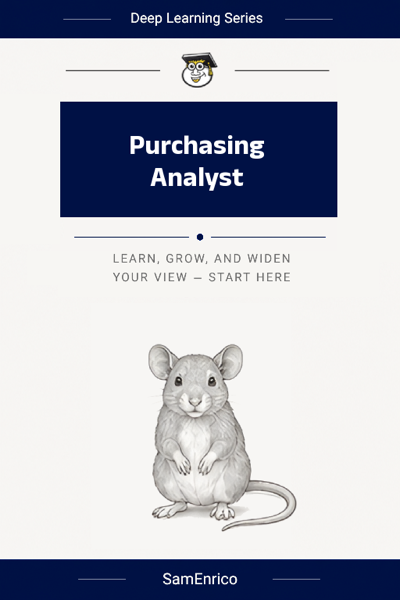
Purchasing Analyst eBook
A Coursebook on Purchasing Analyst
by Jett Gaynell
A Coursebook on Purchasing Analyst
Formats
Free sample
Chapter 1: Beyond The Sticker--–- The most expensive product in your supply chain is not the one with the highest price tag. It is the one whose true costs you have failed to measure. This simple, uncomfortable truth separates world-class purchasing organizations from those that merely shuffle paper. And it is the foundation upon which everything else in this book rests.Every day, in thousands of companies across the globe, purchasing professionals celebrate victories that are actually defeats. They negotiate hard for lower unit prices.
They switch suppliers based on quoted rates. They receive bonuses for "savings" that exist only in spreadsheets. And then, months or years later, the truth emerges. Quality failures eat the savings. Logistics costs devour the margins.
Inventory carrying costs silently accumulate. Supplier instability triggers production shutdowns. The low-price supplier, celebrated as a hero, becomes an expensive nightmare.This is not a story of incompetence. It is a story of measurement failure. Most purchasing organizations measure what is easy to measure, not what matters.
The price on an invoice is easy to see, easy to compare, and easy to celebrate. The cost of a quality failure is harder to track. The cost of holding inventory is spread across multiple budgets. The cost of a production line stoppage is rarely attributed to the purchasing decision that caused it. What gets measured gets managed, and what does not get measured gets ignored.The purchasing analyst exists to solve this measurement problem.
You are the person who sees beyond the sticker price, who builds the models that reveal hidden costs, who provides the data that turns procurement from a reactive clerical function into a proactive strategic advantage. This chapter introduces the foundational concepts that make this possible, starting with the most important distinction in all of purchasing: the difference between price and total cost of ownership.The Anatomy of a False Victory Consider a scenario that plays out somewhere in the global economy every single day. A purchasing manager receives a quote from a new supplier. The price is twelve percent lower than the current supplier. The manager runs the numbers: annual spend of ten million dollars, twelve percent savings equals 1.2 million dollars.
A celebration is in order. The manager presents the savings to leadership, receives recognition, and starts planning which projects the freed-up budget will fund.What the manager has not done, because no one has asked them to do it, is consider the following questions. How reliable is the new supplier's delivery performance? If late shipments cause production delays, what is the cost per hour of idle manufacturing capacity? What is the defect rate of the new supplier's products?
If quality failures require rework, how much labor and material will be consumed? Will the new supplier accept the same payment terms, or will earlier payments strain working capital? Does the new supplier have the financial stability to survive a downturn, or will they collapse without warning? What is the carbon footprint of shipping from the new location, and will future regulations impose costs on that emissions?None of these questions are reflected in the 1.2 million dollar savings calculation. And yet, any of them could wipe out those savings entirely.
The twelve percent price reduction is real, as far as it goes. But it does not go far enough. The purchasing manager has achieved a false victory—a celebration of incomplete data.The purchasing analyst prevents false victories by measuring what others ignore. You will not be popular for this. Your colleagues in procurement will sometimes resent you for complicating their simple success stories.
Your suppliers will sometimes resist your requests for detailed cost breakdowns. Your finance partners will sometimes question your methodology. But you will be right. And in the long run, being right about total cost creates more value than being popular about price.Defining Total Cost of Ownership Total cost of ownership, universally abbreviated as TCO, is the complete lifecycle cost of acquiring, using, maintaining, and disposing of a product or service. It includes every cost that the purchasing organization incurs as a result of the purchase decision, regardless of which budget line item those costs appear in or which department incurs them.The TCO framework was first developed by the logistics consulting firm William M.
Mercer in the 1980s to help organizations understand the hidden costs of their supply chains. Since then, it has become one of the most widely adopted analytical tools in strategic sourcing. Yet despite its theoretical acceptance, TCO is dramatically underutilized in practice. A 2022 survey of procurement professionals found that while ninety-three percent agreed that TCO was important, only thirty-seven percent had formal TCO models for their most critical categories.This gap between belief and practice exists because TCO is hard. It requires data that does not naturally live in one place.
It requires assumptions about the future that cannot be proven. It requires analytical discipline that many organizations have not developed. And it requires organizational courage to question decisions that were made based on incomplete information.The purchasing analyst who masters TCO becomes invaluable precisely because these barriers exist. Every organization wants better decisions. Few have the capability to produce them.
When you build that capability, you become irreplaceable.The Cost Categories That Everyone Forgets A complete TCO model typically includes between eight and fifteen distinct cost categories. Some of these are obvious. Others are almost always overlooked. Let us examine each category in turn, starting with the obvious and moving toward the hidden.The first and most visible cost category is the purchase price itself. This is the amount paid to the supplier per unit, multiplied by the quantity purchased.
It appears on the supplier invoice. It is tracked in the accounts payable system. It is the foundation of every false victory. The purchase price is important, but it is never the whole story.The second cost category is transportation and logistics. This includes freight charges, customs duties, insurance premiums, and handling fees.
It also includes less obvious costs like expediting fees for rush shipments, demurrage charges for containers left too long at ports, and the cost of tracking and tracing shipments. When a supplier is located far from the point of use, logistics costs can easily exceed the purchase price.The third cost category is inventory carrying costs. Every dollar of inventory on the shelf represents capital that could have been used elsewhere. The cost of that capital, known as the inventory carrying rate, typically ranges between fifteen and thirty percent per year. This means that holding one million dollars of inventory for one year costs the organization between one hundred fifty thousand and three hundred thousand dollars.
Inventory also requires warehouse space, which costs rent or depreciation. It requires insurance against theft, fire, and other perils. It requires taxes, which in many jurisdictions are assessed on inventory held at year end. And it incurs risk of obsolescence, as products become outdated before they are used.The fourth cost category is quality. This is where many purchasing organizations fail most dramatically.
Quality costs include inspection of incoming materials, testing of samples, and supplier audits. They include the labor and material consumed when defective products are reworked. They…
This is the end of the free sample. Get the eBook to keep going. Buy now
About this book
Details
- Author
- Jett Gaynell
- Publisher
- SamEnrico
- Language
- English
- Genre
- Non-Fiction, Informative, Educational
- Released
- 2026-05-04
- Pages (approx.)
- 151
- Available as
- eBook, Audiobook

Read better in the ZLOADR app
Your eBooks on your phone or tablet. Sign in with your SamEnrico account and start reading.
More by Jett Gaynell
 Sibling Politics Division GuideJett Gaynell$11.99
 Facebook Groups Time ManagementJett Gaynell$11.99
 TCM Kidney Jing EssenceJett Gaynell$11.99
 Low Carb Meal Prep HandbookJett Gaynell$11.99
 The Dromon Gambit: Byzantine Fire and Viking Fury at the Straits of MessinaJett Gaynell$11.99
 AI Budgeting and Variance AnalysisJett Gaynell$12.99
 How to Produce Cheerleading Pom PomsJett Gaynell$11.99
 10 Ways to Use Allium Canadense (Recipe Book)Jett Gaynell$11.99
You may also like
 Hong Kong Handover 1997Dunn Johnnie$11.99
 Zumba For Postnatal Recovery CourseNeal Christian$11.99
 Zumba for BeginnersLadner Nikia$11.99
 YouTube Comment Mining GuideHumes Pandora$12.99
 Worry Box MeditationCarlin Rudy$11.99
 Workplace Stress MeditationNguyen Lynn$11.99
 Workplace Stress and Sleep RepairHawley Ivory$11.99
 Workplace Perfectionism CureDelaney Jeffry$11.99
 Workplace Injustice Anger GuideWallen Isabelle$11.99
 Work Addiction and Burnout LinkGreenwood Ester$11.99
 Women in Yoga and WellnessBeattie Galina$11.99
 Women in Stand Up ComedyChun Evangeline$11.99