
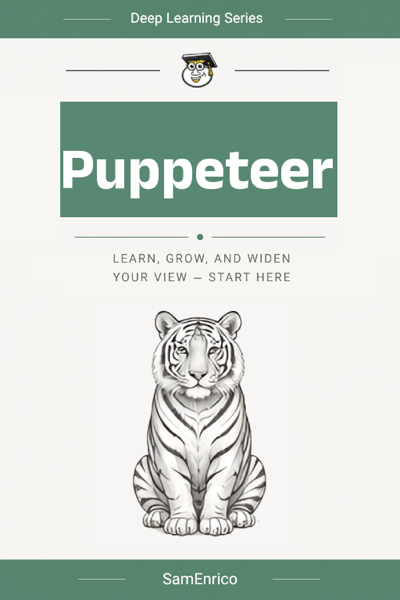
Non-FictionInformativeEducational
Puppeteer eBook
A Coursebook on Puppeteer
by Gooch Marine
A Coursebook on Puppeteer
Formats
Free sample
Chapter 1: The Silent Browser--The browser window opened, then vanished. No fanfare, no loading spinner, no blue bar creeping across the top of a visible window. Just a server log spitting out a single line: Navigation complete. Status: 200. In that silent, invisible moment, a machine had just done what would take a human thirty seconds of clicking, waiting, typing, and squinting at a screen. It had launched a browser, navigated to a website, waited for the network to settle, and shut everything down—all in less time than it takes to read this sentence.This is the headless revolution. And it is changing not only how software is tested, but who gets hired to test it.Let me tell you about Maria.Three years ago, Maria was a manual QA tester at a mid-sized e-commerce company. Her days consisted of clicking through the same thirty-seven checkout flows, verifying that the "Add to Cart" button still added things to carts, and filing bug reports when the payment gateway timed out—which was often. She was good at her job. She could spot a misaligned pixel from across the room. But every Sunday night, she felt a familiar dread: the development team had merged code on Friday, and by Monday morning, something would be broken. She would spend the first three hours of her week manually retesting what had worked on Thursday.Then she learned Puppeteer.Within six months, she had automated every single one of those thirty-seven checkout flows. The Sunday night dread disappeared because the tests ran automatically every time someone pushed code. Her manager noticed. Then her manager's manager noticed. She was promoted to Automation Architect, given a team of three junior engineers, and her salary increased by forty-two percent. The manual clicking was gone. In its place was architecture, strategy, and the kind of leverage that only comes from teaching machines to do the work that humans hate.This book is the roadmap Maria wishes she had.Whether you are a QA engineer tired of repetitive clicking, a developer who wants to ship with confidence, or a Dev Ops practitioner building deployment pipelines, this chapter will transform how you think about browsers. By the time you finish this first chapter, you will have written and executed your first Puppeteer script. You will understand not only how headless browsers work, but why they have become an essential tool in modern software delivery. And you will have taken the first step toward becoming the Maria of your organization.1.1 The Invisible Worker: What Is a Headless Browser?Before we write a single line of code, we need to understand what we are actually controlling. A headless browser is exactly what it sounds like: a web browser running without a graphical user interface. No address bar, no tabs, no back button, no scrolling window. Just the rendering engine, the Java Script runtime, the DOM manipulator, and the network stack—all the machinery of Chrome or Firefox, stripped of the visual chrome that humans need to navigate.Think of it like a restaurant kitchen. The dining room—with its tables, menus, waitstaff, and soft lighting—is the graphical browser. That is where humans sit, read, click, and watch pages render. The kitchen, on the other hand, is headless. It has no windows, no hostess stand, no ambient music. But it has the stoves, the refrigerators, the prep stations, and the chefs who actually produce the food. A headless browser is the kitchen. It does all the work without any of the decoration.Why does this matter? Because speed, scale, and automation all benefit from removing the human interface. A visible browser must render pixels to a screen, manage GPU processes for animation, handle window resizing events, and respond to user input like mouse movements and keyboard presses. A headless browser skips nearly all of that overhead. It still downloads and parses HTML, executes Java Script, loads CSS, and fires network requests—but it never paints a single pixel to a physical display.This efficiency gain is substantial. In benchmark tests conducted by the Puppeteer core team, headless mode typically runs two to three times faster than headful mode for the same automation tasks. For a test suite with two hundred scenarios, that difference can turn a twenty-minute wait into a seven-minute coffee break. For a web scraper processing fifty thousand pages, the difference between headless and headful can mean hours or even days of execution time.But speed is only half the story. Headless browsers are designed to run on servers—machines that often have no graphics hardware at all. When you deploy automation to a continuous integration pipeline running on a Linux server in a cloud data center, there is no monitor to plug in, no display driver to initialize. A headful browser would fail immediately, unable to start without a graphical environment. A headless browser, however, runs perfectly because it never needed the graphics in the first place.This server-friendliness is what makes Puppeteer indispensable for modern Dev Ops. You can run your tests in the same Docker container that builds your application, on the same virtual machine that deploys your code, without any special hardware or configuration beyond Node.js and a few system dependencies. The browser is just another dependency, managed like any other library.1.2 The Contenders: Puppeteer vs. Selenium vs. Playwright No tool exists in a vacuum. Before committing to Puppeteer, you should understand how it compares to the alternatives—not because one is universally "best," but because different projects have different constraints. Choosing the wrong automation tool is like bringing a wrench to a screw-driving job. You can make it work, but you will be fighting your tools every step of the way.Selenium is the grandparent of browser automation. Released in 2004, it standardized the way developers control browsers across different vendors. You write one script, and Selenium translates it into commands that work on Chrome, Firefox, Safari, and Edge. This cross-browser compatibility is Selenium's superpower and its curse. The translation layer adds overhead, making Selenium significantly slower than Puppeteer for the same operations. The Web Driver protocol that Selenium uses was designed for testing, not for the kind of fine-grained control that Puppeteer offers through the Chrome Dev Tools Protocol. Selenium also struggles with modern single-page applications because its waiting strategies were built for traditional full-page reloads, not the asynchronous, API-driven updates of React, Vue, or Angular.In practical terms, Selenium remains the right choice when your organization supports multiple browsers as a non-negotiable requirement. If your application must work on Safari for i OS users and Firefox for Linux desktop users, and you cannot compromise on automated testing coverage for any of them, Selenium is still your best option. But be prepared for slower execution, more complex setup, and a steeper learning curve for advanced scenarios like network interception or performance profiling.Playwright is the new challenger. Developed by Microsoft and released in 2020, Playwright was built by many of the same engineers who worked on Puppeteer. It offers a similar API with one crucial difference: Playwright controls multiple browsers natively, without a translation layer, by using each browser's native debugging protocol. Playwright can drive Chromium (same as Puppeteer), Firefox, and Web Kit (the engine behind Safari) with near-native speed. Its API is more modern in some respects…
This is the end of the free sample. Get the eBook to keep going. Buy now
About this book
Details
- Author
- Gooch Marine
- Publisher
- SamEnrico
- Language
- English
- Genre
- Non-Fiction, Informative, Educational
- Released
- 2026-05-23
- Pages (approx.)
- 156
- Available as
- eBook, Audiobook

Read better in the ZLOADR app
Your eBooks on your phone or tablet. Sign in with your SamEnrico account and start reading.
More by Gooch Marine
 Test Pilot Risk ManagementGooch Marine$11.99
 Pablo Escobar King of CocaineGooch Marine$11.99
 Reverse Brainstorming For EngineersGooch Marine$11.99
 Downsizing Partner DisagreementGooch Marine$11.99
 Social Entrepreneur Family DynamicsGooch Marine$11.99
 The Balloonist of the Indian Ocean: Courage Above the WavesGooch Marine$11.99
 Silent Sabotage: The Hidden War of the Enigma MachineGooch Marine$11.99
 Presenting Data for Compliance DocumentationGooch Marine$12.99
 Ghana Ecommerce Logistics GuideGooch Marine$12.99
 Understanding Familial Intestinal Polyatresia SyndromeGooch Marine$17.99
 How to Become a Case-finishing-machine AdjusterGooch Marine$11.99
You may also like
 Hong Kong Handover 1997Dunn Johnnie$11.99
 Zumba For Postnatal Recovery CourseNeal Christian$11.99
 Zumba for BeginnersLadner Nikia$11.99
 YouTube Comment Mining GuideHumes Pandora$12.99
 Worry Box MeditationCarlin Rudy$11.99
 Workplace Stress MeditationNguyen Lynn$11.99
 Workplace Stress and Sleep RepairHawley Ivory$11.99
 Workplace Perfectionism CureDelaney Jeffry$11.99
 Workplace Injustice Anger GuideWallen Isabelle$11.99
 Work Addiction and Burnout LinkGreenwood Ester$11.99
 Women in Yoga and WellnessBeattie Galina$11.99
 Women in Stand Up ComedyChun Evangeline$11.99