
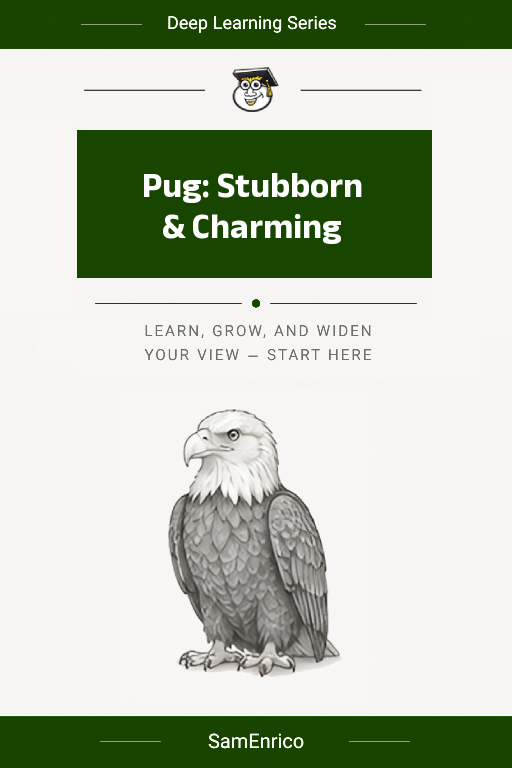
Non-FictionInformativeEducational
Pug: Stubborn & Charming eBook
This publication, published by SamEnrico, covers P
by White Arnold
This publication, published by SamEnrico, covers Pug: Stubborn & Charming
Formats
Free sample
Chapter 1: The Little Emperors...--The first time a Pug leans its full weight against your leg, exhales a dramatic snort, and looks up at you with eyes the size of dinner plates, you understand something immediately: this is not a dog who was ever meant to fetch slippers or herd sheep. This is a creature who once demanded—and received—royal treatment long before you came along. The Pug’s stubbornness did not appear by accident, nor did its charm emerge overnight. Both traits were forged over centuries in the palaces, courts, and secret societies of ancient civilizations, where the little big dog perfected the art of getting exactly what it wanted without ever appearing to ask.To understand why your Pug refuses to move from the warm spot on the couch, why it ignores your commands with the serene confidence of a minor deity, and why you forgive every transgression within seconds, you must travel back more than two thousand years. The Pug’s story begins not in living rooms and Instagram feeds but in the forbidden cities and mountain monasteries of ancient China, where the foundations of its stubborn charm were first laid.The Dragon’s Companion: Origins in Ancient China Long before the first Pug set foot on European soil, before the breed earned its reputation as the clown of the canine world, these square-bodied, wrinkled-faced dogs occupied a place of extraordinary privilege in ancient China.
Historians and canine genealogists generally agree that the Pug belongs to the ancient Molosser family, a group of solid, muscular dogs that included the mastiff. But unlike their larger cousins who pulled carts and guarded livestock, the Pug was bred for one purpose and one purpose only: companionship.During the Han Dynasty (206 BCE to 220 CE), Chinese breeders developed three types of flat-faced dogs: the Lion Dog (which would become the Pekingese), the Peking Spaniel, and the Lo-sze, or “Foo dog,” which is widely accepted as the direct ancestor of the modern Pug. These dogs were not pets in the way we understand the term today. They were living symbols of status, wealth, and spiritual protection. The Chinese believed that flat-faced dogs resembled the mythical Foo lions—guardian spirits carved in stone at the entrances of temples, palaces, and tombs.
To own a Lo-sze was to invite divine protection into your home.But the Pug’s ancestors were not merely decorative. They served a practical function in the imperial court: they were bred to be sensitive to their owners’ emotions, to provide warmth in cold palaces, and to absorb negative energy. Buddhist monks in Tibetan monasteries kept these dogs as companions, believing their wrinkled foreheads resembled the Chinese character for “prince.” Every wrinkle was a mark of nobility. Every snort was a conversation.The selective breeding that produced the Pug’s distinctive features—the flat face, the deep forehead wrinkles, the tightly curled tail—was intentional and meticulous. Chinese emperors employed whole teams of eunuchs whose sole responsibility was the care and breeding of imperial dogs.
These dogs slept on silk cushions, ate from porcelain bowls, and were carried in the sleeves of royal robes. They were never allowed to walk on the ground like common animals. This origin story is essential to understanding the modern Pug’s psychology: this is a breed that spent centuries being treated as royalty. That memory lives somewhere in their DNA. When your Pug refuses to step in a puddle or balks at walking on wet grass, it is not being difficult.
It is remembering.The Wrinkle as Status Symbol No feature of the Pug has inspired more fascination than its wrinkles. The deep furrows across the forehead, the folds around the eyes, the ripples along the muzzle—these are not arbitrary physical traits. In ancient China, the Pug’s wrinkles were deliberately cultivated and celebrated as the breed’s most important feature. Breeders selected dogs with the deepest, most symmetrical forehead wrinkles because those folds were believed to resemble the Chinese character for “prince” (王, wáng). A Pug with three distinct vertical lines between its eyes was considered the most valuable of all.This belief was not merely aesthetic superstition.
The Chinese imperial court operated on a complex system of symbols and omens. Every object, animal, and person in the emperor’s presence was expected to reflect cosmic harmony and good fortune. The Pug’s wrinkled face was a living good luck charm. The more clearly the “prince” character appeared on a dog’s forehead, the more fortune it was believed to bring to its owner.There is a darker aspect to this history as well. Some historical accounts suggest that Chinese breeders deliberately pricked or folded the skin of puppies to create deeper, more defined wrinkles—a practice that would be considered animal cruelty today.
Modern ethical breeding has completely abandoned such practices, and the wrinkles of a healthy Pug today are natural genetic expressions. But the preference for deep, symmetrical folds remains embedded in the breed standard of every major kennel club.The Pug’s tail tells a similar story of selective breeding for symbolic value. A proper Pug tail curls tightly once, or ideally twice, against the hip. The tighter the curl, the better the dog. This trait was selected not for any functional purpose but because the double curl was believed to resemble ancient Chinese calligraphy strokes—another mark of cultural refinement.
Today, the tightly curled tail remains a signature of the breed, though it also makes Pugs vulnerable to spinal issues like hemivertebrae, a condition where the vertebrae are malformed. The same genetic trait that made the Pug beautiful in imperial courts now requires careful monitoring from veterinarians.The Journey West: Pugs on the Silk Road The Pug did not remain sealed within China’s borders forever. As trade routes opened between East and West, these little dogs began a slow, deliberate migration that would eventually place them in the palaces of Europe. The primary conduit for this journey was the Silk Road, the ancient network of trade routes that connected China to the Mediterranean. But the Pug was not a typical commodity.
Unlike silk, spices, or tea, which could be bought and sold in bulk, Pugs were precious gifts exchanged between royalty.During the 16th century, Dutch traders established relationships with Chinese merchants and officials, and Pugs began appearing in European port cities as diplomatic gifts. The breed was still rare and exotic—a living treasure from the mysterious East. European nobles had never seen anything like these square-bodied, wrinkled-faced dogs with their expressive eyes and peculiar snorting sounds. They were immediately captivated.The Dutch East India Company played a particularly important role in the Pug’s European introduction. Dutch traders who had established trading posts in China sent Pugs back to the Netherlands as gifts for wealthy patrons.
These dogs were valued not only for their novelty but also for their temperament. Unlike many small European breeds of the time, which tended to be nervous or yappy, Pugs were calm, affectionate, and remarkably tolerant of handling. They could be carried in sleeves, tucked into baskets, or allowed to nap on laps without fuss. They were, in short, the…
This is the end of the free sample. Get the eBook to keep going. Buy now
About this book
Details
- Author
- White Arnold
- Publisher
- SamEnrico
- Language
- English
- Genre
- Non-Fiction, Informative, Educational
- Released
- 2026-06-03
- Pages (approx.)
- 156
- Available as
- eBook, Audiobook

Read better in the ZLOADR app
Your eBooks on your phone or tablet. Sign in with your SamEnrico account and start reading.
More by White Arnold
 Homicide Detective TraumaWhite Arnold$11.99
 Self Hypnosis for Fear of SymmetryWhite Arnold$11.99
 Child Loss And Financial RuinWhite Arnold$11.99
 French Equatorial Africa BreakupWhite Arnold$11.99
 The Obese Choking GuideWhite Arnold$11.99
 The ABC Please Skill HandbookWhite Arnold$11.99
 Alcohol Recovery for SeniorsWhite Arnold$11.99
 16S Sequencing GuideWhite Arnold$11.99
 The Architect Kings: Nubia's Engineering Marvels of the NileWhite Arnold$11.99
 Letters from the Silent Stage: Étienne Decroux and the Birth of Modern MimeWhite Arnold$11.99
 How to Produce Floss SugarWhite Arnold$11.99
 How to Start a Hobby in Collecting Knives (pocket knives - hunting knives - kitchen knives)White Arnold$11.99
You may also like
 Hong Kong Handover 1997Dunn Johnnie$11.99
 Zumba For Postnatal Recovery CourseNeal Christian$11.99
 Zumba for BeginnersLadner Nikia$11.99
 YouTube Comment Mining GuideHumes Pandora$12.99
 Worry Box MeditationCarlin Rudy$11.99
 Workplace Stress MeditationNguyen Lynn$11.99
 Workplace Stress and Sleep RepairHawley Ivory$11.99
 Workplace Perfectionism CureDelaney Jeffry$11.99
 Workplace Injustice Anger GuideWallen Isabelle$11.99
 Work Addiction and Burnout LinkGreenwood Ester$11.99
 Women in Yoga and WellnessBeattie Galina$11.99
 Women in Stand Up ComedyChun Evangeline$11.99