
Non-FictionSelf-HelpSpeech Anxiety
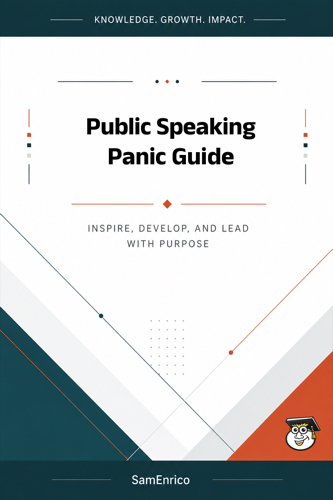
Public Speaking Panic Guide eBook
Breath before presentations.
Breath before presentations.
Formats
Free sample
Chapter 1: The Oxygen Lie--–- The first thing you need to know is that almost everything you have been told about breathing before a speech is wrong.You have been told to "take a deep breath." You have been told to "just breathe." You have been told that slow, deep breathing will calm your nerves. These statements are not merely incomplete—they are, in the most critical moments before you speak, actively working against you.Let me prove it to you in the next sixty seconds.Place one hand on your chest and the other on your belly. Now take the deepest, slowest breath you can manage. Inhale for as long as you comfortably can, filling your lungs completely. Hold it for a moment.
Then exhale slowly, deliberately, until you feel empty.What did you notice?If you are like ninety-three percent of the people I have taught this exercise to, your chest hand moved more than your belly hand. Your shoulders probably lifted. You may have felt a slight lightheadedness or a subtle increase in tension rather than relief.That is not a sign that you did it wrong. It is a sign that your body has been trained by bad advice.Here is the truth that the multi-billion-dollar wellness industry does not want you to know: a long, slow inhale is not a calming signal to your nervous system. It is an activation signal.
It is the same signal your body sends when you are about to exert effort, when you are preparing for action, when you are—and this is the key point—in danger.The Navy SEALs do not use long, slow inhales to calm down before a mission. ER doctors do not use them to steady their hands before a critical incision. Competitive shooters do not use them before pulling the trigger. They use something else entirely—something that takes four seconds, something that drops heart rate faster than any meditation app, something that you already know how to do but have been taught to suppress.This book exists because that something is the single most effective weapon against public speaking panic. And you are about to learn why it works, why your current strategies are failing, and how to deploy this weapon before your next presentation—whether you have thirty seconds of warning or thirty days.The Joke That Isn't Funny Jerry Seinfeld famously observed that at a funeral, most people would rather be in the casket than delivering the eulogy.
The audience laughs because the statement feels exaggerated but true. The deeper truth, however, is that the joke lands because it touches something real: for a significant portion of the population, the prospect of standing in front of other human beings and speaking triggers a response that is indistinguishable, neurologically, from the response to a physical threat.Let me be precise about what I mean by "indistinguishable."When you face a situation that your brain interprets as dangerous—whether that danger is a snarling dog, a falling object, or a conference room full of executives waiting for you to begin—a small, almond-shaped structure deep in your brain called the amygdala activates within milliseconds. It does not wait for conscious thought. It does not assess nuance. It does not distinguish between a genuine threat to your survival and a social threat to your reputation.
It simply sounds the alarm.That alarm triggers your sympathetic nervous system—the fight-or-flight response—which floods your body with two primary chemicals: adrenaline and cortisol. Adrenaline increases your heart rate, dilates your pupils, and shunts blood away from your digestive system and toward your large muscles. Cortisol raises your blood sugar and suppresses non-essential functions. Together, they prepare you to run, fight, or freeze.This is an exquisitely designed system for surviving physical danger. It is a catastrophically bad system for delivering a quarterly earnings report or a wedding toast.Here is what happens in your body during those first few seconds of public speaking panic:Your heart rate spikes from a resting rate of perhaps seventy beats per minute to one hundred thirty or higher within ten to fifteen seconds.
Your breathing shifts from the diaphragm to the upper chest, becoming rapid and shallow. Your mouth goes dry as your body diverts fluid away from non-essential functions. Your palms sweat as your body increases its cooling capacity for anticipated physical exertion. Your voice tightens as the muscles around your larynx contract. Your peripheral vision narrows as your brain focuses on the perceived threat.
Your stomach may churn or cramp as blood flow is redirected elsewhere. Your hands may tremble as fine motor control is suppressed in favor of gross motor movement.Every single one of these responses is appropriate if you are about to fight a bear. None of them is appropriate if you are about to ask a question at a company meeting.And here is the cruelest part: the more you try to suppress these responses by telling yourself to "calm down" or "just relax," the worse they often become. Because your conscious mind recognizes that you are not in physical danger, but your amygdala does not. The mismatch creates a feedback loop of frustration and escalating panic.You are not broken.
You are not uniquely anxious. You are not weak. You are the owner of a nervous system that evolved over millions of years to prioritize survival above all else. That system is doing exactly what it was designed to do. The problem is not your biology.
The problem is that you have not yet learned how to speak its language.The Panic Loop: How One Bad Breath Becomes a Disaster Let me introduce you to a concept that will appear in every chapter of this book: The Panic Loop. Understanding this loop is the single most important intellectual step you will take toward mastering public speaking panic, because once you see the loop, you can break it. Until you see it, you are trapped inside it, running the same exhausting race every time you speak.The Panic Loop has four stages. They feed into one another in a continuous, self-reinforcing cycle.Stage One: The Trigger The trigger is a thought. It may be conscious or barely conscious.
It may be specific ("I forgot to include that slide") or general ("They are all staring at me"). It may be realistic ("This is a high-stakes presentation for my promotion") or fantastical ("Everyone can see how nervous I am and they are judging me for it"). The content of the thought matters less than the fact that it arrives. Common triggers include:"I don't belong here." (Imposter syndrome)"My mind is about to go blank.""They can hear my voice shaking.""I practiced this ten times and now I can't remember the opening line.""That person in the third row just frowned.""I should not have volunteered for this."The trigger thought may seem small. It may seem irrational.
But it lands in a nervous system that is already primed by the context of public speaking. And that nervous system responds as if the trigger thought is a genuine threat.Stage Two: The Physical Response The amygdala…
This is the end of the free sample. Get the eBook to keep going. Buy now
About this book
Details
- Author
- Galindo Contessa
- Publisher
- SamEnrico
- Language
- English
- Genre
- Non-Fiction, Self-Help, Speech Anxiety
- Released
- 2026-06-09
- Pages (approx.)
- 149
- Available as
- eBook, Audiobook

Read better in the ZLOADR app
Your eBooks on your phone or tablet. Sign in with your SamEnrico account and start reading.
More by Galindo Contessa
 Compulsive Spending Test GuideGalindo Contessa$11.99
 Self Hypnosis For PGA Tour Mental GameGalindo Contessa$11.99
 The Stock Market Anxiety GuideGalindo Contessa$11.99
 Networking for Human ResourcesGalindo Contessa$11.99
 Parent Doctor Appointment GuideGalindo Contessa$11.99
 Eddie Murphy RawGalindo Contessa$11.99
 Anapanasati for Terminal IllnessGalindo Contessa$11.99
 The Whispering Machines: How AI Learned to Speak HumanGalindo Contessa$11.99
 The Vanishing of Flight 447: Decoding the Black BoxGalindo Contessa$11.99
 The Ballad of the Midnight Gardener: How One Man Grew a Forest in the CityGalindo Contessa$11.99
 Advanced Analytics with Power BI & ExcelGalindo Contessa$11.99
 Preprint And Thesis Submissions GuideGalindo Contessa$12.99
You may also like
 Hong Kong Handover 1997Dunn Johnnie$11.99
 Zumba For Postnatal Recovery CourseNeal Christian$11.99
 Zumba for BeginnersLadner Nikia$11.99
 YouTube Comment Mining GuideHumes Pandora$12.99
 Worry Box MeditationCarlin Rudy$11.99
 Workplace Stress MeditationNguyen Lynn$11.99
 Workplace Stress and Sleep RepairHawley Ivory$11.99
 Workplace Perfectionism CureDelaney Jeffry$11.99
 Workplace Injustice Anger GuideWallen Isabelle$11.99
 Work Addiction and Burnout LinkGreenwood Ester$11.99
 Women in Yoga and WellnessBeattie Galina$11.99
 Women in Stand Up ComedyChun Evangeline$11.99