
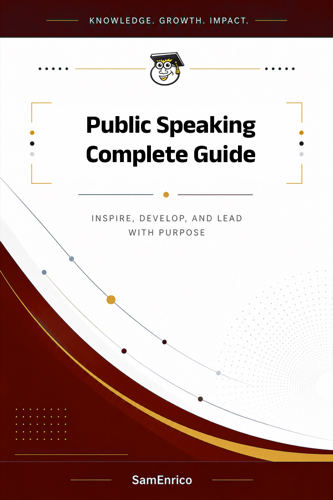
Public Speaking Complete Guide eBook
Comprehensive resource for all speaking scenarios.
Comprehensive resource for all speaking scenarios.
Formats
Free sample
Chapter 1: The Permission Paradox--–- The first lie you were told about public speaking is that it is a performance. The second lie is that you are the problem.Let me reframe something for you immediately, before we go any further. If you have ever stood backstage, palms slick, heart hammering against your ribs, thinking I am not a natural speaker, you have already lost the battle—not because you lack talent, but because you are aiming at the wrong target. You have been taught to chase the ghost of effortless eloquence, to compare your nervous interior with someone else's polished exterior. That comparison is a trap, and this entire chapter is designed to spring you out of it.For the past twenty years, I have watched brilliant people fail at public speaking.
Not because they were unintelligent. Not because they lacked passion. But because they approached the act of speaking as if it were a test of their character rather than a teachable skill. They believed that the ideal state was calm, and when they felt adrenaline instead, they interpreted that as a sign of impending disaster. They are wrong.
And by the end of this chapter, you will understand exactly why.This is the Permission Paradox: the moment you stop trying to eliminate your fear and start giving yourself permission to feel it, the fear loses its grip. You do not conquer the butterflies. You teach them to fly in formation.Why Traditional Advice Fails You Let me name the villains. You have heard them all before.Take a deep breath. On its face, this seems harmless.
But deep breathing without technique often becomes over-breathing—rapid, shallow gasps that actually mimic the physiological symptoms of panic. You tell yourself to breathe deeply, and instead you hyperventilate. Your hands tingle. Your vision narrows. You think something is wrong, and now you have two problems: the original anxiety and the new fear that the breathing isn't working.Imagine the audience naked.
This is not only absurd but actively counterproductive. Naked audiences are distracting. They provoke confusion, not calm. And more to the point, they reinforce the adversarial frame—that you are over there and they are over here, and you need a psychological trick to tolerate their presence. That is not a formula for connection.
It is a formula for dissociation.Fake it until you make it. This advice asks you to perform confidence you do not feel, which creates a gap between your internal experience and your external behavior. That gap is exhausting. It requires constant monitoring. And audiences, despite the common myth, are exquisitely sensitive to inauthenticity.
They may not be able to name what feels off, but they feel it.No one can tell you are nervous. This is a well-intentioned lie. The truth is that audiences can absolutely detect nervousness—but they do not punish it the way you imagine. They forgive sweaty palms. They forgive a stumbled word.
What they do not forgive is disconnection. The problem is not that you look nervous. The problem is that nervousness often makes you turn inward, away from the audience, and that withdrawal is what kills your impact.All of this advice shares a common flaw: it treats anxiety as a malfunction to be suppressed rather than a signal to be interpreted. This chapter offers a complete alternative.The Physiology of Stage Fright: What Is Actually Happening To reframe fear, you must first understand it. Let me walk you through the biology.When you stand in front of a group—whether five people in a conference room or five thousand in an arena—your amygdala, the brain's ancient threat-detection system, does something remarkable.
It scans the environment for danger. And here is the critical insight: social evaluation triggers the exact same physiological cascade as physical threat. Your body does not distinguish between being chased by a predator and being judged by an audience. Both register as danger.This is not a design flaw. It is a design feature.
Your ancestors who were unconcerned about social rejection did not survive to pass on their genes. Belonging to the tribe was a matter of life and death. So your nervous system is not broken. It is doing exactly what evolution designed it to do: preparing you for a high-stakes moment.Here is what that preparation looks like:Your adrenal glands release epinephrine and norepinephrine.Your heart rate increases. Blood redirects to large muscle groups.Your breathing quickens to oxygenate your blood.Your pupils dilate to take in more visual information.Your non-essential systems (digestion, reproduction) temporarily slow down.Every single one of these changes is performance-enhancing.
Increased heart rate delivers oxygen to your brain faster. Dilated pupils help you read audience reactions. Quickened breathing primes your voice for projection. The problem is not the activation. The problem is the interpretation.In one landmark study, researchers told two groups of participants that they would be giving a speech.
One group was told to say "I am calm" before speaking. The other group was told to say "I am excited." The group that said "I am excited" performed significantly better—more persuasive, more confident, more likable. The reason is simple: calm is a low-arousal state incompatible with high adrenaline. Excitement is a high-arousal state that matches the body's activation. The second group did not reduce their physiological response.
They re-labeled it.That is the core skill this chapter teaches. You do not need to lower your heart rate. You need to change the story you tell yourself about what that heart rate means.Stage Delight: Reframing Arousal as Resource I want to introduce you to a concept that will serve as the foundation for every technique in this book: Stage Delight.Stage Delight is the opposite of stage fright not because it eliminates arousal but because it harnesses it. Where stage fright says something is wrong, Stage Delight says something is important. Where stage fright says you might fail, Stage Delight says you are ready to succeed.
Where stage fright says they are judging you, Stage Delight says they are waiting for you.The shift from fright to delight is not a matter of positive thinking. It is a matter of cognitive reframing, a technique borrowed from cognitive behavioral therapy. Here is how it works.Your body sends you a signal: racing heart, dry mouth, trembling hands. That signal is neutral. It carries no inherent meaning.
Your brain then interprets that signal based on context. If you are about to go on a first date, you might call it excitement. If you are about to receive bad news, you might call it dread. If you are about to speak in public, you might call it nervousness. The interpretation is a choice—not always an easy one, but a choice nonetheless.Stage Delight is the conscious decision to interpret high arousal as readiness rather than dread.
It is the difference between saying "I am terrified" and "I am energized." The body does not know the difference. The mind creates it.Let me give you a concrete exercise. The next time you feel the physical symptoms of stage fright, run this mental checklist:My heart is…
This is the end of the free sample. Get the eBook to keep going. Buy now
About this book
Details
- Author
- Hollingsworth Sherwood
- Publisher
- SamEnrico
- Language
- English
- Genre
- Non-Fiction, Self-Help, Complete
- Released
- 2026-06-09
- Pages (approx.)
- 127
- Available as
- eBook, Audiobook

Read better in the ZLOADR app
Your eBooks on your phone or tablet. Sign in with your SamEnrico account and start reading.
More by Hollingsworth Sherwood
 Sugar Cravings Neuroscience GuideHollingsworth Sherwood$11.99
 Personal Ing For Success HealthcareHollingsworth Sherwood$11.99
 Adrenal Fatigue Symptoms Recognition GuideHollingsworth Sherwood$11.99
 Coworker Interruption Scripts GuideHollingsworth Sherwood$11.99
 Echoes of the Lost Fleet: The Last Voyage of the USS IndianapolisHollingsworth Sherwood$11.99
 How to Become a Automobile-body RepairerHollingsworth Sherwood$11.99
 Voiceover Sibilance GuideHollingsworth Sherwood$12.99
 Cross Border Data BreachHollingsworth Sherwood$12.99
 Understanding Ectodermal Dysplasia Neurosensory DeafnessHollingsworth Sherwood$17.99
 Digital Content CreatorHollingsworth Sherwood$11.99
You may also like
 Hong Kong Handover 1997Dunn Johnnie$11.99
 Zumba For Postnatal Recovery CourseNeal Christian$11.99
 Zumba for BeginnersLadner Nikia$11.99
 YouTube Comment Mining GuideHumes Pandora$12.99
 Worry Box MeditationCarlin Rudy$11.99
 Workplace Stress MeditationNguyen Lynn$11.99
 Workplace Stress and Sleep RepairHawley Ivory$11.99
 Workplace Perfectionism CureDelaney Jeffry$11.99
 Workplace Injustice Anger GuideWallen Isabelle$11.99
 Work Addiction and Burnout LinkGreenwood Ester$11.99
 Women in Yoga and WellnessBeattie Galina$11.99
 Women in Stand Up ComedyChun Evangeline$11.99