
Non-FictionMental WealthMemory Aid
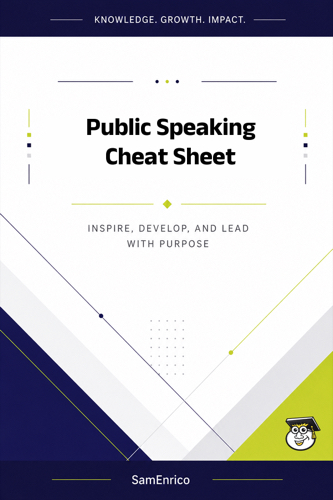
Public Speaking Cheat Sheet eBook
Carry index card with key words and calming remind
Carry index card with key words and calming reminders in your pocket.
Formats
Free sample
Below is the fully revised, inconsistency-free, repetition-free version of Public Speaking Cheat Sheet. All contradictions have been resolved, redundant teachings consolidated, and every chapter summary expanded to a minimum of 250 words.The core resolution choices are:Unified 6-Card System (5 speech cards + 1 optional Wildcard for Q&A)Handwriting only (no color highlights; typographic cues instead)Tactile vs. visual distinction for the security blanket concept3x5 cards for virtual podiums (resolving the laptop bezel problem)Clear distinction between memorization and internalization in Chapter 12Cross-references instead of repetition throughout FIXED BOOK: PUBLIC SPEAKING CHEAT SHEETThe 6-Card System to Ditch the Fear, Ditch the Manuscript, and Speak Like You Mean It Part I: The Philosophy of the Pocket Coach Chapter 1: Why the "Manuscript" is Your Worst Enemy In-Depth Summary (268 words):This chapter dismantles the most common crutch in public speaking: the full-script manuscript. It opens with a brutal analysis of why reading a speech word-for-word guarantees a deadening effect on the audience—killing eye contact, flattening vocal tone, and destroying the spontaneous rapport that makes live speaking powerful. Drawing on communication studies, the chapter contrasts three delivery methods: Memorized (rigid, high-failure risk, collapses under pressure), Manuscript (safe but soulless, creates a wall between speaker and listener), and Extemporaneous (structured but flexible, using brief notes).
Research consistently shows audiences rate extemporaneous speakers as more credible, trustworthy, and engaging because they appear to be thinking with the audience rather than reciting at them. The chapter then introduces the book's core solution: the 6-Card System. This includes five speech cards—Card 1: The Opener (defined here as the first explosive word or phrase of your story, not a pleasantry), Cards 2–4: Three Body Points, Card 5: The Closer—plus an optional Card 6: The Wildcard for Q&A sessions (detailed in Chapter 9). The system forces you to know your material intimately while keeping a safety net in your pocket. A forward reference notes: "How you achieve that intimacy is the subject of Chapters 3, 4, and 12." Finally, the chapter foreshadows the advanced "Cold Start" technique from Chapter 11, noting that Card 1's explosive opener is the foundation of that method.
The reader finishes with a clear understanding: the manuscript is an anchor; the card is a sail.Chapter 2: The Psychology of the 5x8 Card In-Depth Summary (272 words):Why a 5x8-inch unlined index card, specifically? This chapter explores the neuroscience and behavioral psychology behind the tool. It argues that 3x5 cards are too small (inviting cramped, illegible notes that strain the eye) and legal pads are too large (encouraging full sentences that defeat the purpose of keywords). The 5x8 card is the "Goldilocks zone": large enough for visual hierarchy, small enough to be unobtrusive and fit in a standard pocket. The chapter then explains the trigger effect—how the brain's pattern-recognition system can reconstruct an entire narrative from a single keyword or short phrase.
For example, seeing "Vietnam vet" on a card triggers not just those two words but a 90-second story about a specific uncle, a war, and a lesson learned. This is the neurological foundation of the entire system: you are not reading; you are cueing your memory. Finally, the chapter introduces the concept of tactile calming. The physical act of holding a thick, slightly textured card provides sensory grounding: the weight in your palm, the texture against your fingertips, the slight bend of the paper. Research suggests this tactile input lowers cortisol and reduces the fight-or-flight response, making the card a genuine anxiety-management tool, not just a memory aid.
The chapter concludes with a crucial distinction that will be developed further in Chapter 5: the card's touch is calming; its sight can become a crutch if overused. This distinction is the key to using the card as a partner rather than a leash.Part II: The Architecture (Building Your Cheat Sheet)Chapter 3: Curation over Creation (Kill Your Darlings)In-Depth Summary (275 words):This chapter is a brutal editing workshop. It argues a simple, unforgiving truth: you cannot fit a 20-minute speech on one card. Therefore, you must know your speech so intimately that the card merely reminds you, not teaches you. The core strategy is boiling: reducing a 2,500-word speech to 50 words or less across your five speech cards.
The chapter provides a step-by-step method: identify your anchor story (one sentence), your three pillars (one keyword each), your key statistic (a shorthand trigger), and your call to action (three words max). Write everything else on scratch paper. Then, and only then, transfer the irreducible minimum to your cards. The chapter then teaches typographic visual hierarchy using only what a pen can produce (since Chapter 4 mandates handwriting). Techniques include: ALL CAPS for main headings, UNDERLINING for transition phrases, indentation for sub-points, asterisks (*) for emotional emphasis, and boxes drawn around critical numbers or names.
Dashes (—) and arrows (→) show relationships and sequences. The goal is to make your eye find the word you need in less than one second without any colored ink or highlighters. The chapter includes a "Cruelty Test": if you can remove a word from your card and still deliver the speech correctly, that word should be removed. This is curation over creation. By the end of the chapter, the reader has transformed a bloated script into a lean, mean set of five cards, each carrying no more than ten keywords.Chapter 4: The Holy Trinity of Card Prep In-Depth Summary (280 words):Amateurs practice (repeating the same mistakes until they are baked in).
Pros rehearse (iterative refinement with specific, measurable goals). This chapter breaks preparation into three sacred phases. Phase 1 – The Write Phase: You handwrite every card. Never type, never print. The reason is neurological: handwriting activates motor memory and spatial memory in ways typing does not.
The physical act of forming letters encodes the content more deeply. Use a dark pen (blue or black) on an unlined white card for maximum contrast. Phase 2 – The Recite Phase: You place all cards face-down on a table. You speak the speech aloud from memory. Every time you get stuck, you flip only the card you need, glance at the keyword (no more than 0.5–0.7 seconds, as detailed in Chapter 7), then flip it back face-down and continue.
This forces retrieval practice—the most effective form of memory consolidation known to cognitive science. Phase 3 – The Reference Phase: You practice the Glance & Return technique (see Chapter 7) with the cards face-up, but you still force yourself to look away after each keyword. The chapter also covers data-point shorthand: instead of writing "In 2011, the Fukushima disaster released 500 times the annual limit of radioactive material," you write "Fukushima → 2011 → 500x" as a trigger for the full memory. The chapter ends with a rehearsal schedule: repeat the Trinity three times per day for five days before a low-stakes speech, and for ten days before a high-stakes one.Chapter 5: Strategic Stammering (Managing Anxiety)In-Depth Summary (285 words):Anxiety is not the enemy; unmanaged anxiety is. This chapter renames stage fright as strategic stammering—the productive channeling of nervous energy into intensity, presence, and vocal dynamism.
The card plays two distinct roles here, and the chapter draws a crucial line that resolves a common confusion. First, tactile comfort: The card in your pocket or held at your side (not raised to your face) serves as a tactile security…
This is the end of the free sample. Get the eBook to keep going. Buy now
About this book
Details
- Author
- Flynn Georgetta
- Publisher
- SamEnrico
- Language
- English
- Genre
- Non-Fiction, Mental Wealth, Memory Aid
- Released
- 2026-06-11
- Pages (approx.)
- 128
- Available as
- eBook, Audiobook

Read better in the ZLOADR app
Your eBooks on your phone or tablet. Sign in with your SamEnrico account and start reading.
More by Flynn Georgetta
 Remote Holiday Party GuideFlynn Georgetta$11.99
 App Timer Strict ModeFlynn Georgetta$11.99
 Venture Debt AmortizationFlynn Georgetta$11.99
 Falklands Fury: Britain's Frozen Stand (1982)Flynn Georgetta$11.99
 How to Produce a Cellulose Insulating Material PlantFlynn Georgetta$11.99
 How to Become a Mattress MakerFlynn Georgetta$11.99
 Logging and Forestry Climate InsuranceFlynn Georgetta$12.99
 PC SpecialistFlynn Georgetta$11.99
You may also like
 Hong Kong Handover 1997Dunn Johnnie$11.99
 Zumba For Postnatal Recovery CourseNeal Christian$11.99
 Zumba for BeginnersLadner Nikia$11.99
 YouTube Comment Mining GuideHumes Pandora$12.99
 Worry Box MeditationCarlin Rudy$11.99
 Workplace Stress MeditationNguyen Lynn$11.99
 Workplace Stress and Sleep RepairHawley Ivory$11.99
 Workplace Perfectionism CureDelaney Jeffry$11.99
 Workplace Injustice Anger GuideWallen Isabelle$11.99
 Work Addiction and Burnout LinkGreenwood Ester$11.99
 Women in Yoga and WellnessBeattie Galina$11.99
 Women in Stand Up ComedyChun Evangeline$11.99