
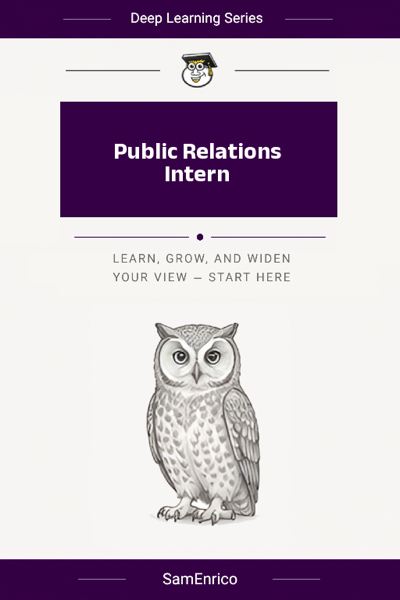
Non-FictionInformativeEducational
Public Relations Intern eBook
A Coursebook on Public Relations Intern
A Coursebook on Public Relations Intern
Formats
Free sample
Chapter 1: The Memo You’ll Never Forget--–- You will remember exactly where you were when you first understood that public relations is not what you thought it was.For some future PR interns, that moment comes during a rushed morning meeting, coffee in hand, when a senior executive says something so casually cynical about the media that your stomach turns. For others, it comes at 11:47 on a Tuesday night, alone in a fluorescent-lit office, when you realize the press release you just “fact-checked” contains a number that you know—you absolutely know—is a lie. And for a lucky few, that moment comes right now, in the pages of this book, before you have ever sent a single pitch email or assembled a single swag bag.Let it be now.Public relations is not “spin.” It is not “flacking.” It is not a collection of clever tricks to make bad companies look good or good companies look better than they actually are. That version of PR died sometime in the early 2000s, although nobody told the television shows and movies that keep replaying the same tired stereotypes of hard-drinking, fast-talking crisis managers who can bury any story with a single phone call. Those characters are fiction.
The real PR profession—the one that will determine whether you get a job offer, build a career, and sleep well at night—is something else entirely.This chapter dismantles the outdated stereotype that public relations is merely “writing press releases and throwing parties.” It introduces you to the modern definition of PR as a strategic management function that builds mutually beneficial relationships between organizations and their publics. You will learn the RACE model that will structure every campaign you ever work on. You will distinguish PR from advertising, marketing, and journalism—not as an academic exercise, but because mixing them up will get you fired. And you will walk away with a practical roadmap of internship structures: agency, corporate, and nonprofit.But first, let us tell you a story about a memo that changed everything.The Memo That Invented Modern PRIn 1906, a former journalist named Ivy Lee was hired by the Pennsylvania Railroad after a tragic accident. A train had derailed.
Passengers were dead. The railroad’s standard response—like every major corporation of the era—was to say nothing, hide behind lawyers, and hope the story went away.Lee did something radical. He convinced the railroad to let him issue a statement to the press. Not a defensive denial. Not a legalistic non-denial.
An actual statement that acknowledged what had happened, expressed regret, and promised a full investigation. Then he did something even more radical: he arranged for reporters to be taken to the accident scene on a special train.The press was stunned. No company had ever done this before. The resulting coverage was not positive—people had died, after all—but it was accurate. And more importantly, the railroad’s willingness to be transparent, to speak directly to the public through the media, marked the birth of modern public relations.Lee followed this up with a document called the Declaration of Principles.
In it, he wrote: “This is not a secret press bureau. All our work is done in the open. We supply information. Our plans are made for the purpose of furnishing the press with information. We are not concerned with puffery.”That phrase—“We supply information”—was revolutionary.
Lee was not promising to make his clients look good. He was promising to tell the truth. That was the original compact between public relations and the public.Now, here is the part that most textbooks skip: Lee was not a saint. He later worked for the Rockefeller family during the Ludlow Massacre, where Colorado National Guardsmen killed striking miners and their families. Lee’s PR efforts helped rehabilitate Rockefeller’s image after the violence.
Ethical? Debatable. Effective? Absolutely. That tension—between serving a client and serving the truth—has never gone away.
It will be waiting for you on your first day.From Lee, the profession evolved through Edward Bernays, the nephew of Sigmund Freud, who applied his uncle’s psychological theories to public persuasion. Bernays famously staged the 1929 “Torches of Freedom” campaign, in which he paid debutantes to march in New York’s Easter Parade while smoking Lucky Strike cigarettes. At the time, women smoking in public was taboo. Bernays reframed cigarettes as “torches of freedom” and women who smoked as liberated. Sales skyrocketed.Bernays called this “the engineering of consent.” He was not trying to inform the public.
He was trying to change behavior. And he was very, very good at it.These two figures—Lee, the information-provider, and Bernays, the consent-engineer—represent the two poles of public relations. The profession has never fully resolved which one is correct. Neither will you. But understanding that tension is the first step to becoming a thoughtful, effective, and ethical PR professional.What PR Actually Is (And What It Isn’t)Let us begin with a formal definition.
The Public Relations Society of America (PRSA) defines public relations as: “A strategic communication process that builds mutually beneficial relationships between organizations and their publics.”Every word in that definition matters.Strategic. PR is not reactive. It is not a fire department that only shows up when something goes wrong. Good PR anticipates, plans, and aligns communication with organizational goals. That is why the RACE model—Research, Action, Communication, Evaluation—appears in this chapter and will reappear throughout this book.Communication process.
PR is a verb, not a noun. It is what you do, not what you have. You cannot “do PR” once and check the box. Relationships require ongoing communication.Mutually beneficial. This is the part most people forget.
PR is not just about making the organization look good. It is about creating value for the public as well. A press release that only lists the client’s achievements is not PR. It is advertising without a media budget. A genuine PR effort answers the question: “What does the public gain from knowing this?”Relationships.
Not transactions. Not one-off campaigns. Relationships. Built over time. Trust is the currency of PR, and trust cannot be bought.
It must be earned.Organizations and their publics. “Publics” is the PR term for specific groups of people who matter to an organization. Customers are a public. Employees are a public. Investors are a public.
Journalists are a public. Regulators are a public. Community members are a public. Each public requires different messages, different channels, and different relationship strategies.Now let us clarify what PR is not.PR is not advertising. Advertising is paid media.
You buy space or time, and you control exactly what appears. A print ad in a magazine costs money, but you know the ad will run exactly as you designed it. PR is earned media. You cannot buy coverage. You pitch a story to a journalist, and if they decide it is newsworthy, they write about it—in their own words, with their own angle, and possibly with criticism you did not anticipate.
Advertising guarantees placement. PR guarantees nothing except the opportunity to try.PR is not marketing. Marketing focuses on customers, transactions, and…
This is the end of the free sample. Get the eBook to keep going. Buy now
About this book
Details
- Author
- Cotton Marita
- Publisher
- SamEnrico
- Language
- English
- Genre
- Non-Fiction, Informative, Educational
- Released
- 2026-06-02
- Pages (approx.)
- 160
- Available as
- eBook, Audiobook

Read better in the ZLOADR app
Your eBooks on your phone or tablet. Sign in with your SamEnrico account and start reading.
More by Cotton Marita
 Teen Parenting Stress GuideCotton Marita$11.99
 Growth Hormone and FertilityCotton Marita$11.99
 The Poker Room Recovery GuideCotton Marita$11.99
 Panic Disorder Performance Anxiety GuideCotton Marita$11.99
 AI Video Restoration for ArchivesCotton Marita$11.99
 The Lost Symphony of the Sea: How a 19th-Century Shipwreck Sparked a Musical RevolutionCotton Marita$11.99
 The Ghost of Flight 447: The Last Words Before the DeepCotton Marita$11.99
 How to Become a Scarfing Machine OperatorCotton Marita$11.99
 Invitation To Apply ProcessCotton Marita$12.99
 Automated Sales Tax CalculationCotton Marita$12.99
 Understanding Bruyn Scheltens SyndromeCotton Marita$17.99
You may also like
 Hong Kong Handover 1997Dunn Johnnie$11.99
 Zumba For Postnatal Recovery CourseNeal Christian$11.99
 Zumba for BeginnersLadner Nikia$11.99
 YouTube Comment Mining GuideHumes Pandora$12.99
 Worry Box MeditationCarlin Rudy$11.99
 Workplace Stress MeditationNguyen Lynn$11.99
 Workplace Stress and Sleep RepairHawley Ivory$11.99
 Workplace Perfectionism CureDelaney Jeffry$11.99
 Workplace Injustice Anger GuideWallen Isabelle$11.99
 Work Addiction and Burnout LinkGreenwood Ester$11.99
 Women in Yoga and WellnessBeattie Galina$11.99
 Women in Stand Up ComedyChun Evangeline$11.99