
Non-FictionStudent's ShortcutPublic Economics
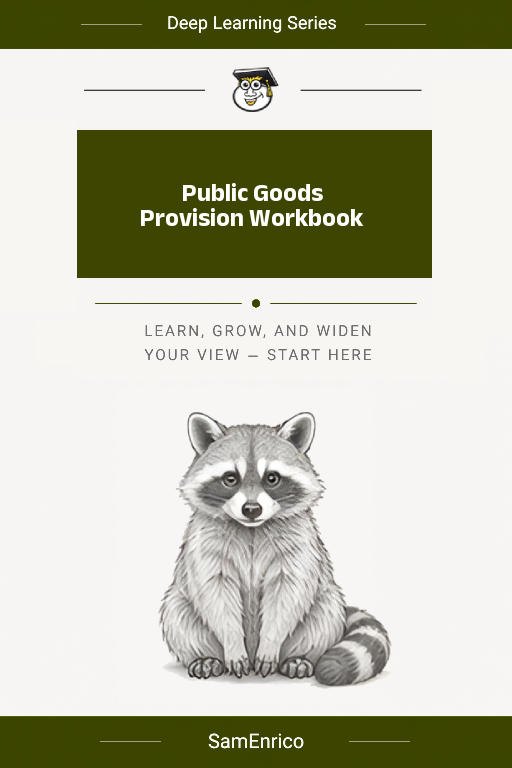
Public Goods Provision Workbook
Calculate optimal provision levels for public good
by Burris Trinh
Calculate optimal provision levels for public goods using demand aggregation. Solve free rider and Lindahl pricing exam questions in Excel.
Formats
About this book
Free sample
Chapter 1: The Free Rider Next Door--The email arrived on a Tuesday afternoon, forwarded by a friend who had finally had enough. The subject line read: “Our condo association is falling apart — and I know exactly who’s to blame.” The body of the email described a familiar war. Fourteen units in a building. A roof that needed replacing. A landscaping service that kept threatening to cancel.
And one neighbor — always the same neighbor — who attended every meeting, praised every proposal, and then quietly refused to pay his share. The friend had done the math. If everyone else paid just a little more, they could cover the deficit. But everyone else had started asking the same question: “Why should we pay for his free ride?”That question, in its many forms, is the starting point of this book. Why should I pay for something my neighbor will enjoy for free?
Why does the group project always end with one person doing nothing? Why do taxes fund things I never use? And — most painfully — why does the rational, self-interested choice so often lead to outcomes that make everyone worse off?This chapter answers those questions by building the conceptual foundation for everything that follows. You will learn what makes a public good different from a private good, why the free rider problem is not a moral failing but a logical inevitability, and how economists think about the underproduction trap. By the end of this chapter, you will have built your first Excel model — a willingness‑to‑pay simulator that proves, with actual numbers, why your neighbor’s behavior is not personal.
It is structural. And understanding that structure is the first step toward fixing it.What is a Public Good? The Two Critical Ingredients Economists classify goods based on two properties. The first is rivalry. A good is rival if one person’s consumption reduces the amount available for others.
A slice of pizza is rival. If you eat it, I cannot. A seat on a subway car is rival during rush hour. A password for a streaming service is rival if…
This is the end of the free sample. Get the eBook to keep going. Buy now
Contents
- Chapter 1
- Chapter 2
- Chapter 3
- Chapter 4
- Chapter 5
- Chapter 6
- Chapter 7
- Chapter 8
- Chapter 9
- Chapter 10
- Chapter 11
- Chapter 12
Details
- Author
- Burris Trinh
- Publisher
- SamEnrico
- Language
- English
- Genre
- Non-Fiction, Student's Shortcut, Public Economics
- Released
- 2026-05-30
- Pages (approx.)
- 134
- Available as
- eBook, Audiobook

Read better in the ZLOADR app
Your eBooks on your phone or tablet. Sign in with your SamEnrico account and start reading.
More by Burris Trinh
 Engineering Student StressBurris Trinh$11.99
 Cleopatra River Economy GuideBurris Trinh$11.99
 Mindfulness Meditation for TravelBurris Trinh$11.99
 Caregiver Burnout Prevention GuideBurris Trinh$11.99
 The Serpent’s Gambit: Kali’s Dance of DestructionBurris Trinh$11.99
 How to Become a Pouncing-lathe OperatorBurris Trinh$11.99
 How to Produce Automatic Dishwashing ProductsBurris Trinh$11.99
 Guest ServiceBurris Trinh$11.99
You may also like
 Hong Kong Handover 1997Dunn Johnnie$11.99
 Zumba For Postnatal Recovery CourseNeal Christian$11.99
 Zumba for BeginnersLadner Nikia$11.99
 YouTube Comment Mining GuideHumes Pandora$12.99
 Worry Box MeditationCarlin Rudy$11.99
 Workplace Stress MeditationNguyen Lynn$11.99
 Workplace Stress and Sleep RepairHawley Ivory$11.99
 Workplace Perfectionism CureDelaney Jeffry$11.99
 Workplace Injustice Anger GuideWallen Isabelle$11.99
 Work Addiction and Burnout LinkGreenwood Ester$11.99
 Women in Yoga and WellnessBeattie Galina$11.99
 Women in Stand Up ComedyChun Evangeline$11.99