
Non-FictionSelf-HelpPublic Interaction
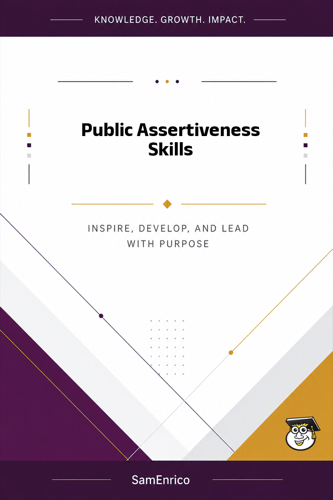
Public Assertiveness Skills eBook
Speak up in crowds, question speakers, and address
by Ivey Tinisha
Speak up in crowds, question speakers, and address rude strangers.
Formats
Free sample
Chapter 1: The Three-Second Window--–- You are in a meeting. The speaker has just said something demonstrably false—not a minor exaggeration, not a matter of opinion, but a factual error that could lead to a bad decision affecting your work, your team, or your paycheck. You know the correct information. The person next to you knows it too; you can see it in the slight furrow of their brow. Three other people in the room are quietly shifting in their seats.
The speaker pauses for breath. The room goes silent. And in that silence, you feel it: a window. A brief, shimmering moment when you could speak. Your heart rate spikes.
Your throat tightens. Your mind, which ten seconds ago was perfectly clear, is now a fog of competing thoughts: Should I say something? Will I sound stupid? What if I'm wrong? What if they get defensive?
What if everyone stares at me? The speaker continues. The moment passes. You say nothing. Three hours later, lying in bed, you think of the perfect thing you should have said.This book is the cure for the three-hour-late comeback.The scenario above is not a failure of knowledge.
You knew the facts. It was not a failure of desire. You wanted to speak. It was a failure of timing—specifically, the failure to act within what this book calls The Three-Second Window. The Three-Second Window is the brief period between the moment you recognize that you should speak and the moment your brain's threat-response system talks you out of it.
Research on decision-making under social stress suggests that this window closes within three to five seconds. After that, the opportunity is gone, and your cognitive machinery shifts from "action mode" to "post-hoc justification mode"—the mode where you convince yourself that staying silent was actually the smart choice. It wasn't that important. Someone else will say something. I don't want to make waves.
These justifications are not lies; they are your brain's way of protecting you from the discomfort of recognizing that you just failed to act on your own values.This chapter introduces the central framework of this book: assertiveness is not a personality trait, not a matter of being "born confident," not something you either have or don't have. Assertiveness is a timing skill. It is the ability to recognize the Three-Second Window and to train your body and mind to act within it before the window closes. Every technique in this book—from the physiological regulation tools in this chapter to the verbal scripts in later chapters—is designed to do one thing: widen and extend your Three-Second Window so that you have enough time to choose to speak.The Anatomy of Silence To understand how to speak, we must first understand why we stay silent. Silence is not the absence of behavior; it is a behavior in itself, and it is produced by a specific sequence of psychological and physiological events.
Let us walk through that sequence in slow motion.Stage One: Recognition. You notice something wrong. A false statement. A rude action. A line being cut.
A person being excluded. This recognition happens almost instantly, in less than a second. Your brain is constantly scanning the environment for violations of expected patterns, and when it detects one, it flags it for attention. At this stage, you are not yet afraid. You are simply aware.Stage Two: Appraisal.
Within the next second, your brain begins to answer a single question: Is this a threat? This appraisal is not a rational, deliberate calculation. It is automatic, unconscious, and heavily influenced by past experience, social conditioning, and your current physiological state. Your brain asks sub-questions: Does this situation involve people whose opinion matters to me? Could speaking lead to social rejection?
Has speaking up in the past led to negative outcomes? Do I have evidence that this environment is safe for dissent? For most people, in most public settings, the appraisal comes back positive: Yes, this is a threat.Stage Three: Activation. The appraisal triggers the amygdala, the brain's ancient threat-detection system. The amygdala does not distinguish between a physical predator and a room full of staring faces; both register as danger.
Within milliseconds, the amygdala activates the sympathetic nervous system—the "fight, flight, or freeze" response. Adrenaline and cortisol flood the bloodstream. Your heart rate accelerates. Blood moves away from your prefrontal cortex (the rational planning center) and toward your large muscle groups (in case you need to run or fight). Your throat constricts as the body prepares for potential injury.
Your working memory—the cognitive system that holds information in mind for active use—begins to shut down. This is not a failure of character. This is your nervous system doing exactly what evolution designed it to do: prioritize survival over social niceties.Stage Four: The Window. For approximately three to five seconds after the appraisal, your prefrontal cortex and your amygdala are in competition. The amygdala is screaming Danger!
Stay silent! The prefrontal cortex is whispering But the facts are on your side, and staying silent will feel worse later. This competition creates the window. During these seconds, you still have the ability to override the amygdala's signal and speak. But the window is narrow, and it requires two things: sufficient physiological regulation (so your body is not in full panic mode) and sufficient cognitive framing (so your mind does not catastrophize the outcome).Stage Five: Closure.
If you do not act within the window, the amygdala's signal wins by default. Your prefrontal cortex, deprived of blood flow and working memory capacity, stops fighting. You remain silent. Within seconds, your brain begins the post-hoc justification process: It wasn't that important. Someone else will handle it.
Speaking would have made things worse. These justifications are not lies; they are your brain's attempt to resolve the cognitive dissonance between your values (I am someone who speaks up) and your behavior (I stayed silent). The justification protects your self-image in the short term, but it comes at a cost: each time you justify silence, you strengthen the neural pathway that produces silence in the future.This sequence—Recognition, Appraisal, Activation, The Window, Closure—happens dozens of times per day in social environments. Most of those windows close without action. The goal of this book is not to eliminate the sequence; the sequence is hardwired and cannot be removed.
The goal is to lengthen the window and train your ability to act within it.Why "Just Be Confident" Does Not Work If you have ever been told to "just be confident" or "just speak up" or "just stop caring what people think," you know that this advice is not only useless but actively harmful. It implies that your failure to speak is a moral failure—a lack of courage or willpower—rather than a physiological and cognitive reality. This book rejects that framing entirely.Confidence is not a switch you can flip. Confidence is an emergent property of successful action. You do not become confident and then speak; you speak, experience a positive or neutral outcome, and then become more confident about speaking in the future.
This is called behavioral activation, and it is the foundation of all effective assertiveness training. You cannot think your way…
This is the end of the free sample. Get the eBook to keep going. Buy now
About this book
Details
- Author
- Ivey Tinisha
- Publisher
- SamEnrico
- Language
- English
- Genre
- Non-Fiction, Self-Help, Public Interaction
- Released
- 2026-06-10
- Pages (approx.)
- 131
- Available as
- eBook, Audiobook

Read better in the ZLOADR app
Your eBooks on your phone or tablet. Sign in with your SamEnrico account and start reading.
More by Ivey Tinisha
 Morning Light Sleep Prep GuideIvey Tinisha$11.99
 Relationship Goal Setting GuideIvey Tinisha$11.99
 Phobia Comprehensive GuideIvey Tinisha$11.99
 Continuing Care Retirement Communities GuideIvey Tinisha$11.99
 The Lost Code of Hammurabi: Secrets of the First Legal RevolutionIvey Tinisha$11.99
 Desktop Support EngineerIvey Tinisha$11.99
 A Beginners Guide to Body Building (Volume 1)Ivey Tinisha$11.99
 Middle East B2B Buying GuideIvey Tinisha$12.99
 Deep Work Digital ResetIvey Tinisha$12.99
 Understanding Intestinal Pseudo-obstructionIvey Tinisha$17.99
You may also like
 Hong Kong Handover 1997Dunn Johnnie$11.99
 Zumba For Postnatal Recovery CourseNeal Christian$11.99
 Zumba for BeginnersLadner Nikia$11.99
 YouTube Comment Mining GuideHumes Pandora$12.99
 Worry Box MeditationCarlin Rudy$11.99
 Workplace Stress MeditationNguyen Lynn$11.99
 Workplace Stress and Sleep RepairHawley Ivory$11.99
 Workplace Perfectionism CureDelaney Jeffry$11.99
 Workplace Injustice Anger GuideWallen Isabelle$11.99
 Work Addiction and Burnout LinkGreenwood Ester$11.99
 Women in Yoga and WellnessBeattie Galina$11.99
 Women in Stand Up ComedyChun Evangeline$11.99