
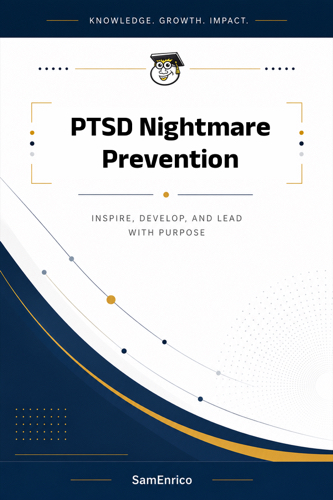
PTSD Nightmare Prevention
Grounding practice to reduce nightmare frequency.
Grounding practice to reduce nightmare frequency.
Formats
About this book
Free sample
Chapter 1: The 3 AM Spike--–- The bedroom is dark. The clock on your nightstand—if you still have one—reads somewhere between 2:47 and 3:15 AM. You are drenched in sweat, your heart is slamming against your ribs like a fist on a locked door, and your brain is screaming that something terrible is happening. You look around the room. The dresser is where it should be.
The curtains are still. The world is perfectly, maddeningly still. And yet your body refuses to believe it. You just woke from a dream that felt more real than the chair you are now staring at. It was not a weird dream about showing up to work without pants.
It was a nightmare—the kind that has a signature, a fingerprint, a recurring theme that you have come to dread. Perhaps you were back in the car, or the hallway, or the room you have spent years trying to forget. Perhaps the person who hurt you was standing over you again. Perhaps you were running, or falling, or drowning, or screaming with no sound coming out. And now you are awake, but your body has not gotten the memo.
Your muscles are tense. Your breath is shallow. You are afraid to close your eyes because you know—you know—that if you drift off again, the nightmare will pick up right where it left off, like a movie you did not buy a ticket for. If this sounds familiar, you are not broken. You are not weak.
And you are not alone. Nearly 80 percent of people with post-traumatic stress disorder experience clinically significant nightmares. For many, these nightmares are not just a symptom of PTSD. They are the symptom. They are the reason you dread the dark.
They are the reason you stay up until your eyelids feel like sandpaper, hoping that exhaustion will somehow protect you. It does not. In fact, it makes things worse. This chapter is called "The 3 AM Spike" because that is what happens inside your brain at that hour. It is not random.
It is not supernatural. It is neuroscience. And once you understand why your brain attacks you during sleep, you can…
This is the end of the free sample. Get the eBook to keep going. Buy now
Contents
- Chapter 1
- Chapter 2
- Chapter 3
- Chapter 4
- Chapter 5
- Chapter 6
- Chapter 7
- Chapter 8
- Chapter 9
- Chapter 10
- Chapter 11
- Chapter 12
Details
- Author
- Barrow Merrie
- Publisher
- SamEnrico
- Language
- English
- Genre
- Non-Fiction, Self-Help, PTSD
- Released
- 2026-06-09
- Pages (approx.)
- 151
- Available as
- eBook, Audiobook

Read better in the ZLOADR app
Your eBooks on your phone or tablet. Sign in with your SamEnrico account and start reading.
More by Barrow Merrie
 Half Smile PracticeBarrow Merrie$11.99
 Design Thinking for BudgetingBarrow Merrie$11.99
 Step One Acceptance WorkbookBarrow Merrie$11.99
 Validating Jealousy GuideBarrow Merrie$11.99
 Metabolic Damage RecoveryBarrow Merrie$11.99
 The Tactician: Bob Hawke and the Making of Australia's Rugby RevolutionBarrow Merrie$11.99
 Remote Work for ResearchersBarrow Merrie$11.99
 Catherine Correspondence LeadershipBarrow Merrie$11.99
 The Golden Pirouettes: How Black Choreographers Revolutionized BalletBarrow Merrie$11.99
 How to Produce Incense HoldersBarrow Merrie$11.99
 How to Become a Graves Registration SpecialistBarrow Merrie$11.99
 Service Providers Guide to General DentistryBarrow Merrie$11.99
You may also like
 Hong Kong Handover 1997Dunn Johnnie$11.99
 Zumba For Postnatal Recovery CourseNeal Christian$11.99
 Zumba for BeginnersLadner Nikia$11.99
 YouTube Comment Mining GuideHumes Pandora$12.99
 Worry Box MeditationCarlin Rudy$11.99
 Workplace Stress MeditationNguyen Lynn$11.99
 Workplace Stress and Sleep RepairHawley Ivory$11.99
 Workplace Perfectionism CureDelaney Jeffry$11.99
 Workplace Injustice Anger GuideWallen Isabelle$11.99
 Work Addiction and Burnout LinkGreenwood Ester$11.99
 Women in Yoga and WellnessBeattie Galina$11.99
 Women in Stand Up ComedyChun Evangeline$11.99