
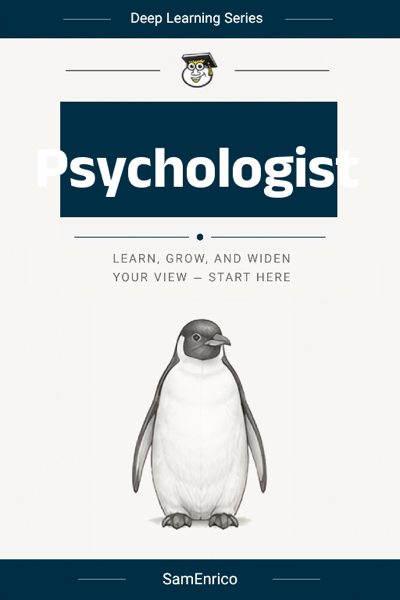
Non-FictionInformativeEducational
Psychologist eBook
A Coursebook on Psychologist
A Coursebook on Psychologist
Formats
Free sample
Chapter 1: The Leaking Diagnosis...–- Dr. Elena Vasquez had been a clinical psychologist for nineteen years when she made the mistake that nearly ended her career. The client was a forty-two-year-old accountant named David, referred by his primary care physician for "treatment-resistant depression." David had tried three different antidepressants, two courses of CBT, and even a brief trial of mindfulness-based stress reduction. Nothing worked. His chart was thick with failed interventions.
Elena, who prided herself on her clinical intuition, took one look at David's flat affect, his monotone voice, and his report of early morning awakening, and she thought: Dysthymia. Persistent depressive disorder. Probably with anxious distress. She wrote the diagnosis in under two minutes.Three months later, David was worse. Much worse.
He had stopped coming to sessions, then returned after his wife called Elena in tears. He was irritable, paranoid, convinced his colleagues were sabotaging him. Elena adjusted the diagnosis to major depressive disorder with psychotic features. She added an antipsychotic to his regimen, referred him to a psychiatrist, and felt a quiet satisfaction that she had caught the deterioration early.Six months after that, David was hospitalized for a cerebral hemorrhage. The cause was not psychiatric at all.
It was a slow-growing meningioma—a brain tumor—that had been pressing on his frontal lobe for years. The depression, the irritability, the paranoia? Neurological symptoms, not psychopathology. Elena had missed it because she never ordered a brain scan. She never asked about headaches, never checked for subtle cognitive decline, never paused to consider that a first-time depressive episode in a forty-two-year-old man with no family history might be something else entirely.David survived.
But he lost his job, his savings, and nearly his marriage. And Elena lost something too: the smug certainty that her clinical intuition was enough.The Problem with Intuition This chapter is not about brain tumors. It is about how psychologists think—and how thinking fails. Every clinician, no matter how experienced, carries a brain that evolved to take shortcuts. Those shortcuts, called heuristics, are the reason you can walk into a room and immediately sense the emotional temperature.
They are the reason you can listen to a client for five minutes and feel a hypothesis forming. They are also the reason you will make mistakes.The science of clinical judgment is sobering. Across dozens of studies, psychologists show what researchers call "overconfidence in clinical intuition." When compared to statistical prediction rules (actuarial formulas based on large datasets), clinical judgment is either equally accurate or, more often, less accurate—yet clinicians report being more confident in their own judgment than in any algorithm. This is known as the clinical versus actuarial debate, and the evidence is clear: formulas beat intuition, especially when the intuition belongs to an expert who has seen hundreds of similar cases.But here is the paradox that will echo through this entire book: the same intuition that fails in diagnosis is essential in relationship. You cannot build a therapeutic alliance through checklists.
You cannot repair a rupture with a statistical formula. The challenge of becoming a psychologist is learning when to trust your gut and when to strangle it.System 1 and System 2: A Map of the Mind To understand this paradox, we turn to Daniel Kahneman, the Nobel Prize-winning psychologist who spent a lifetime mapping the architecture of human judgment. His great contribution was the Two Systems model, and though you may have encountered it in popular psychology, most applications miss a crucial nuance.System 1 is fast, automatic, emotional, and intuitive. It is the voice that says, "This client seems anxious" before the client has said a word. It is the feeling of recognition when a pattern of symptoms matches a case you saw last month.
System 1 never stops running. It processes faces, voices, postures, and tones in milliseconds. It generates impressions, feelings, and inclinations. It is effortless—you cannot turn it off—and it is usually right enough to keep you alive.System 2 is slow, deliberate, analytical, and effortful. It is the voice that says, "Wait, let me check the diagnostic criteria." It is the act of opening the DSM, reviewing differentials, writing down a timeline of symptoms, and forcing yourself to consider alternative explanations.
System 2 is lazy. It tires quickly. It would rather agree with System 1 than do its own work. And it is the only thing standing between you and a missed brain tumor.Most psychology textbooks present System 1 as the villain. They point to Kahneman's famous examples: the conjunction fallacy (Linda the bank teller), the anchoring effect (unrelated numbers influencing judgments), and the availability heuristic (overestimating the probability of events you can easily recall).
And these are real. System 1 does produce systematic errors.But here is what those textbooks miss: System 1 is also the source of clinical brilliance.Consider the work of the late John Gottman, who could watch a married couple interact for fifteen minutes and predict, with over ninety percent accuracy, whether they would divorce within six years. Gottman was not running statistical regressions in real time. He was using System 1—trained, disciplined, exquisitely calibrated System 1. He had watched thousands of hours of videotaped interactions.
He had coded micro-expressions, voice tones, and body postures until the patterns became automatic. His intuition was not raw instinct; it was compressed expertise.The distinction, then, is not between good intuition and bad analysis. It is between untrained intuition (raw, biased, overconfident) and disciplined intuition (expertise that has been stress-tested by feedback and analysis). And it is between diagnostic contexts (where slow, deliberate, checklist-driven thinking is superior) and relational contexts (where rapid, intuitive responsiveness is not just helpful but necessary).The Diagnostic Context: When to Slow Down Diagnosis is pattern recognition. You listen to a client's story, you compare it to the prototypes stored in your memory, and you assign a label.
This is exactly the kind of task where System 1 leads you astray.The reason is statistical. The base rate of any given disorder in your practice is shaped by your referral stream, your specialty, and sheer chance. If you work in a trauma clinic, you will see PTSD everywhere—even in clients whose symptoms better fit a different diagnosis. If you just finished a difficult case of borderline personality disorder, you will be primed to see splitting and idealization in your next client, even if they are actually demonstrating a normal grief response.Kahneman identified dozens of heuristics that distort judgment. For psychologists, three are especially dangerous.The Availability Heuristic You judge an event as more likely if you can easily recall an instance of it.
If your last three clients had panic disorder, you will overestimate how many of your future clients will have panic disorder. If a colleague recently told you a horror story about a missed diagnosis of bipolar disorder, you will suddenly see bipolar disorder everywhere.The availability heuristic is why clinicians develop "pet diagnoses"—conditions they see in every client. It is why emergency room physicians miss heart attacks in young women (they recall heart attacks as occurring in older men). And it is why your clinical intuition about "what's common" is probably wrong.The fix is not to abolish memory. The fix is to…
This is the end of the free sample. Get the eBook to keep going. Buy now
About this book
Details
- Author
- Jewell Raelene
- Publisher
- SamEnrico
- Language
- English
- Genre
- Non-Fiction, Informative, Educational
- Released
- 2026-05-04
- Pages (approx.)
- 150
- Available as
- eBook, Audiobook

Read better in the ZLOADR app
Your eBooks on your phone or tablet. Sign in with your SamEnrico account and start reading.
More by Jewell Raelene
 Tinder Dating App AddictionJewell Raelene$11.99
 TCM Autoimmune ManagementJewell Raelene$11.99
 Sibling Respect GuideJewell Raelene$11.99
 HIIT Science WorkbookJewell Raelene$11.99
 The Iron Spires of Byzantium: A Lost Renaissance of Western EngineeringJewell Raelene$11.99
 How to Become a Hobbing-press OperatorJewell Raelene$11.99
 AI Payroll Processing for Small FirmsJewell Raelene$12.99
 How to Produce Charms and PendantsJewell Raelene$11.99
You may also like
 Hong Kong Handover 1997Dunn Johnnie$11.99
 Zumba For Postnatal Recovery CourseNeal Christian$11.99
 Zumba for BeginnersLadner Nikia$11.99
 YouTube Comment Mining GuideHumes Pandora$12.99
 Worry Box MeditationCarlin Rudy$11.99
 Workplace Stress MeditationNguyen Lynn$11.99
 Workplace Stress and Sleep RepairHawley Ivory$11.99
 Workplace Perfectionism CureDelaney Jeffry$11.99
 Workplace Injustice Anger GuideWallen Isabelle$11.99
 Work Addiction and Burnout LinkGreenwood Ester$11.99
 Women in Yoga and WellnessBeattie Galina$11.99
 Women in Stand Up ComedyChun Evangeline$11.99