
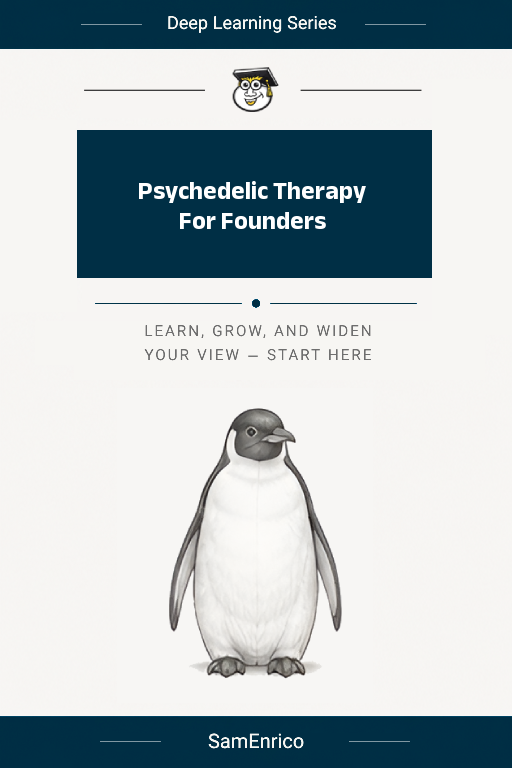
Psychedelic Therapy For Founders eBook
Research legal ketamine or psilocybin options for
by Lewis Toni
Research legal ketamine or psilocybin options for treatment resistant depression affecting startup leadership.
Formats
Free sample
Chapter 1: The Silent Epidemic...--The founder wakes up at 3:14 AM. This is not unusual. What is unusual is the absence of anxiety. For the past eighteen months, he has jolted awake with his heart pounding,脑海中 immediately auditing every metric that could have gone wrong overnight. But tonight, after closing a 5million Series Ajustsixhoursago,hefeelsnothing.Notrelief.Notjoy.Noteventhefamiliarhumofimpendingdoom.Heliesperfectlystillina5 million Series A just six hours ago, he feels nothing.
Not relief. Not joy. Not even the familiar hum of impending doom. He lies perfectly still in a 5million Series Ajustsixhoursago,hefeelsnothing.Notrelief.Notjoy.Noteventhefamiliarhumofimpendingdoom.Heliesperfectlystillina4,000 mattress, in a house his equity bought, next to a partner who has learned not to ask how he's doing because the answer is always a rehearsed "fine." He stares at the ceiling and thinks, quietly, without drama: I wouldn't mind if the plane went down on my next work trip.Then he gets up, showers, puts on the same uniform of dark jeans and a quarter-zip fleece that every other founder wears, and walks into a board meeting where everyone congratulates him on his resilience.This is the startup trap. And if you are reading this book, you already know exactly what it feels like.The Paradox at the Center of the Throne Silicon Valley and its global outposts have perfected a particular kind of mythology: the founder as hero, the founder as martyr, the founder as someone who burns so brightly that the rest of us should simply be grateful to witness the fire.
Venture capitalists fund narratives as much as they fund companies, and the most seductive narrative is the one where suffering is repackaged as virtue. The founder who works through a fever. The founder who misses their child's birthday for a demo day. The founder whose marriage collapses under the weight of a pivot, then raises a down round anyway and calls it "resilience."But here is the truth that no one tells you in the pitch deck: the same neural architecture that makes you a great founder—the hypervigilance, the pattern recognition, the tolerance for chaos, the ability to hold ten contradictory variables in your head at once—is also the architecture that, over time, will try to kill you.This is not a metaphor. This is neurobiology.The startup life is not merely stressful.
It is a prolonged, low-grade traumatic environment for the human brain. Chronic cortisol elevation, the kind that comes from years of fundraising sprints, product launch cycles, and the ambient fear of running out of money, does something specific to the dopamine system. It downregulates your dopamine receptors. In plain English: your brain stops being able to feel pleasure. Not just reduced pleasure.
The actual, biological inability to experience joy, excitement, or even relief. This is called anhedonia, and it is the hallmark of treatment-resistant depression in high-performing individuals.You are not broken because you are weak. You are broken because you have been strong for too long.The Mask That Raises Money There is a particular cruelty to high-functioning depression, which is the kind that founders almost always have. Low-functioning depression keeps you in bed. It makes you unable to shower, unable to answer emails, unable to show up.
High-functioning depression—the kind that masks itself as productivity—lets you close the round, hire the team, give the keynote, and then go home and stare at a wall for three hours before doing it all again the next day.Your co-founders do not see it. Your investors definitely do not see it. Your spouse might suspect something, but you have become so skilled at performing "fine" that even you believe the performance some days. The therapist you see twice a month—when you can fit it in—says you're making progress because you show up on time and you're articulate. But you have learned to perform for the therapist too.This is the mask.
And the mask is killing you slowly.Consider Marcus, a Saa S founder I worked with (his name and identifying details changed, as they will be throughout this book). Marcus built a company from two people in a coffee shop to two hundred employees across four countries. He raised a Series B at a valuation that made his father finally proud. He was featured on a "30 Under 30" list. He had a Peloton in his home office and a therapist on retainer.
By every external metric, Marcus had won.Internally, Marcus had stopped feeling anything at all.He described it to me as "watching my life through a pane of frosted glass." He could see that things were happening—his daughter took her first steps, his company launched a feature that would define its next decade, his co-founder cried with gratitude at a holiday party—but he couldn't feel any of it. Not the joy. Not the pride. Not even the frustration. Just a flat, gray, endless plateau of performance without presence.His therapist told him he was "managing well" because his PHQ-9 scores had improved slightly on a new SSRI.
Marcus didn't tell his therapist that he had started to imagine, with increasing specificity, what it would feel like to drive his car into a concrete pillar at seventy miles per hour. Not because he wanted to die, necessarily. But because the idea of feeling something—anything—was more attractive than another day of the gray.Six months later, Marcus attempted suicide the night before a board meeting. He survived. He spent three weeks in a psychiatric hospital.
And when he got out, he told me: "I was the highest-performing depressive my team had ever seen. And none of them knew. Not one."The Neurobiology of the Founder's Brain Let me explain what was happening inside Marcus's head, because understanding the biology is the first step toward forgiving yourself for the symptoms.The human brain evolved in environments of acute stress: predators, famines, tribal conflicts. In those environments, cortisol—the primary stress hormone—served a useful purpose. It sharpened attention, mobilized energy, and kept you alive long enough to escape the saber-toothed tiger.
The problem is that the founder's brain is not experiencing acute stress. It is experiencing chronic stress. The saber-toothed tiger never goes away. It just changes shape: the term sheet that might fall through, the key hire who might leave, the competitor who just raised at a higher valuation.Chronic cortisol exposure does three specific things to the brain that matter for founders:First, it shrinks the hippocampus. The hippocampus is the region responsible for learning, memory, and emotional regulation.
A smaller hippocampus means you are more reactive, less flexible, and more likely to get stuck in loops of rumination—the kind where you replay the same mistake or the same investor rejection over and over, as if solving it through sheer repetition.Second, it enlarges the amygdala. The amygdala is your brain's smoke detector. A larger, more sensitive amygdala means you perceive threat everywhere. A slightly negative email from an investor becomes a potential bridge-burning catastrophe. A missed product deadline becomes evidence that you are a fraud.
A co-founder's neutral comment becomes a sign of impending betrayal.Third, it downregulates dopamine receptors. Dopamine is not just the "pleasure…
This is the end of the free sample. Get the eBook to keep going. Buy now
About this book
Details
- Author
- Lewis Toni
- Publisher
- SamEnrico
- Language
- English
- Genre
- Non-Fiction, Mental Wealth
- Released
- 2026-06-01
- Pages (approx.)
- 142
- Available as
- eBook, Audiobook

Read better in the ZLOADR app
Your eBooks on your phone or tablet. Sign in with your SamEnrico account and start reading.
More by Lewis Toni
 Digital Boundary WorkbookLewis Toni$11.99
 Mindfulness Meditation in Everyday LifeLewis Toni$11.99
 Meditation for Evening Wind DownLewis Toni$11.99
 The Student Burnout PreventionLewis Toni$11.99
 Bedtime Body ScanLewis Toni$11.99
 Metta For BossesLewis Toni$11.99
 Frost Belt Talent LossLewis Toni$11.99
 The Spy Who Defied an Empire: James Armistead Lafayette’s Double LifeLewis Toni$11.99
 The Architect of the Cosmos: The Lost Genius of Byzantine AstronomyLewis Toni$11.99
 The Fall of the Great Wall: The Manchu Storm (1644)Lewis Toni$11.99
 Tiger Global African Exit GuideLewis Toni$12.99
 Your First Sales Script in 30 DaysLewis Toni$12.99
You may also like
 Hong Kong Handover 1997Dunn Johnnie$11.99
 Zumba For Postnatal Recovery CourseNeal Christian$11.99
 Zumba for BeginnersLadner Nikia$11.99
 YouTube Comment Mining GuideHumes Pandora$12.99
 Worry Box MeditationCarlin Rudy$11.99
 Workplace Stress MeditationNguyen Lynn$11.99
 Workplace Stress and Sleep RepairHawley Ivory$11.99
 Workplace Perfectionism CureDelaney Jeffry$11.99
 Workplace Injustice Anger GuideWallen Isabelle$11.99
 Work Addiction and Burnout LinkGreenwood Ester$11.99
 Women in Yoga and WellnessBeattie Galina$11.99
 Women in Stand Up ComedyChun Evangeline$11.99