
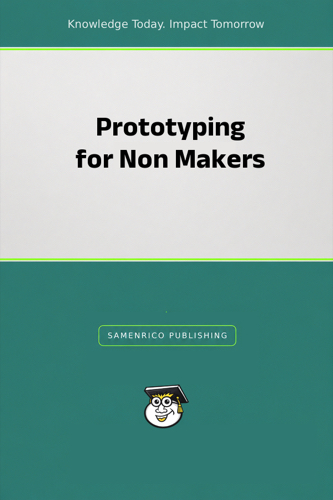
Non-FictionSelf-HelpPrototyping
Prototyping for Non Makers eBook
Use paper, spreadsheets, or role play to test idea
by Ellison Eden
Use paper, spreadsheets, or role play to test ideas cheaply.
Formats
Free sample
Chapter 1: The Pinocchio Principle–- The first time I watched a startup burn $80,000 on a prototype that nobody wanted, I was sitting in a We Work conference room in Austin, Texas. The founder, a brilliant former engineer named Marcus, had just clicked through the final screen of his fully functional mobile app. He looked up with the exhausted pride of someone who had just given birth to a digital baby. "It's done," he said. "Eight months.
Two developers. One designer. And eighty grand of my father-in-law's money."I asked him the only question that mattered: "Have you shown it to a customer?"Marcus blinked. "Well, no. We wanted it to be perfect first."Three weeks later, he showed it to seven potential customers.
Six of them said, "That's not what I meant." The seventh said, "I already use something else." The app never launched. Marcus went back to engineering. His father-in-law stopped returning his calls.Then there is Sarah. I met her at the same co-working space six months later. She had an idea for a dog-walking service that matched owners with local walkers based on personality, not just proximity.
She had zero coding skills, zero design training, and approximately $400 in her business account. "How are you going to build it?" I asked."I'm not," she said. "I'm going to fake it."She printed five sheets of paper, each with a different screen drawn in Sharpie. She invited three dog owners to a coffee shop. She played the "human computer," flipping pages as they tapped.
She learned in two hours that her pricing model confused everyone and that nobody cared about personality matching. They just wanted someone who showed up on time.She changed her entire approach before spending a dollar on development. Eighteen months later, she sold that business for $1.2 million.This book is for the Sarahs of the world. And it is for the Marcuses, so they never make that mistake again.The Lie We Tell Ourselves About Prototyping Here is a lie that has destroyed more good ideas than bad execution ever will: You cannot test an idea until you build something real.This lie is seductive because it feels responsible. It feels like diligence.
"We need to do it right. We need to be thorough. We need a working prototype before we show anyone." But underneath that responsible language is something uglier: fear. Fear of looking stupid. Fear of showing something ugly.
Fear of hearing "no."The truth is the exact opposite. The more you build before testing, the more you are guaranteed to build the wrong thing.Why? Because every hour you spend coding, wiring, welding, or designing is an hour you are falling in love with your own assumptions. You are not testing whether the idea works. You are testing whether you can execute it.
And those are two completely different questions.I have seen this pattern hundreds of times across startups, corporate innovation labs, and even non-profits. The pattern is always the same:Someone has an idea.They assume they need a "real" prototype to test it.They spend weeks or months building.They show it to users.The users say "no" (politely or otherwise).The team feels devastated and confused.The confusion is the saddest part. Because the team genuinely believed they were doing everything right. They followed the playbook. They built something.
Why didn't it work?Here is why: They confused fidelity with validity. A high-fidelity prototype (something that looks and feels real) is not more valid than a low-fidelity prototype. In fact, it is often less valid, because users are too polite to criticize something that looks finished. They will say "It's great!" and then never use it again.What you need is not a miniature version of your product. What you need is a question-answering machine.
And that machine can be built with paper, spreadsheets, and your own two feet.The Pinocchio Principle: Why Fake Wood Works Better Than Real Wood Geppetto, the woodcarver in Carlo Collodi's The Adventures of Pinocchio, did not carve a perfect boy. He carved a puppet. A puppet is obviously fake. It has strings. Its movements are jerky.
Its face is painted wood. Nobody would mistake it for a real child.But here is the genius of Geppetto: He did not need a real boy to start learning. He needed something that could pretend to be a boy long enough to stumble, fall, ask questions, and make mistakes. The puppet was not the final product. It was the learning vehicle.
The puppet could fail cheaply. The puppet could be repaired with glue. And when the puppet finally learned enough to become real, all those failures were already behind him.That is the Pinocchio Principle: Your prototype only needs to seem real enough to get genuine feedback. It does not need to be real. It just needs to be real enough.The moment you accept this principle, everything changes.
You stop asking "How do I build this?" and start asking "What is the cheapest, fastest, ugliest thing I can make that will answer my question?"This is not laziness. This is strategic minimalism. It is the opposite of the "move fast and break things" nonsense that got so many startups in trouble. Moving fast is not the goal. Learning fast is the goal.
And you learn fastest when your prototypes are cheap enough to throw away and ugly enough that users feel comfortable telling you the truth.Let me give you a concrete example. A few years ago, I worked with a team building a new kind of fitness app. They wanted to use AI to generate personalized workout plans based on how you felt each morning. Their plan was to spend six months building a machine learning model, integrating with wearables, and designing a beautiful interface.I asked them: "What is the single riskiest assumption you are making?"They said: "That people will actually answer a daily 'How do you feel?' question."So I said: "Then test that assumption tomorrow. For zero dollars."They looked at me like I had three heads.
But they did it. They created a simple Google Form with one question: "How do you feel today? (1-10)" They sent it to ten friends every morning for a week. After seven days, they had data. Only 40% of people answered on any given day.
By day four, that number dropped to 20%.They killed the AI idea before writing a single line of code. They saved six months and hundreds of thousands of dollars. And they learned something they could never have learned from a high-fidelity prototype: the core behavior they were betting on did not exist.That is the power of the Pinocchio Principle. It lets you kill bad ideas while they are still cheap.The 1-10-100 Rule (The Only Math You Need)Let me give you a simple framework that will guide every prototyping decision you ever make. I call it the 1-10-100 Rule, and it is the only math you need to know.Investment Prototype Type Time to Answer Risk of Being Wrong$1Paper, role play, spreadsheet1 day Very low$10Clickable mockup, digital proxy1 week Medium$100+Coded prototype, hardware, custom build1 month+Very high Here is what…
This is the end of the free sample. Get the eBook to keep going. Buy now
About this book
Details
- Author
- Ellison Eden
- Publisher
- SamEnrico
- Language
- English
- Genre
- Non-Fiction, Self-Help, Prototyping
- Released
- 2026-06-08
- Pages (approx.)
- 149
- Available as
- eBook, Audiobook

Read better in the ZLOADR app
Your eBooks on your phone or tablet. Sign in with your SamEnrico account and start reading.
More by Ellison Eden
 Airline Gate Agent Stress GuideEllison Eden$11.99
 Russian Call Center FraudEllison Eden$11.99
 Anxiety Driven Anger at WorkEllison Eden$11.99
 Self Hypnosis for Peak PerformanceEllison Eden$11.99
 CPR for Pregnant WomenEllison Eden$11.99
 Senior Pet Therapy EsteemEllison Eden$11.99
 Goal Setting for ManagersEllison Eden$11.99
 The Bard’s Echo: How a Forgotten Actor Revived Shakespeare in AmericaEllison Eden$11.99
 Ganga's Descent: The River That Swallowed the PoisonEllison Eden$11.99
 Maguey: Agave AmericanaEllison Eden$11.99
 How to Produce Pressure Cookers and CannersEllison Eden$11.99
 How to Start a Plants for Planting or Ornamental Purposes Business (Beginners Guide)Ellison Eden$11.99
You may also like
 Hong Kong Handover 1997Dunn Johnnie$11.99
 Zumba For Postnatal Recovery CourseNeal Christian$11.99
 Zumba for BeginnersLadner Nikia$11.99
 YouTube Comment Mining GuideHumes Pandora$12.99
 Worry Box MeditationCarlin Rudy$11.99
 Workplace Stress MeditationNguyen Lynn$11.99
 Workplace Stress and Sleep RepairHawley Ivory$11.99
 Workplace Perfectionism CureDelaney Jeffry$11.99
 Workplace Injustice Anger GuideWallen Isabelle$11.99
 Work Addiction and Burnout LinkGreenwood Ester$11.99
 Women in Yoga and WellnessBeattie Galina$11.99
 Women in Stand Up ComedyChun Evangeline$11.99