
Non-FictionSide Hustle ArchitectPrototypes
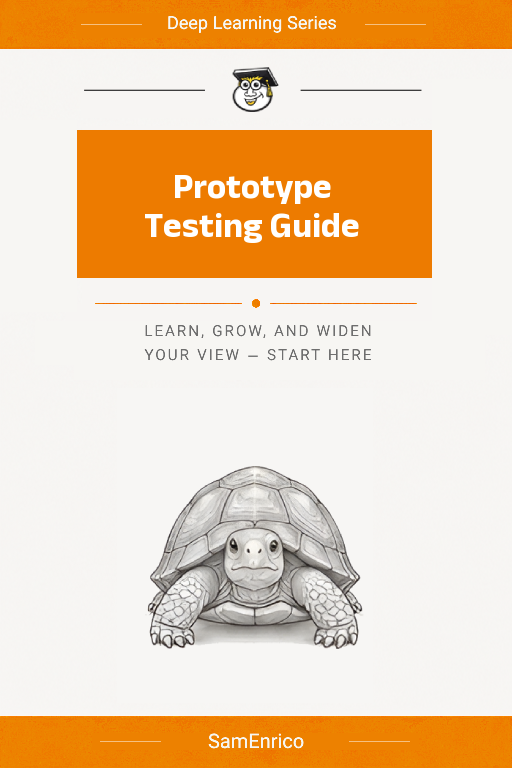
Prototype Testing Guide eBook
Tests wireframes and interactive prototypes for 60
Tests wireframes and interactive prototypes for 60-100 per test, providing feedback on early-stage designs before coding begins.
Formats
Free sample
Chapter 1: The Million-Dollar Eraser--–- The most expensive tool in any software company is not a designer’s Sketch license, a developer’s standing desk, or a project manager’s Jira subscription. It is the eraser. Not the one attached to a pencil. The one attached to a launch date. The one that gets picked up after three months of coding, two weeks of QA, and one devastating customer support call that begins with, “I’m sorry, but your product doesn’t do what I need it to do.”I have watched this scene play out more times than I can count.
A team gathers around a conference table. Someone pulls up a prototype that has already been handed off to engineering. Someone else says, “We should probably test this first.” A third person says, “We don’t have time.” And then they build it anyway. And then they launch it anyway. And then they spend the next six weeks patching, hotfixing, apologizing, and erasing.Here is what they do not understand: testing does not add time to the schedule.
It subtracts time. Because every hour you spend testing a wireframe saves ten hours you would have spent rewriting code. Every dollar you spend on a participant saves a hundred dollars in engineering rework. The eraser is not the tool you reach for after you make a mistake. The eraser is the test session you run before you make the mistake in the first place.This book exists because that math is also an invitation.
You do not need a Ph D in human-computer interaction. You do not need a six-figure research budget. You do not need permission from a committee. You need sixty to one hundred dollars, a wireframe or interactive prototype, and the willingness to watch someone struggle with your design while you sit silently and take notes. That is it.
That is the million-dollar eraser.Welcome to the Prototype Testing Guide.The Geometry of Failure: Why Later Is Always More Expensive Let me introduce you to a concept that will follow us through every chapter of this book. It is called the cost of change curve, and it is the single most important economic principle in software development. The idea is simple: the later you discover a problem, the more expensive it is to fix. But simple ideas often hide devastating consequences.Imagine a line that starts at the left edge of a graph and moves right. The left side represents the earliest moments of a project: brainstorming, whiteboarding, sketching on napkins.
The right side represents the latest moments: production, deployment, customer support. Now imagine a line that starts flat and then curves upward, slowly at first and then exponentially, like a hockey stick lying on its side. That is the cost of change curve.In the brainstorming phase, changing a requirement costs nothing. You cross out a word and write another word. In the wireframe phase, changing a flow costs an hour.
You drag some boxes around in Figma or Balsamiq. In the high-fidelity mockup phase, changing a visual hierarchy costs half a day. You update a few artboards and regenerate a link. In the coded prototype phase, changing a behavior costs two days. You rewrite some Java Script, retest the interaction, and update the documentation.
In the production phase, changing a feature costs two weeks. You write a spec, get approval, schedule the work, code, test, deploy, and monitor.Here is the specific math that drives this book. Fixing a flow issue in a wireframe typically costs between sixty and one hundred dollars in cash. That covers one test session with a participant, your time to moderate or analyze, and a quick iteration on the wireframe. Fixing that same issue after it has been coded, tested, and deployed typically costs between three thousand and fifteen thousand dollars, depending on team size, complexity, and how many customers have already complained.But the real cost is not the money.
The real cost is what you cannot do while you are fixing yesterday’s mistake. Every hour an engineer spends patching a preventable design flaw is an hour they are not spending on the feature that will actually differentiate your product. Every sprint consumed by rework is a sprint where your competitor pulls ahead. Every time you ship something broken because you were afraid to test it, you teach your users a lesson they will not forget.I once worked with a team that spent nine months building a data visualization dashboard. Nine months.
The design had been reviewed by executives. The code had been reviewed by senior engineers. The product had been tested by QA. And then it launched, and within forty-eight hours, the support queue filled with the same complaint: “I cannot figure out how to filter the data by date range.”The filter was there. It was a dropdown menu in the top right corner of the screen.
But in every single test the team had not run, users had looked for the filter next to the chart, not next to the title. The team had assumed that because the dropdown was visible, it was findable. They were wrong. The fix took two days. The damage to customer trust took months to repair.
And the entire disaster could have been avoided with a single sixty-dollar test on a wireframe that showed a user trying to find a filter.The Sixty-to-One-Hundred Dollar Window: Why This Budget Is Not Arbitrary If the cost of change curve explains why testing early is valuable, the sixty-to-one-hundred-dollar budget explains how to do it without a research department. This number is not pulled from thin air. It emerges from three specific conditions that define the current product development landscape.First, the supply of test participants has been commoditized. Platforms like User Testing, User Interviews, Respondent, and even Craigslist have created a marketplace where you can recruit a screened, vetted participant who matches your target persona for between sixty and one hundred dollars. You do not need to know anyone.
You do not need to offer a personal favor. You need a credit card and fifteen minutes to write a screener.Second, the demand for testing has become urgent enough that sixty to one hundred dollars is below most approval thresholds. If you are an individual contributor or a team lead, you can likely spend this amount without asking for permission. It is less than the cost of a team lunch. It is less than the cost of the design software you already pay for monthly.
It is an amount that fits on a corporate credit card without raising eyebrows.Third, the learning rate at this price point is optimal. At sixty to one hundred dollars per test, you can run a test every week. Five tests cost five hundred dollars. Ten tests cost one thousand dollars. After ten tests, you have observed forty to fifty participants interacting with your prototypes.
You have seen patterns emerge. You have learned what works and what does not. You have built a habit. And habits are where expertise lives.However, we need to be precise about what this budget includes and what it does not. Throughout…
This is the end of the free sample. Get the eBook to keep going. Buy now
About this book
Details
- Author
- Ireland Kristel
- Publisher
- SamEnrico
- Language
- English
- Genre
- Non-Fiction, Side Hustle Architect, Prototypes
- Released
- 2026-05-29
- Pages (approx.)
- 138
- Available as
- eBook, Audiobook

Read better in the ZLOADR app
Your eBooks on your phone or tablet. Sign in with your SamEnrico account and start reading.
More by Ireland Kristel
 Jet Lag Prevention GuideIreland Kristel$11.99
 The Opioid Withdrawal Medical GuideIreland Kristel$11.99
 Cree Summer Different VoiceIreland Kristel$11.99
 Navigating Family Difficult TalksIreland Kristel$11.99
 People Pleasing Teen RecoveryIreland Kristel$11.99
 The Sky Is Not the Limit: The Rise of Base Jumping in AsiaIreland Kristel$11.99
 CAC Tools ShowdownIreland Kristel$12.99
 First Heart Transplant: Medical MiracleIreland Kristel$11.99
 How to Start a Bars Made of Copper Business (Beginners Guide)Ireland Kristel$11.99
 Understanding X Chromosome, Monosomy Xp22 PterIreland Kristel$17.99
You may also like
 Hong Kong Handover 1997Dunn Johnnie$11.99
 Zumba For Postnatal Recovery CourseNeal Christian$11.99
 Zumba for BeginnersLadner Nikia$11.99
 YouTube Comment Mining GuideHumes Pandora$12.99
 Worry Box MeditationCarlin Rudy$11.99
 Workplace Stress MeditationNguyen Lynn$11.99
 Workplace Stress and Sleep RepairHawley Ivory$11.99
 Workplace Perfectionism CureDelaney Jeffry$11.99
 Workplace Injustice Anger GuideWallen Isabelle$11.99
 Work Addiction and Burnout LinkGreenwood Ester$11.99
 Women in Yoga and WellnessBeattie Galina$11.99
 Women in Stand Up ComedyChun Evangeline$11.99