
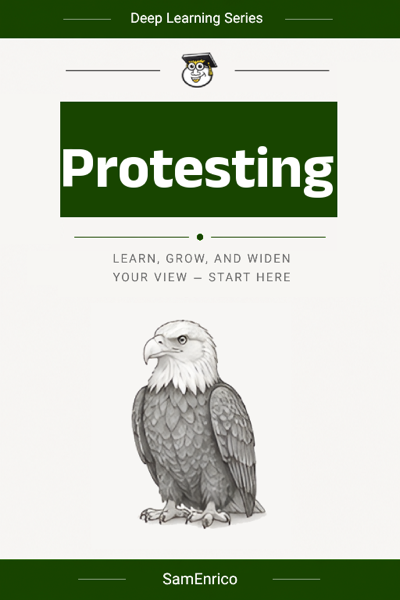
Non-FictionInformativeEducational
Protesting eBook
A Coursebook on Protesting
by Stepp Gavin
A Coursebook on Protesting
Formats
Free sample
Chapter 1: The Conversion Moment...--Protest is not an outburst. It is not the moment when a crowd loses its mind and decides, collectively, to break things. That image—the mob, foaming and irrational—is the single most effective piece of propaganda ever invented by the powerful. Because if protest is madness, then nothing protesters say needs to be heard. If protest is spontaneous combustion, then no one is responsible for starting the fire except the arsonists themselves.
And if protest is just anger looking for an excuse, then the only rational response is to contain it, criminalize it, and wait for it to burn itself out.None of this is true. Not a single word of it.Protest follows a predictable, almost mechanical logic. It has preconditions, structures, and a life cycle that can be studied, understood, and—most importantly—deliberately initiated. The difference between a riot and a revolution is not the level of anger. It is the presence or absence of a single, invisible transformation.
That transformation is called conversion. And until you understand it, you will never understand why some grievances die in silence while others bring down governments.This chapter refines the myth of spontaneity. It does not simply dismiss it. Instead, it distinguishes between two very different kinds of spontaneity. The first is the spontaneous emergence of large-scale protest movements from deep structural conditions—that is not a myth at all.
The second is tactical spontaneity: a crowd deciding, in the moment, to block a highway or smash a window without planning. That kind of spontaneity is real, common, and often strategically disastrous. The difference between the two is the difference between a movement that changes laws and a crowd that gets tear-gassed and forgotten by morning.Understanding protest begins with understanding the moment a person stops being a private citizen with private grievances and becomes a public actor demanding public change. That moment is conversion. And it is the most fragile, most powerful, most poorly understood event in the entire lifecycle of resistance.The Grievance Trap Let us begin with a paradox.
The world is full of suffering. Every day, millions of people experience injustice: eviction, wage theft, police violence, environmental poisoning, discrimination, neglect. And yet, for every thousand people who suffer, perhaps one joins a protest. For every ten thousand who suffer, perhaps one helps start a movement.Why? The obvious answer—that people are afraid—is true but incomplete.
Fear explains passivity, but it does not explain why some people overcome fear while most do not. The deeper answer is that suffering alone is not enough. Anger alone is not enough. Even moral outrage alone is not enough.This is the Grievance Trap. It is the seductive but fatal mistake of assuming that if you simply show people how badly they are suffering, they will rise up.
They will not. Suffering can just as easily produce despair, withdrawal, substance abuse, domestic violence, or suicide as it can produce protest. The Grievance Trap is the reason why movements that lead with statistics—"Look at this chart! Look at this number! Look at how many people are dying!"—almost always fail to mobilize more than the already converted.The trap works like this.
When a person experiences a private grievance—a landlord raises the rent unfairly, a boss steals wages, a cop makes a racist remark—the brain processes it as an individual problem. The victim asks: What did I do wrong? How can I avoid this next time? Should I have been more careful? These questions lead nowhere.
They convert suffering into shame.Protest requires a different cognitive operation. It requires the victim to ask a different set of questions: Who benefits from this? What system produces this pattern? Who else is experiencing the same thing? These questions convert suffering into politics.
They move the locus of explanation from the self to the structure. And that move—from "what did I do?" to "what is being done to us?"—is the psychological heart of conversion.John Lofland, the sociologist who wrote the foundational text on protest movements, called this process "bridging." A person must bridge their personal troubles to public issues. Without the bridge, the grievance stays private. With the bridge, it becomes the seed of collective action.The Three Preconditions Conversion does not happen in a vacuum. Lofland identified three preconditions that must exist for a protest movement to emerge.
These are not sufficient conditions—they do not guarantee protest—but they are necessary. Without all three, movement is impossible.The first is structural conduciveness. This is a dry sociological term for a simple idea: the system must allow dissent. Not encourage it, not protect it, but allow it. A protest movement cannot emerge in a society where every gathering is immediately met with mass execution.
North Korea does not have protest movements because the cost of the first meeting is death. The United States, for all its carceral violence, has structural conduciveness: you can gather, you can chant, you can hold a sign, and you will probably not be shot. (Probably. The word matters.) Conduciveness is the permission slip of protest. Without it, the game ends before it begins.The second is structural strain.
This is the fancy term for widespread suffering. Economic depression, housing crisis, police killing, legal rollback, environmental disaster—these are the cracks in the system where grievances pool. But note: strain alone does nothing. The United States had structural strain during the 2008 financial crisis, when millions lost their homes and jobs. And yet, the protest movement that emerged—Occupy Wall Street—was smaller, shorter, and less effective than the structural strain seemed to demand.
Why? Because the third precondition was only partially met.The third is generalized belief. This is the shared story about who is to blame. A generalized belief takes raw suffering and gives it a plot. It names the villain.
It offers a simple, memorable narrative: "The bankers crashed the economy and we paid for it." "The police protect property, not people." "The rich stole our future." Without a generalized belief, strain produces only confusion and atomized anger. With it, strain becomes fuel.Occupy Wall Street had a generalized belief—the 1% versus the 99%—but it arrived late, after the movement had already begun to fracture. Movements that develop their generalized belief before they launch tend to last longer. Movements that search for their villain in real time tend to dissolve into arguments.The Conversion Moment Imagine a person named Maria. Maria works two jobs.
Her rent just increased by forty percent. Her landlord ignored her last three repair requests. Last week, her ceiling collapsed. She is angry. She is exhausted.
She is one bad day away from screaming at a stranger.Right now, Maria has a grievance. She does not have a protest movement.Now imagine that Maria's coworker, Jamal, tells her about a tenant union. He says: "Your landlord did the same thing to me. And to Elena on the third floor. And to the family in 4B.
There are forty of us. We're meeting Thursday. We're going to demand repairs and rent control. If he says no, we strike."Something shifts in Maria's…
This is the end of the free sample. Get the eBook to keep going. Buy now
About this book
Details
- Author
- Stepp Gavin
- Publisher
- SamEnrico
- Language
- English
- Genre
- Non-Fiction, Informative, Educational
- Released
- 2026-05-04
- Pages (approx.)
- 149
- Available as
- eBook, Audiobook

Read better in the ZLOADR app
Your eBooks on your phone or tablet. Sign in with your SamEnrico account and start reading.
More by Stepp Gavin
 Oceanside Sleep MeditationStepp Gavin$11.99
 Runway ML Video Workflow GuideStepp Gavin$11.99
 Same Sex Relationship Self EsteemStepp Gavin$11.99
 OKRs for Writing a BookStepp Gavin$11.99
 Emotional Healing After AlcoholismStepp Gavin$11.99
 The Oracle of Delphi: Wisdom at the Heart of GreeceStepp Gavin$11.99
 Ultimate Handbook Guide to Tianchang : (China) Travel GuideStepp Gavin$11.99
 Vertical Farming Technology GuideStepp Gavin$12.99
 China-US Tariff Reset ManualStepp Gavin$12.99
 Understanding Idiopathic Dilatation of The Pulmonary ArteryStepp Gavin$17.99
You may also like
 Hong Kong Handover 1997Dunn Johnnie$11.99
 Zumba For Postnatal Recovery CourseNeal Christian$11.99
 Zumba for BeginnersLadner Nikia$11.99
 YouTube Comment Mining GuideHumes Pandora$12.99
 Worry Box MeditationCarlin Rudy$11.99
 Workplace Stress MeditationNguyen Lynn$11.99
 Workplace Stress and Sleep RepairHawley Ivory$11.99
 Workplace Perfectionism CureDelaney Jeffry$11.99
 Workplace Injustice Anger GuideWallen Isabelle$11.99
 Work Addiction and Burnout LinkGreenwood Ester$11.99
 Women in Yoga and WellnessBeattie Galina$11.99
 Women in Stand Up ComedyChun Evangeline$11.99