

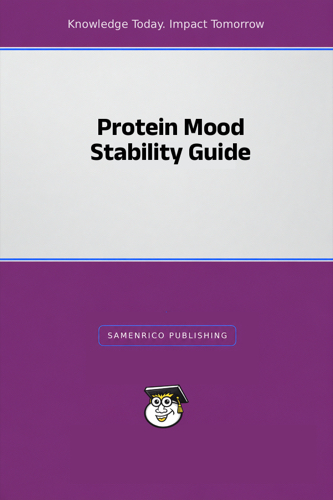
Protein Mood Stability Guide eBook
Uses amino acids for neurotransmitter production.
by Edge Cinda
Uses amino acids for neurotransmitter production.
Formats
Free sample
Chapter 1: The 3 PM Betrayal--–- The first time my brain broke, I was standing in the freezer aisle of a grocery store, staring at a bag of frozen peas like it held the meaning of life.Not because I was having a poetic moment. Because I couldn't remember why I had walked into the store. I had driven there on autopilot, parked the car, walked through the automatic doors, and then—nothing. The previous thirty minutes were a fog. My hands were shaking.
My heart was pounding like I had just run a sprint, but I had only walked two hundred feet on linoleum. A bead of sweat rolled down my ribcage despite the fact that the freezer section was thirty-four degrees Fahrenheit.I was thirty-one years old. I was not sick. I had no history of mental illness. I ate what I thought was a healthy diet—salads, grilled chicken, quinoa, the occasional sweet potato.
I exercised four times a week. I meditated, for God's sake. I had a meditation app with a two-hundred-day streak. And yet here I was, in the middle of a Tuesday afternoon, experiencing what I would later learn was not a panic attack (though it felt like one) but something far more insidious: a complete metabolic crash of my neurotransmitter systems, triggered by nothing more dramatic than the lunch I had eaten three hours earlier.That lunch was a masterpiece of conventional nutritional wisdom. A large chicken breast—lean protein, no skin.
A cup of quinoa—complex carbohydrate, high in fiber. A handful of raw almonds—healthy fats. A side of steamed broccoli—antioxidants. By every metric of every diet book I had ever read, this was a perfect meal. It was low in saturated fat.
It was high in protein. It had no refined sugar. It was, I believed, exactly what a healthy, productive, mentally stable person should eat.But my brain disagreed. Violently.By 2:30 PM, I had started to feel "off." A vague sense of unease, like I had forgotten something important. By 2:45, my thoughts had become sticky and repetitive—the same anxious loop playing over and over: Did I send that email?
Did I lock the front door? Did I say something wrong in the meeting? By 3:00, I was standing in the freezer aisle, unable to remember my own errand, convinced that something was deeply, fundamentally wrong with me.The frozen peas, I would later realize, were a red herring. I didn't need peas. I needed tryptophan.The Great Nutritional Lie Let me tell you something that no diet book, no wellness influencer, and surprisingly few doctors will tell you: The conventional wisdom about "healthy eating" is silently making millions of people anxious, depressed, and irritable.
And it's not because you're weak. It's not because you're not meditating enough. It's not because you need more "gratitude practice" or "mindfulness" or "resilience training."It's because your brain runs on a specific set of molecular building blocks called amino acids, and the way most people eat—even the way most health-conscious people eat—is systematically starving their brains of the precise ones required to feel calm, focused, and stable.This is not opinion. This is biochemistry.Your brain is the most metabolically expensive organ in your body. It accounts for only two percent of your body weight but consumes twenty percent of your energy.
Every thought you have, every emotion you feel, every decision you make is the product of chemical reactions happening at lightning speed across a hundred billion neurons. And those reactions don't run on willpower. They don't run on positive thinking. They run on raw materials—specifically, on a class of molecules called neurotransmitters.The four most important neurotransmitters for mood are:Serotonin – the "calm and content" chemical. Regulates mood, sleep, appetite, and impulse control.Dopamine – the "drive and reward" chemical.
Governs motivation, focus, pleasure, and initiative.GABA – the "brake pedal" chemical. Inhibits overexcitation, reduces anxiety, and promotes relaxation.Endorphins – the "pain relief and pleasure" chemicals. Buffer physical and emotional distress.Here's what nobody told me, and what nobody tells the forty million Americans on antidepressants or the sixty million with diagnosed anxiety disorders: You cannot make these neurotransmitters out of thin air. Every single one of them must be built, molecule by molecule, from amino acids that come exclusively from the protein you eat.Serotonin comes from tryptophan. Dopamine and norepinephrine come from tyrosine.
GABA comes from glutamine (and requires specific co-factors to convert properly). Endorphins come from a cascade that begins with the amino acid phenylalanine.If you don't eat enough of the right amino acids at the right time and in the right combination with other nutrients, your neurotransmitter factories slow down, sputter, and eventually shut off. And when that happens, you don't just feel "a little off." You feel anxious, depressed, foggy, irritable, and exhausted. You crave sugar and caffeine and alcohol—not because you lack willpower, but because your brain is desperately searching for any external source of the molecules it cannot produce internally.The frozen peas, by the way, were irrelevant. What I needed was tryptophan.
But the chicken breast I had eaten for lunch—the "perfect" lean protein—was so packed with competing amino acids (leucine, isoleucine, valine, tyrosine, phenylalanine) that the tryptophan never stood a chance of reaching my brain. It was crowded out at the blood-brain barrier, left to circulate uselessly in my bloodstream until it was metabolized by my liver or excreted in my urine. I had eaten protein, yes. But I had not eaten usable protein for my mood. And my brain was screaming at me in the only language it knew: panic, confusion, and the desperate need to stand motionless in front of a freezer full of vegetables.The Blood-Brain Barrier: Your Brain's Bouncer To understand why a "healthy" meal can make you feel terrible, you need to understand the blood-brain barrier (BBB).
Imagine your brain is a high-security nightclub. It's exclusive. It has to be—if just anything wandered in, the delicate electrical and chemical environment that allows you to think and feel would be destroyed. So the BBB acts as a bouncer at the door, carefully checking the ID of every molecule that tries to enter.Some molecules get waved through without question. Oxygen.
Carbon dioxide. Small lipids (which is why alcohol hits you so fast). But most molecules require a specific transport carrier—think of it as a special pass—to get inside.Amino acids, the building blocks of protein, have their own transport system. But here's the cruel twist: they all share the same carrier. The carrier is called LAT1 (Large Neutral Amino Acid Transporter 1), and it can only move a limited number of molecules across the barrier per minute.
When multiple amino acids arrive at the door at the same time, they have to compete for the limited seats on the transport bus.The amino acids that use the LAT1 transporter are called Large Neutral Amino Acids (LNAA). They include:Tryptophan (precursor to serotonin)Tyrosine (precursor to dopamine and norepinephrine)Phenylalanine (precursor to tyrosine and, indirectly, to endorphins)Leucine, isoleucine, and valine (the branched-chain amino acids, primarily used for muscle protein synthesis)Here's what matters: these amino acids do…
This is the end of the free sample. Get the eBook to keep going. Buy now
About this book
Details
- Author
- Edge Cinda
- Publisher
- SamEnrico
- Language
- English
- Genre
- Non-Fiction, Self-Help, Protein
- Released
- 2026-06-07
- Pages (approx.)
- 160
- Available as
- eBook, Audiobook

Read better in the ZLOADR app
Your eBooks on your phone or tablet. Sign in with your SamEnrico account and start reading.
More by Edge Cinda
 Debt Related Stress SolutionsEdge Cinda$11.99
 Tobacco Cessation for People With AnxietyEdge Cinda$11.99
 The Spacing EffectEdge Cinda$11.99
 The Great Parisian Heist: The Mind of a Master ThiefEdge Cinda$11.99
 How to Produce AsparagusEdge Cinda$11.99
 Duplicate Payment DetectorEdge Cinda$12.99
 How to Become a Stock PreparerEdge Cinda$11.99
 Clerical AssistantEdge Cinda$11.99
You may also like
 Hong Kong Handover 1997Dunn Johnnie$11.99
 Zumba For Postnatal Recovery CourseNeal Christian$11.99
 Zumba for BeginnersLadner Nikia$11.99
 YouTube Comment Mining GuideHumes Pandora$12.99
 Worry Box MeditationCarlin Rudy$11.99
 Workplace Stress MeditationNguyen Lynn$11.99
 Workplace Stress and Sleep RepairHawley Ivory$11.99
 Workplace Perfectionism CureDelaney Jeffry$11.99
 Workplace Injustice Anger GuideWallen Isabelle$11.99
 Work Addiction and Burnout LinkGreenwood Ester$11.99
 Women in Yoga and WellnessBeattie Galina$11.99
 Women in Stand Up ComedyChun Evangeline$11.99