
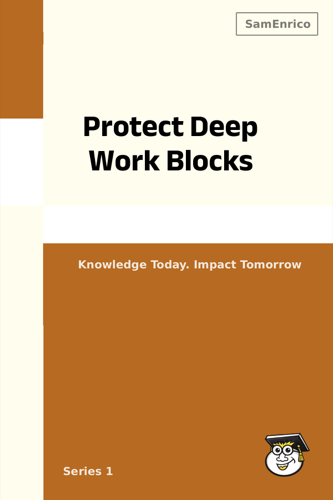
Protect Deep Work Blocks eBook
Schedule uninterrupted 90 minute sessions for high
Schedule uninterrupted 90 minute sessions for high concentration tasks.
Formats
Free sample
Chapter 1: The Ultradian Key--–- The first time I lost four hours of my life, I was sitting in a third-floor office with a degree on the wall, a salary I had begged for, and absolutely nothing to show for the day except a growing sense that I had been professionally lobotomized.It was a Tuesday. I remember Tuesdays because that was the day my calendar looked the most heroic. Back-to-back meetings from 9:00 AM to 11:00 AM. A thirty-minute "lunch" that I ate while typing. Then a solid block from 11:30 AM to 4:00 PM that I had proudly labeled "DEEP WORK – DO NOT DISTURB" in aggressive red capital letters.
I was the kind of person who used aggressive red capital letters. I thought it made me look serious.What actually happened between 11:30 AM and 4:00 PM was a slow-motion collapse of human cognition. I opened a document. I wrote two sentences. I remembered an email I had forgotten to send.
I opened my inbox. I answered the email. I wrote another sentence. I realized I needed a statistic. I opened a browser.
I saw a news headline. I clicked it. I read three paragraphs about something that had nothing to do with my work. I closed the browser. I stared at the document.
I opened my phone to check the time. I saw a Slack notification. I answered it. I put my phone down. I wrote half a sentence.
I stood up to get coffee. I sat down. I opened the document again. I deleted the half sentence. I looked at the clock.It was 3:47 PM.I had been "working" for four hours and seventeen minutes.
I had produced approximately two hundred words of mediocre content. I had answered eleven emails, eight Slack messages, and read one entirely irrelevant news article. My neck hurt. My eyes felt like they had been sandblasted. And I had absolutely no memory of where the time had gone.That was the moment I started asking a question that would change everything: What if my brain was never designed to work the way I was forcing it to work?What if the four-hour "deep work" block was not a sign of discipline but a confession of biological ignorance?
What if the problem was not my willpower, my motivation, or my work ethic—but my complete and total misunderstanding of how the human brain actually functions?This chapter is the answer to that question. It is the scientific foundation upon which every subsequent chapter is built. And it begins with a single, uncomfortable truth: You have been fighting your own biology, and you have been losing.The Myth of the Marathon Mind Let me name the enemy. It is not your phone. It is not your boss.
It is not your open office plan or your chatty coworker or your addiction to refreshing your email. Those are symptoms. The enemy is a story you have been told since elementary school, repeated in every corporate training seminar, and reinforced by every productivity guru who has ever told you to "grind harder."The story is this: Human attention is a marathon.We believe that the highest form of work discipline is the ability to sit down and focus for three, four, or five hours without stopping. We admire the novelist who writes until 3:00 AM. We celebrate the executive who "powers through" back-to-back strategy sessions.
We have built an entire culture around the assumption that longer focus equals better output.This story is wrong. It is not just mildly inaccurate. It is biologically backwards, scientifically bankrupt, and personally destructive. And the reason it is wrong comes down to a discovery made by a sleep researcher named Nathan Kleitman in the 1950s—a discovery that should have revolutionized the way we work but has been almost completely ignored.Kleitman discovered something called the Basic Rest-Activity Cycle, or BRAC. Here is what he found: throughout the day and night, the human body operates in cycles of approximately 90 to 120 minutes.
During each cycle, your physiology moves from high alertness to low alertness and back again. Your heart rate accelerates and decelerates. Your hormone levels rise and fall. Your brain waves shift from fast to slow.You experience this cycle every night when you sleep. Those 90-minute sleep cycles—from light sleep to deep sleep to REM and back again—are the reason you wake up groggy if your alarm goes off in the middle of a cycle.
But the cycle does not stop when you wake up. It continues all day. Your brain is constantly moving through waves of peak focus and inevitable fatigue, regardless of how much coffee you drink or how urgently your boss needs that report.Here is the implication that should terrify you: When you try to focus for four hours straight, you are not demonstrating discipline. You are demonstrating that you do not understand your own nervous system.For the first 60 to 90 minutes of focused work, your brain is capable of remarkable things. Your prefrontal cortex—the part of your brain responsible for complex decision-making, creative thinking, and impulse control—operates at full capacity.
Your neural networks fire efficiently. Your working memory holds multiple pieces of information simultaneously. This is the window of deep work.But then something happens. Around the 90-minute mark, your brain begins to signal fatigue. Not because you are lazy.
Not because you lack willpower. But because your ultradian rhythm is completing its cycle. Your brain is telling you: "The sprint is over. Time to recover before the next sprint."When you ignore that signal and push through, you enter what neuroscientists call the "compensation zone." Your brain starts using different neural pathways—less efficient ones. Your performance degrades.
Your error rate increases. Your creativity plummets. You are still working, technically. But the quality of that work is a fraction of what it was during the first 90 minutes.And yet, we celebrate this. We call it "hard work." We call it "dedication." We put it on our resumes as if cognitive collapse were a virtue.The Science of the Sprint Let me be precise about what happens in those first 90 minutes of focused work, because understanding the mechanism is the first step to using it.When you engage in deep, concentrated work, your brain releases a cocktail of neurochemicals that are remarkably similar to what athletes experience during peak performance.
Norepinephrine sharpens your focus. Dopamine motivates you to continue. Acetylcholine enhances your pattern recognition and creative connections. This is the flow state that Mihaly Csikszentmihalyi spent his career studying—a state of complete absorption where time disappears, self-consciousness vanishes, and performance feels effortless.But here is what Csikszentmihalyi discovered that most productivity advice ignores: Flow states are not sustainable indefinitely. They are episodic.
They have a natural arc—a ramp-up, a peak, and a decline. Attempting to sustain flow beyond its natural endpoint does not produce more flow. It produces frustration, errors, and burnout.In The Rise of Superman, Steven Kotler documents how extreme performers—world-class surfers, chess grandmasters, Formula One drivers—structure their training around this biological reality. They work in intense sprints followed by deliberate recovery. A big-wave surfer does not paddle for four hours straight.…
This is the end of the free sample. Get the eBook to keep going. Buy now
About this book
Details
- Author
- Gatlin Vannesa
- Publisher
- SamEnrico
- Language
- English
- Genre
- Non-Fiction, Self-Help, Deep Work
- Released
- 2026-06-09
- Pages (approx.)
- 151
- Available as
- eBook, Audiobook

Read better in the ZLOADR app
Your eBooks on your phone or tablet. Sign in with your SamEnrico account and start reading.
More by Gatlin Vannesa
 Pomodoro Technique Remote WorkGatlin Vannesa$11.99
 Tone of Voice GuideGatlin Vannesa$11.99
 Climate Risk in Retirement HousingGatlin Vannesa$11.99
 The Resilience GymGatlin Vannesa$11.99
 Remote Work Travel GuideGatlin Vannesa$11.99
 Estate Settlement GriefGatlin Vannesa$11.99
 Personal Branding for VeterinariansGatlin Vannesa$11.99
 The Whispering Fingerprints: The First Forensic Breakthrough in the Victorian EraGatlin Vannesa$11.99
 The Celestial Architects: Designing the Future of HumanityGatlin Vannesa$11.99
 How to Start a Esters of Methacrylic Acid Business (Beginners Guide)Gatlin Vannesa$11.99
 How to Produce Water Filter HousingsGatlin Vannesa$11.99
 How to Produce Linens and BeddingGatlin Vannesa$11.99
You may also like
 Deep Work Scheduling HandbookRuby Ngoc$11.99
 Long Pomodoro for Deep WorkMetzler Man$11.99
 Deep Work Scheduling StrategiesSoares Raisa$11.99
 The Four-Hour Focus Block CourseLong Ray$11.99
 The 90 Minute Deep MorningMcnabb Apolonia$11.99
 The Deep Work Schedule BlueprintHewitt Eddie$11.99
 Deep Work Block SchedulingSams Willian$11.99
 Individual Contributor FocusLadner Kourtney$11.99
 Deep Work Interruption Protection CourseTorrence Steffanie$11.99
 Deep Work GoalsCasas Jada$11.99
 Deep Concentration GuideDanielson Terese$11.99
 Quadrant Two Deep Work FocusMontero Racheal$11.99