
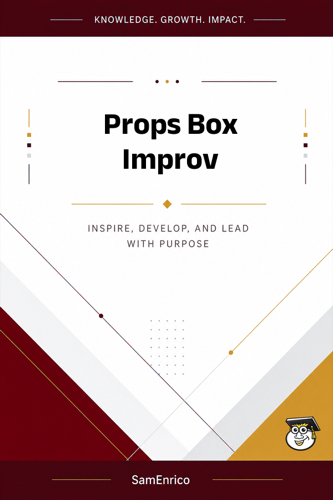
Non-FictionSelf-HelpObject Transformation
Props Box Improv eBook
Transform random objects into anything needed.
Transform random objects into anything needed.
Formats
Free sample
Chapter 1: The Empty Crutch–- Every improv teacher has seen it. A student reaches into the prop box, pulls out a rubber chicken, freezes for three seconds, then drops it back in and says, “I’ll just mime it.” The class nods sympathetically. The scene continues with invisible telephones, invisible coffee cups, and an invisible baby that no one quite believes in. The audience smiles politely but feels nothing.This book exists because of that moment.The rubber chicken is not the enemy. The empty hand is not the solution.
And the fear that grips you when confronted with a random object is not a sign of failure—it is the exact pressure point where improvisational gold is either forged or abandoned. Most improvisers choose to abandon it. They retreat into the safety of spacework, convinced that real objects will limit their imagination. They are wrong.This chapter dismantles the most pervasive myth in modern improv: that the empty hand is a sign of skill, and that physical props are training wheels for the insecure. In fact, the opposite is true for the vast majority of performers.
The empty hand is a crutch—a comfortable, familiar, and often disastrous crutch that allows improvisers to avoid specificity, avoid commitment, and avoid the very friction that creates compelling theater.We will explore why real objects terrify us, how that fear manifests as the “Prop Vacuum,” and why the best improvisers in the world reach for the rubber chicken, not away from it. You will learn the reframed Gift Paradigm, which turns every object—no matter how absurd—into a narrative gift. And you will practice the revised Knife/Gun Rule, which transforms prop handling from nervous fiddling into intentional, scene-driving action.By the end of this chapter, you will never look at a stapler the same way again.The Prop Vacuum: Why Your Brain Freezes Let us name the enemy. The Prop Vacuum is the psychological paralysis that occurs when an improviser faces a box, a bag, or even a single unexpected object. It feels like this: you reach in, your hand closes around something, and suddenly your mind goes blank.
What is this? What do I do with it? What if I choose wrong? What if the audience laughs at me for holding a rubber chicken like it matters?This vacuum has three distinct stages.Stage One: Recognition Failure. Your brain tries to categorize the object.
Is it a tool? A toy? A weapon? A piece of garbage? The left hemisphere fires rapidly, searching its database.
But the object is random. It does not belong to any clear category. The database returns “unknown.” Panic begins.Stage Two: Over-Analysis. The left hemisphere, frustrated, hands the problem to the right hemisphere. Now you are imagining possibilities—but too many of them.
The chicken could be a phone. It could be a baby. It could be a sacred artifact. It could be a murder weapon. The sheer volume of options creates paralysis.
You cannot choose because you have not yet learned the rules of transformation (Chapter 3 will solve this).Stage Three: Retreat. You put the object back. You say, “Never mind, I’ll just pretend.” The class exhales. The vacuum collapses. But so does your scene.
You have traded specificity for comfort. You have traded commitment for vagueness. You have lost the gift.The Prop Vacuum is not a personal failing. It is a structural feature of how the human brain responds to novelty under time pressure. Every improviser experiences it.
The difference between a beginner and a master is not the absence of the vacuum—it is the speed and grace with which they move through it. Masters recognize the vacuum, name it internally, and then apply a technique (any technique) to break the freeze.This chapter gives you the first technique.Spacework vs. Physical Props: A Nuanced Distinction Before we go further, we must clarify a critical distinction that most improv books get wrong. They treat spacework (mime) and physical props as opposing philosophies—one pure, one impure. This is a false binary.Spacework is the art of creating invisible objects through precise physical memory.
A master mime can make you believe in a wall that does not exist, a glass of water that has weight, a rope that burns the hands. Spacework is beautiful, difficult, and advanced. It requires years of practice to be convincing. When done poorly—and it is almost always done poorly by intermediate improvisers—spacework produces vague, floating hands and objects that change size, weight, and texture from moment to moment. The audience does not believe.
They tolerate.Physical Props are actual objects. A real stapler. A real rubber chicken. A real scarf. They have fixed weight, fixed texture, and fixed physical presence.
You cannot accidentally make a real stapler weigh nothing. You cannot forget its size. The audience believes instantly because the evidence is right there, in your hand, obeying the laws of physics.Here is the nuance that resolves the apparent contradiction between this chapter and Chapter 5 (where we will study advanced spacework): Real props are for foundation and clarity. Spacework is for flexibility and transitions. Beginners and intermediate improvisers should prioritize real props.
Advanced improvisers learn to blend both seamlessly.Think of it as a ladder.Rung One (Beginner): Use real props exclusively. Build the habit of commitment and specificity.Rung Two (Intermediate): Add basic spacework for transitions (setting down a real cup, picking up an imaginary one).Rung Three (Advanced): Perform full silent scenes with spacework only, as a practice discipline.Rung Four (Master): Move between real and imagined objects so fluidly that the audience never notices the switch.Most improvisers never leave Rung One because they never truly commit to real props. They retreat to spacework too early, mistaking their own comfort for skill. This chapter exists to keep you on Rung One until you have earned the right to climb.The empty hand is not a liar, as some books claim. It is a crutch.
A crutch is a useful tool for someone who is injured or learning to walk again. But if you use a crutch when both your legs are strong, you are only limiting your stride. Most improvisers have strong legs. They are just afraid to run.The Gift Paradigm: Reframing the Rubber Chicken The single most transformative mental shift you can make in prop work is this: Every prop is a gift from the universe (or your scene partner).A gift does not need to be perfect. It does not need to match your preconceived idea of where the scene was going.
In fact, the best gifts are the ones you did not expect. A rubber chicken is not a joke. It is not an inconvenience. It is a clue—a piece of evidence about character, relationship, or environment that you have not yet discovered.Let us work through an example.You are in a scene. You have established nothing yet.
You reach into the prop box and pull out a rubber chicken. Your old instinct: panic. Your new instinct: gratitude. The chicken is not random. It is information.Ask yourself three questions, in order:Who would have this…
This is the end of the free sample. Get the eBook to keep going. Buy now
About this book
Details
- Author
- Smithson Judi
- Publisher
- SamEnrico
- Language
- English
- Genre
- Non-Fiction, Self-Help, Object Transformation
- Released
- 2026-06-11
- Pages (approx.)
- 132
- Available as
- eBook, Audiobook

Read better in the ZLOADR app
Your eBooks on your phone or tablet. Sign in with your SamEnrico account and start reading.
More by Smithson Judi
 Menopause And Mental HealthSmithson Judi$11.99
 Thanks for Feedback SummarySmithson Judi$11.99
 Cue Dependent Dream TriggerSmithson Judi$11.99
 Time Allocation During ExamsSmithson Judi$11.99
 Sunset Sky Calming JourneySmithson Judi$11.99
 Grey DeLisle Griffin to FairlySmithson Judi$11.99
 Morning Routine for MusiciansSmithson Judi$11.99
 The Poisoned Chalice: Dr. Thomas Neill Cream's Trial and the Birth of Forensic ToxicologySmithson Judi$11.99
 The Dot-Com Bubble Burst: When the Internet Dream Crashed to EarthSmithson Judi$11.99
 Service Providers Guide to BookkeepingSmithson Judi$11.99
 How to Produce Vehicle Fishing Rod RacksSmithson Judi$11.99
 How to Produce a LabeltagSmithson Judi$11.99
You may also like
 Hong Kong Handover 1997Dunn Johnnie$11.99
 Zumba For Postnatal Recovery CourseNeal Christian$11.99
 Zumba for BeginnersLadner Nikia$11.99
 YouTube Comment Mining GuideHumes Pandora$12.99
 Worry Box MeditationCarlin Rudy$11.99
 Workplace Stress MeditationNguyen Lynn$11.99
 Workplace Stress and Sleep RepairHawley Ivory$11.99
 Workplace Perfectionism CureDelaney Jeffry$11.99
 Workplace Injustice Anger GuideWallen Isabelle$11.99
 Work Addiction and Burnout LinkGreenwood Ester$11.99
 Women in Yoga and WellnessBeattie Galina$11.99
 Women in Stand Up ComedyChun Evangeline$11.99