
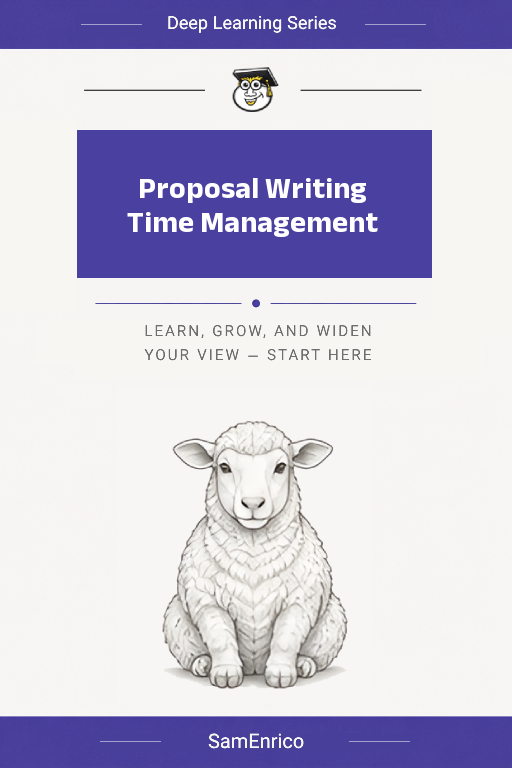
Non-FictionStudent's ShortcutTime ManagementWriting Schedule
Proposal Writing Time Management eBook
Manage research proposal writing timeline across m
by Kyle Cammy
Manage research proposal writing timeline across months including drafting revising and submission milestones.
Formats
Free sample
Chapter 1: The Geometry of Deadlines--–- Most proposal writers do not fail because they lack skill, intelligence, or determination. They fail because they start at the wrong end of the timeline. They open their calendar, look at today, and begin marching forward toward the deadline like a hiker who has no map, only a vague sense that the mountain lies somewhere to the east. This is not a productivity problem. It is a geometry problem.
And like all geometry problems, it has a solution that is both counterintuitive and mathematically certain: you must start at the deadline and work backward.The central argument of this book is that time management for proposal writing is not about working faster, eliminating distractions, or summoning more willpower. It is about building a timeline that accounts for three things that almost every proposal writer ignores: the logical order of milestones, the inevitability of life interruptions, and the difference between deadlines that cannot move and tasks that can flex. Most proposal timelines fail because they assume perfect conditions—no sick days, no reviewer delays, no formatting disasters, no last-minute requests from co-authors. This chapter replaces that fantasy with a system that expects reality.This chapter introduces the Reverse Calendar, a backward-planning method that transforms a blurry six-month slog into a set of small, hard deadlines surrounded by protective margins. You will learn the difference between static windows (dates you cannot change) and fluid windows (tasks you can reschedule).
You will build the 12-Week Reverse Engineering Worksheet with integrated slack—buffer days built directly into the timeline rather than added as an afterthought. You will calculate your Point of No Return, the latest date by which a full draft must exist or you mathematically cannot finish on time. And you will learn why the 80% Rule is not a suggestion but a structural necessity.By the end of this chapter, you will never again look at a proposal deadline the same way. You will see it not as a wall approaching but as an anchor point from which everything else flows backward in an orderly, predictable cascade.Why Forward Planning Always Breaks Down Imagine you are standing in New York City and need to be in Los Angeles seven days from now. You have never made this trip before.
You do not know the distance, the modes of transportation available, or the obstacles along the way. A forward-planning approach would look like this: Day 1, start driving west. Day 2, continue driving. Day 3, continue driving. You have no milestones, no checkpoints, no way to know if you are on track until you either arrive or discover that you cannot.
This is how most people write proposals. They know the deadline, they know they should start early, and they have a vague sense that working consistently will get them there. But they have no intermediate targets, no way to measure progress, and no warning system for delays until it is too late.A backward-planning approach reverses the logic. You start in Los Angeles on Day 7 and ask: What must be true on Day 6 to arrive on Day 7? You must be within fifty miles of the city.
What must be true on Day 5 to be within fifty miles on Day 6? You must have crossed the Arizona border. What must be true on Day 4 to cross Arizona by Day 5? You must be in New Mexico. You work backward step by step until you reach Day 1, at which point you know exactly what you need to do each day.
This is not a metaphor. This is the only reliable method for multi-stage projects with fixed end dates.Proposal writing is such a project. A typical grant proposal involves drafting multiple sections (Introduction, Literature Review, Methods, Budget Justification, Human Subjects, Data Management Plan), gathering input from co-authors and advisors, incorporating feedback through multiple revision rounds, satisfying institutional compliance requirements (IRB, routing, signatures, biosketches), formatting to sponsor specifications, converting to PDF, and uploading to a portal that may or may not work on the first attempt. Each of these steps depends on the completion of previous steps. Each step has a variable duration that you cannot predict perfectly.
And each step is vulnerable to delays that have nothing to do with your work ethic.Forward planning fails because it treats all days as equal and all tasks as independent. It says: I have ninety days until the deadline. I will write for two hours each day. That will produce one hundred eighty hours of work. Surely that is enough.
But this calculation ignores that writing the Methods section depends on having finalized your research design. Finalizing your research design depends on feedback from your advisor. Feedback from your advisor depends on when they check their email. Checking their email depends on whether they are traveling, teaching, or sick. The dependencies cascade.
A two-day delay in advisor feedback becomes a five-day delay when it pushes other tasks into weekends. A formatting error discovered at 10 PM on deadline day becomes a crisis when the sponsor portal crashes at 11 PM.The Reverse Calendar solves this by making dependencies visible and building margins around them. You do not plan for the best case. You plan for the realistic case, then add slack for the worst case, then structure your work so that a single delay does not collapse the entire timeline.Static Windows Versus Fluid Windows Before you can build a Reverse Calendar, you must understand the difference between two types of timeline elements. Static windows are dates and deadlines that cannot move.
They are imposed by external entities—sponsors, institutions, regulations—and no amount of hard work or good intentions will change them. Fluid windows are tasks and activities whose timing you control. They can expand or contract if managed properly, but they require active management to do so.Static windows include the sponsor submission deadline. This is the most obvious static window. If you miss it, the proposal is not accepted.
No exceptions for good excuses. They also include internal routing deadlines set by your grants office or department. Many institutions require proposals to be submitted to an internal review at least five business days before the sponsor deadline. This is a static window. The routing process takes a fixed amount of time, and the people who handle it work on their schedules, not yours.IRB or IACUC approval cutoffs are another static window.
If your research involves human subjects or animals, you cannot submit a proposal without approved protocols or explicit documentation of exemption. These approvals take time, often weeks, and they operate on institutional timelines that do not bend for your deadline. Signature deadlines also fall into this category. If your proposal requires signatures from co-PIs, department chairs, deans, or research offices, those people have their own calendars. A signature request sent on a Friday afternoon may not be seen until Monday or Tuesday.
A signature request sent during winter break may not be seen for two weeks.Finally, sponsor-specific formatting requirements are static constraints. If the sponsor requires a specific font, margin size, page limit, or file naming convention, those are non-negotiable. You cannot negotiate them. You can only discover them early or discover them…
This is the end of the free sample. Get the eBook to keep going. Buy now
About this book
Details
- Author
- Kyle Cammy
- Publisher
- SamEnrico
- Language
- English
- Genre
- Non-Fiction, Student's Shortcut, Time Management, Writing Schedule
- Released
- 2026-06-01
- Pages (approx.)
- 144
- Available as
- eBook, Audiobook

Read better in the ZLOADR app
Your eBooks on your phone or tablet. Sign in with your SamEnrico account and start reading.
More by Kyle Cammy
 Loving Kindness Meditation for StressKyle Cammy$11.99
 Preferred Equity GuideKyle Cammy$11.99
 LBO Regulatory Approval GuideKyle Cammy$11.99
 Diamond Heist Cold Case StatusKyle Cammy$11.99
 Bariatric Surgery Vegetable First WorkbookKyle Cammy$11.99
 The Forbidden Academy: How a Secretive Southeast Asian School Revolutionized ScienceKyle Cammy$11.99
 The Last Dance of the Century: How a High School Sweetheart Reunited After 30 YearsKyle Cammy$11.99
 ILS EngineerKyle Cammy$11.99
 AI Financial Data Aggregation GuideKyle Cammy$12.99
 Understanding Cdg Syndrome Type 1bKyle Cammy$17.99
 How to Start a Postage Stamp Perforating Business (Beginners Guide)Kyle Cammy$11.99
You may also like
 Hong Kong Handover 1997Dunn Johnnie$11.99
 Zumba For Postnatal Recovery CourseNeal Christian$11.99
 Zumba for BeginnersLadner Nikia$11.99
 YouTube Comment Mining GuideHumes Pandora$12.99
 Worry Box MeditationCarlin Rudy$11.99
 Workplace Stress MeditationNguyen Lynn$11.99
 Workplace Stress and Sleep RepairHawley Ivory$11.99
 Workplace Perfectionism CureDelaney Jeffry$11.99
 Workplace Injustice Anger GuideWallen Isabelle$11.99
 Work Addiction and Burnout LinkGreenwood Ester$11.99
 Women in Yoga and WellnessBeattie Galina$11.99
 Women in Stand Up ComedyChun Evangeline$11.99