
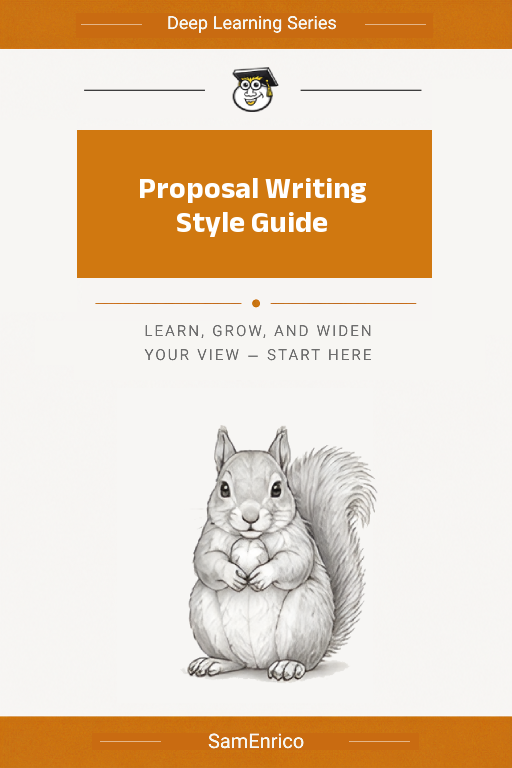
Non-FictionStudent's ShortcutWriting StyleClarity Guide
Proposal Writing Style Guide eBook
Write clear concise and persuasive research propos
by German Ozell
Write clear concise and persuasive research proposals using active voice and avoiding jargon and passive construction.
Formats
Free sample
Chapter 1: The Manatee Test--–- Every year, across university offices, research hospitals, and government laboratories, thousands of intelligent, highly educated people sit down to write a grant proposal. They have brilliant ideas. They have rigorous methods. They have compelling preliminary data. And then they open a blank document and type: “It is anticipated that the experiment will be conducted by the research team in order to facilitate the assessment of key variables.”No one talks like that.
No one thinks like that. And yet, when researchers begin writing proposals, something strange happens. Their prose stiffens. Their sentences lengthen. Their verbs disappear.
They start writing as if a committee of drowsy bureaucrats has taken possession of their fingers.This chapter is about why that happens and how to stop it forever.The Proposal Zombie Awakens Let us name the enemy. The passive voice is a grammatical construction in which the subject of the sentence receives the action rather than performing it. In active voice, you write: “The team conducted the experiment.” In passive voice, you write: “The experiment was conducted by the team.” The difference seems small. Four extra words. A slight rearrangement.
But the psychological effect on a reviewer is devastating.Passive voice hides responsibility. It obscures agency. It adds cognitive friction to every sentence. A reviewer reading passive prose must constantly ask: Who did what? Who decided?
Who will act? By the time they reach the bottom of the first page, they are already exhausted.Worse, passive voice breeds more passive voice. Like a virus, it spreads through paragraphs, infecting nearby sentences until entire proposals become impenetrable thickets of “it was determined that” and “consideration was given to” and “a decision was reached regarding.” This is not formal writing. This is not scholarly prose. This is a Proposal Zombie—a shambling, noun-choked monster that eats reviewer attention spans.The good news?
Zombies can be killed.The Manatee Test: A Two-Second Diagnosis Before you can eliminate passive voice, you need to spot it instantly. Here is a tool so simple that you can teach it to a child in under thirty seconds. It is called the Manatee Test.Take any sentence that contains a verb. Ask yourself: Can I insert the words “by a manatee” immediately after the verb and still have a grammatically correct sentence? If yes, the sentence is passive.
If no, it is active.Let us try. “The sample was collected.” Insert “by a manatee”: “The sample was collected by a manatee.” That works perfectly. The sentence is passive.Now try: “The manatee collected the sample.” Insert “by a manatee”: “The manatee collected by a manatee the sample.” That is nonsense. The sentence is active.The Manatee Test works because passive voice always includes a form of the verb “to be” (is, am, are, was, were, be, being, been) followed by a past participle, and that construction leaves an opening for an agent. Active voice closes that opening.
The test is absurd, which is precisely why it is memorable. You will never forget a manatee.Try a few more. “Recruitment will be conducted.” Insert “by a manatee”: “Recruitment will be conducted by a manatee.” Passive. “We will recruit.” Insert “by a manatee”: “We will recruit by a manatee.” Active. “Data were analyzed using SPSS.” Insert “by a manatee”: “Data were analyzed by a manatee using SPSS.” Passive.
“We analyzed data using SPSS.” Insert “by a manatee”: “We analyzed by a manatee data using SPSS.” Active.The test takes less than two seconds per sentence. In the time it takes to sip your coffee, you can scan an entire paragraph.Why Passive Voice Is Not More Professional Many researchers believe that passive voice sounds more objective, more formal, more scientific. This belief is wrong, and it is damaging your chances of getting funded.The myth of passive objectivity comes from a misreading of scientific history. For decades, methods sections were written in passive voice because journal editors wanted to emphasize procedures rather than people. “The solution was heated to 50°C” sounds as if the experiment happened on its own, without human intervention.
But grant proposals are not journal articles. Grant proposals are arguments. And arguments require agents.When you write “It was hypothesized that,” you are not being objective. You are being evasive. Who hypothesized?
You did. Own it.When you write “Participants were recruited from,” you are not being formal. You are being vague. Who recruited them? You did.
Say so.When you write “A decision was made to,” you are not being scholarly. You are being cowardly. Who decided? You did. Take credit.Reviewers are not fooled by passive voice.
They see it for what it is: a rhetorical hedge, a stylistic crutch, a signal that the writer is either uncertain or untrained. In study after study of grant review panels, proposals written in active voice receive higher clarity scores, higher confidence scores, and ultimately higher funding scores. Reviewers want to know who is doing what. Give them that information in the clearest possible way.The Three-Step Slap: From Passive to Active in Seconds Once you have identified a passive sentence using the Manatee Test, you need a reliable method for transforming it into active voice. The Three-Step Slap is that method.
It takes less than ten seconds per sentence.Step One: Find the actor. Who or what is performing the action? In passive sentences, the actor often appears after the word “by” or is missing entirely. “The experiment was conducted by the team.” The actor is “the team.” “Recruitment will be completed in June.” No actor is mentioned at all. You must supply one—usually “we” or “the research team.”Step Two: Move the actor to the front.
Put the actor at the beginning of the sentence, right where readers expect the subject. “The team the experiment was conducted by” is not a complete sentence yet, but you have moved the actor.Step Three: Change the verb to active form. Remove the “to be” verb and the past participle, then use the active version of the action. “Was conducted” becomes “conducted.” Now put it together: “The team conducted the experiment.”That is it. Three steps.
Ten seconds. One zombie sentence transformed into a living, breathing claim.Let us practice on a more complex example. “It was determined by the institutional review board that the study protocol met ethical guidelines.”Step One: The actor is “the institutional review board.” Step Two: Move “the institutional review board” to the front. Step Three: “Was determined” becomes “determined.” The result: “The institutional review board determined that the study protocol met ethical guidelines.”Shorter. Clearer.
More confident.The Rare Exceptions: When Passive Voice Is Acceptable No rule in writing is absolute, and passive voice has its place. There are exactly three situations where passive voice is not just acceptable but preferable. Learn them, use them sparingly, and then return to active voice for everything else.Exception One: The actor is unknown. If you do not know who performed the action, passive voice is fine. “The sample was contaminated during shipping.” You do not know who contaminated it.
Active voice would require a fake actor (“Someone contaminated the sample”), which adds no value.Exception Two: The actor is irrelevant.…
This is the end of the free sample. Get the eBook to keep going. Buy now
About this book
Details
- Author
- German Ozell
- Publisher
- SamEnrico
- Language
- English
- Genre
- Non-Fiction, Student's Shortcut, Writing Style, Clarity Guide
- Released
- 2026-06-01
- Pages (approx.)
- 140
- Available as
- eBook, Audiobook

Read better in the ZLOADR app
Your eBooks on your phone or tablet. Sign in with your SamEnrico account and start reading.
More by German Ozell
 Mindful Movement for Chronic StressGerman Ozell$11.99
 Nomophobia Recovery WorkbookGerman Ozell$11.99
 LBO Retail Sector GuideGerman Ozell$11.99
 LBO Model Construction BlueprintGerman Ozell$11.99
 Bariatric Surgery Financial Planning CourseGerman Ozell$11.99
 Vanishing Vermeer: The $120 Million Heist That Shocked the Art WorldGerman Ozell$11.99
 The Fire Below the Jungle: Magellan’s Secret Volcanic Discovery in BorneoGerman Ozell$11.99
 Understanding Caudal Appendage DeafnessGerman Ozell$17.99
 Client Success SpecialistGerman Ozell$11.99
 AI Financial Scenario AnalysisGerman Ozell$12.99
 How to Start a Potassium Salts (natural) Mining Business (Beginners Guide)German Ozell$11.99
You may also like
 Hong Kong Handover 1997Dunn Johnnie$11.99
 Zumba For Postnatal Recovery CourseNeal Christian$11.99
 Zumba for BeginnersLadner Nikia$11.99
 YouTube Comment Mining GuideHumes Pandora$12.99
 Worry Box MeditationCarlin Rudy$11.99
 Workplace Stress MeditationNguyen Lynn$11.99
 Workplace Stress and Sleep RepairHawley Ivory$11.99
 Workplace Perfectionism CureDelaney Jeffry$11.99
 Workplace Injustice Anger GuideWallen Isabelle$11.99
 Work Addiction and Burnout LinkGreenwood Ester$11.99
 Women in Yoga and WellnessBeattie Galina$11.99
 Women in Stand Up ComedyChun Evangeline$11.99