
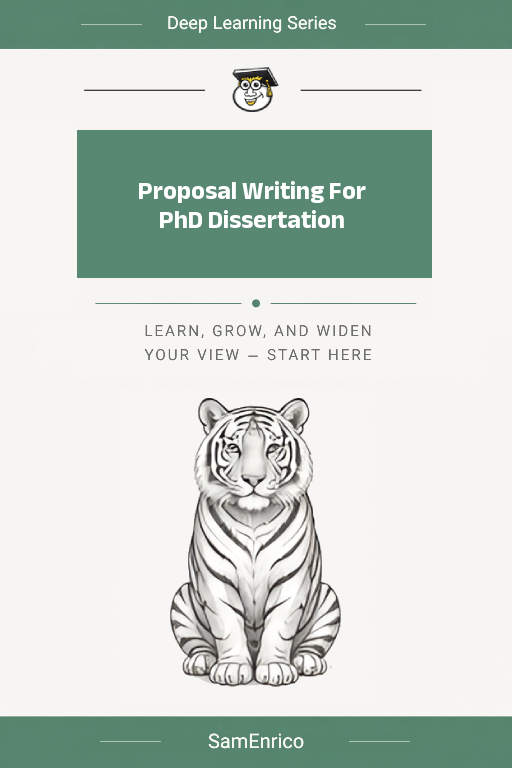
Proposal Writing For PhD Dissertation eBook
Write comprehensive dissertation proposals that se
Write comprehensive dissertation proposals that set up your entire doctoral research.
Formats
Free sample
Chapter 1: The Golden Gap--Most doctoral students begin their proposal journey with a dangerous assumption. They believe that having a topic is the same as having a problem. They walk into their advisor’s office and announce, “I want to study online learning,” or “I am interested in teacher burnout,” or “My topic is climate change policy.” And then, when the advisor asks, “What is your research problem?” the student stares back in silence. They have confused an area of interest with a researchable, defensible, and dissertation-sized problem. That confusion is the single greatest predictor of proposal rejection, committee frustration, and the slow erosion of doctoral momentum.This chapter exists to solve that confusion permanently.
Before you write a single sentence of your proposal, before you open a citation manager, before you schedule another meeting with your advisor, you must learn how to find what this book calls the Golden Gap. The Golden Gap is the precise intersection between a genuine real-world problem, a documented gap in the scholarly literature, and a feasible research question that you can realistically answer within the constraints of a doctoral program. When you find the Golden Gap, your proposal writes itself. When you miss it, everything becomes a struggle.The distinction between a topic and a problem is not semantic. It is structural.
A topic is a broad domain of inquiry. It tells your committee what you are curious about, but it does not tell them why anyone should care, what is broken, or what your study will accomplish. A research problem, by contrast, is a specific, documented, and troubling condition that demands attention. It is a deficiency, a tension, a contradiction, or an unexplained phenomenon. It has evidence behind it.
It has consequences attached to it. And most importantly, it has a clear boundary that makes it solvable within three to five years.Consider the difference. A student with a topic says, “I want to study online learning.” A student with a problem says, “Community college students in rural counties with substandard broadband infrastructure fail to complete online STEM courses at triple the rate of their urban peers, despite identical course materials and instructor qualifications.” The first statement generates a vague nod. The second statement generates immediate attention. The committee thinks, “That is specific.
That is measurable. That is a real problem. And we can evaluate whether this student has a plan to address it.”The Golden Gap is not something you find by accident. It is something you construct through a deliberate process of narrowing, justifying, and testing. This chapter walks you through that process in four movements.
First, you will learn the three types of gaps that every dissertation must address, and why most students focus on only one. Second, you will master the So What test, which separates problems that matter from problems that only interest you. Third, you will learn delimitation techniques that carve a dissertation-sized problem from a topic that could fill an entire career. Fourth, you will produce a Golden Gap Statement, a private planning document that serves as the foundation for your formal problem statement in Chapter 2.By the end of this chapter, you will never again confuse a topic with a problem. You will have a tool that your advisor will recognize as doctoral-level thinking.
And you will save yourself hundreds of hours of revision because you will have built your proposal on a foundation that cannot crack.The Three Types of Gaps: Why Most Students Only Find One Before you can find your Golden Gap, you must understand that not all gaps are the same. The word “gap” gets thrown around in doctoral programs as if it means one thing: a hole in the literature. Find something no one has studied, the conventional wisdom goes, and you have a dissertation. This advice is not wrong, but it is dangerously incomplete. A literature gap alone cannot sustain a doctoral proposal because your committee will immediately ask, “Why does that gap matter?
Who cares what has not been studied?”The strongest proposals address three distinct types of gaps simultaneously. This book refers to them as the Real-world Gap, the Literature Gap, and the Methodological Gap. Each serves a different rhetorical purpose. Each appears in a different section of your proposal. And each must be present for your committee to approve your work.The Real-world Gap is the discrepancy between how things should be and how things actually are.
It is the suffering, the inefficiency, the inequality, the waste, or the missed opportunity that exists outside of academic journals. In a quantitative study, the real-world gap might be a decline in test scores, an increase in hospital readmissions, or a persistent wage disparity. In a qualitative study, it might be a group of people whose experiences have been ignored, a policy that produces unintended harm, or a professional practice that has drifted from its ethical foundations. The real-world gap answers the question, “Why should anyone outside of my discipline care about this study?”The Literature Gap is what the scholarly community has not yet adequately studied, theorized, or measured. It is the missing conversation in peer-reviewed journals.
But here is the crucial insight that most doctoral students miss: the literature gap is not valuable in itself. It is valuable only insofar as it helps explain or address the real-world gap. Your committee does not want you to study something just because no one has studied it. They want you to study something because the world has a problem, and the academic literature has failed to provide a solution, and your study will begin to close that failure.The Methodological Gap is the mismatch between the questions that need answering and the methods that have been used to answer them. Perhaps every study on your topic has used surveys, but surveys cannot capture the lived experience you need to understand.
Perhaps every study has used small convenience samples, but the phenomenon demands a large-scale random sample. Perhaps every study has been quantitative, but the most urgent questions are qualitative. The methodological gap answers the question, “Why is your chosen method necessary rather than merely convenient?”Here is the formula that separates successful proposals from failures: Your study must address a real-world gap that is documented in the literature gap, using a methodological gap as your justification for why previous work has fallen short. Most students pick one. Strong students pick two.
The best students weave all three together in the first ten pages of their proposal.Let us see how this works in practice. A weak proposal says, “No one has studied how community college students experience online STEM courses.” That is a literature gap alone. The committee will ask, “So what? Maybe no one studied it because it is not important.” A stronger proposal says, “Community college students in rural areas fail online STEM courses at triple the rate of their urban peers (real-world gap). However, the existing literature has focused exclusively on four-year university students and has ignored the rural community college population (literature gap).
Therefore, this qualitative study will use phenomenological interviews to understand the lived barriers these rural students face (methodological gap).” That proposal has…
This is the end of the free sample. Get the eBook to keep going. Buy now
About this book
Details
- Author
- Herring Chelsey
- Publisher
- SamEnrico
- Language
- English
- Genre
- Non-Fiction, Student's Shortcut
- Released
- 2026-06-01
- Pages (approx.)
- 160
- Available as
- eBook, Audiobook

Read better in the ZLOADR app
Your eBooks on your phone or tablet. Sign in with your SamEnrico account and start reading.
More by Herring Chelsey
 CrossFit Olympic LiftingHerring Chelsey$11.99
 Parent Death and GrandparenthoodHerring Chelsey$11.99
 The Nap Biohacking ToolkitHerring Chelsey$11.99
 Study Motivation GuideHerring Chelsey$11.99
 Any do Reminder GuideHerring Chelsey$11.99
 Bipolar And Sleep DisruptionHerring Chelsey$11.99
 The 21 Day Rewire ProtocolHerring Chelsey$11.99
 Parenting After Child LossHerring Chelsey$11.99
 Boundary Setting For ExecutorsHerring Chelsey$11.99
 The Battle of Swally: The East India Company's Deadly Gambit (1628)Herring Chelsey$11.99
 Quetzalcoatl's Feathered Flight: The Serpent God's Cosmic JourneyHerring Chelsey$11.99
 The Last Broadcast: How a Radio Show Predicted the Fall of the Soviet UnionHerring Chelsey$11.99
You may also like
 Hong Kong Handover 1997Dunn Johnnie$11.99
 Zumba For Postnatal Recovery CourseNeal Christian$11.99
 Zumba for BeginnersLadner Nikia$11.99
 YouTube Comment Mining GuideHumes Pandora$12.99
 Worry Box MeditationCarlin Rudy$11.99
 Workplace Stress MeditationNguyen Lynn$11.99
 Workplace Stress and Sleep RepairHawley Ivory$11.99
 Workplace Perfectionism CureDelaney Jeffry$11.99
 Workplace Injustice Anger GuideWallen Isabelle$11.99
 Work Addiction and Burnout LinkGreenwood Ester$11.99
 Women in Yoga and WellnessBeattie Galina$11.99
 Women in Stand Up ComedyChun Evangeline$11.99