
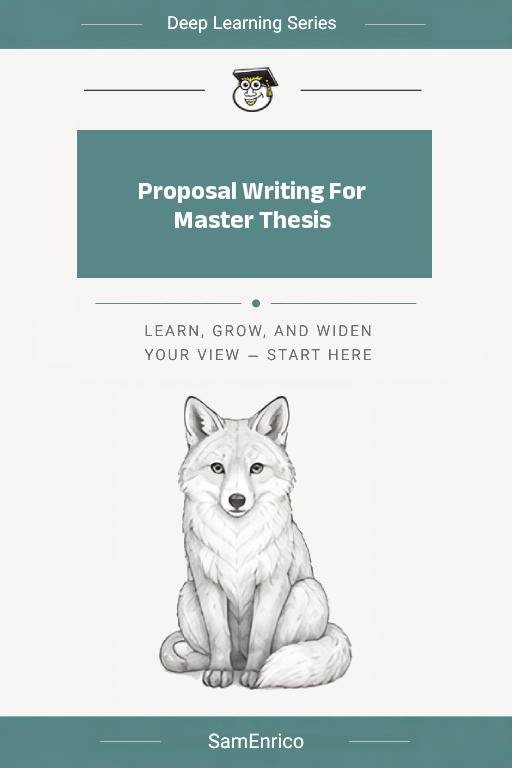
Proposal Writing For Master Thesis eBook
Draft research proposals specifically for master's
by Mccann Neta
Draft research proposals specifically for master's degree thesis requirements.
Formats
Free sample
Chapter 1: The Proposal Trap--You are probably reading this because you have to write a Master's thesis proposal, and you have no idea what you are doing. Or you have some idea, but that idea is wrong. Or you had an idea, submitted a draft, and your advisor returned it with more red ink than a stoplight at rush hour. Whatever brought you here, let me tell you something that no professor will ever say out loud: Your committee does not expect a masterpiece. They expect a manageable plan.The gap between what students think committees want and what committees actually want is the single greatest source of proposal anxiety—and proposal failure.
Students spend weeks trying to be brilliant. Committees spend minutes trying to determine if you can finish. Students worry about changing the field. Committees worry about you changing your topic three months before graduation. This mismatch of expectations is what I call the Proposal Trap, and most Master's students fall into it before they write a single word.This chapter will pull you out of that trap.
You will learn why Master's proposals are fundamentally different from Ph D proposals, what committees actually look for (spoiler: it is not groundbreaking theory), and how to reframe your entire approach from "impress them" to "convince them I can finish." By the end of this chapter, you will have a clear framework for evaluating every decision you make in the remaining eleven chapters. More importantly, you will stop wasting energy on things that do not matter and start focusing on the only thing that does: feasibility.The Mini-Dissertation Myth Let us start with the most damaging misconception in graduate education: the belief that a Master's thesis is a "mini-dissertation." This myth persists because it is flattering. It suggests that you are doing the same work as a Ph D student, just on a smaller scale. It suggests that your proposal should look like a doctoral proposal, just shorter. It suggests that originality, theoretical contribution, and methodological sophistication are the gold standards you must meet.All of this is wrong.A Master's thesis is not a smaller version of a Ph D.
It is a different genre entirely. A Ph D demonstrates that you can make an original contribution to knowledge. A Master's thesis demonstrates that you can conduct a supervised research project from start to finish. The Ph D candidate must convince a committee that they have discovered something new about the world. The Master's candidate must convince a committee that they have learned the research process well enough to apply it independently.This distinction changes everything about your proposal.
Consider the three dimensions where Master's and doctoral proposals differ most sharply:Depth of literature review. A doctoral proposal often requires 100-200 sources, demonstrating comprehensive command of an entire field. A Master's proposal requires 15-30 core sources, demonstrating that you have identified the key conversations relevant to your specific question. You do not need to read everything. You need to read enough to know what matters.Expected originality.
A doctoral proposal must identify a genuine gap in human knowledge—something no one has ever discovered before. A Master's proposal must identify a fresh application of existing knowledge to a new context, population, or setting. You are not expected to invent a new theory. You are expected to apply an existing theory to a situation it has not yet been applied to.Project timeline. A doctoral proposal often spans 3-7 years of work, with multiple studies, phases, or sites.
A Master's proposal spans 6-12 months of actual research time (not counting courses, teaching, or other obligations). Your proposal must prove that your project can be completed in that window.Here is the most important sentence in this book: If your proposal would take three years to complete, it is a doctoral proposal. If it would take three months to complete, it is an undergraduate project. Your job is to hit the sweet spot in between.Most Master's students fail because they aim for the doctoral standard. They propose complex mixed-methods designs with 200 participants, three rounds of interviews, and statistical analyses they have never run before.
Their committees look at these proposals and think, "This student has no idea how long this takes." Rejection follows. Not because the idea is bad, but because the timeline is fantasy.What Committees Actually Want I have reviewed over 200 Master's proposals in the past five years. I have served on committees that approved proposals and committees that rejected them. I have read the feedback forms, attended the closed-door deliberations, and interviewed dozens of faculty about what they actually look for when they read a proposal. The results might surprise you.When faculty members are asked to rank the importance of various proposal elements, "theoretical contribution" consistently ranks near the bottom.
"Methodological rigor" ranks in the middle. The top three, in order, are: feasibility, clarity, and evidence of planning.Let me translate that for you.Feasibility means your committee believes you can finish. This is not about your intelligence or work ethic. It is about the fit between your proposed project and the resources available to you: time, access to participants, equipment, funding, and your own skills. A brilliant proposal that requires a research team is a bad Master's proposal.
A modest proposal that you can complete alone in six months is an excellent Master's proposal.Clarity means your committee understands exactly what you are proposing. Vague statements like "I will explore the relationship between social media and well-being" signal that you have not thought deeply enough. Specific statements like "I will survey 100 first-year Master's students to measure the correlation between daily Instagram use and scores on the Warwick-Edinburgh Mental Well-being Scale" signal that you have a plan.Evidence of planning means your committee sees that you have anticipated problems. Have you accounted for advisor lag? Have you built buffer time into your schedule?
Have you identified a backup participant pool if your first recruitment strategy fails? Have you checked whether the dataset you want to use is actually available? Committees love contingency plans because they show maturity.One committee member I interviewed put it bluntly: "I don't care if your research changes the world. I care if you graduate on time. If your proposal proves you can finish, I will approve it.
If it proves you do not understand time, I will reject it."This is the dirty secret of proposal review: Your committee is not evaluating your brilliance. They are evaluating your judgment. They want to see that you know what is realistic, what is possible, and what is delusional. They want to see that you have thought through the practical challenges of doing research. They want to see that you will not need hand-holding at every step.The Two-Semester Rule Let me give you a concrete formula that will save you months of misery.
I call it the Two-Semester Rule.Most Master's programs give students two semesters to complete their thesis. Sometimes three. Rarely four. For the sake of this formula, assume you have exactly two semesters from proposal approval to final submission. That is roughly eight months of calendar time, but not all of that…
This is the end of the free sample. Get the eBook to keep going. Buy now
About this book
Details
- Author
- Mccann Neta
- Publisher
- SamEnrico
- Language
- English
- Genre
- Non-Fiction, Student's Shortcut
- Released
- 2026-05-30
- Pages (approx.)
- 160
- Available as
- eBook, Audiobook

Read better in the ZLOADR app
Your eBooks on your phone or tablet. Sign in with your SamEnrico account and start reading.
More by Mccann Neta
 Small Talk for Hearing ImpairedMccann Neta$11.99
 The Smoke Free Driving PlanMccann Neta$11.99
 Spin Recovery WeekMccann Neta$11.99
 Napping for Dementia CaregiversMccann Neta$11.99
 The Treatment DecisionMccann Neta$11.99
 TickTick Task ManagerMccann Neta$11.99
 Procrastination Study FixMccann Neta$11.99
 Empathy Development EQ WorkbookMccann Neta$11.99
 Rainbow Baby After LossMccann Neta$11.99
 The Day the Sky Fell: The 1970 Bhola Cyclone That Changed HistoryMccann Neta$11.99
 The Opium King of Hong Kong: How One Man Built a Smuggling EmpireMccann Neta$11.99
 Red Dust Rising: The Untold Story of the First Martian Dust StormMccann Neta$11.99
You may also like
 Hong Kong Handover 1997Dunn Johnnie$11.99
 Zumba For Postnatal Recovery CourseNeal Christian$11.99
 Zumba for BeginnersLadner Nikia$11.99
 YouTube Comment Mining GuideHumes Pandora$12.99
 Worry Box MeditationCarlin Rudy$11.99
 Workplace Stress MeditationNguyen Lynn$11.99
 Workplace Stress and Sleep RepairHawley Ivory$11.99
 Workplace Perfectionism CureDelaney Jeffry$11.99
 Workplace Injustice Anger GuideWallen Isabelle$11.99
 Work Addiction and Burnout LinkGreenwood Ester$11.99
 Women in Yoga and WellnessBeattie Galina$11.99
 Women in Stand Up ComedyChun Evangeline$11.99