
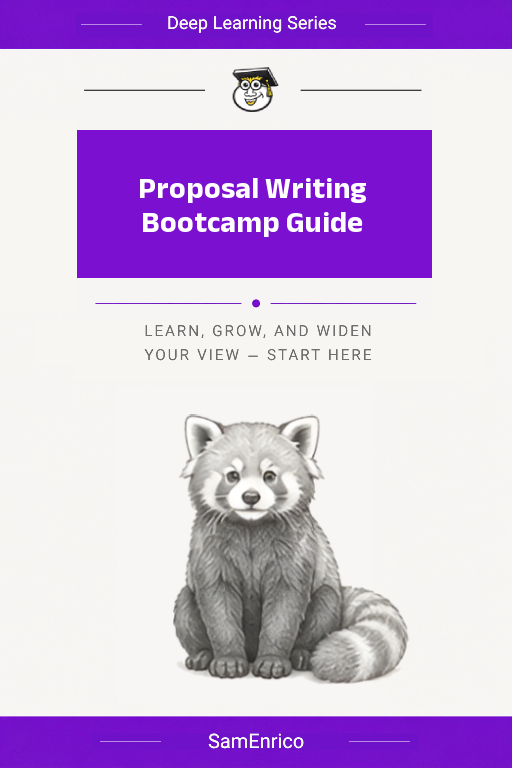
Proposal Writing Bootcamp Guide eBook
Write a complete draft in one week using intensive
by Lira Nakita
Write a complete draft in one week using intensive focused writing sessions.
Formats
Free sample
Chapter 1: The Ghost Deck--–- The blank page is lying to you. It always does. It sits there, white and innocent, and whispers a seductive promise: “Whenever you are ready, I will wait.” That promise is a trap. The blank page will wait forever. It has no deadlines.
It has no urgency. It has no memory of the RFP that landed in your inbox at 4:47 PM on a Friday, the one that gave you five days to respond including the weekend. The blank page does not care that your competitor has a three-person proposal team and you are alone. The blank page is patient. And patience is exactly what will kill you.Every proposal writer knows this feeling.
You open a new document. You stare at the cursor blinking at the top of page one. You know you need to write something persuasive, something that will make the client choose you over every other bidder. But nothing comes. Or rather, everything comes at once—a jumble of ideas, data points, case studies, budget constraints, team bios, and urgent emails from colleagues who “just have a few quick thoughts.” You cannot hold all of it in your head.
So you freeze. You open a browser window to “do a little research.” Four hours later, you have seventeen tabs open, a half-empty coffee mug, and zero new paragraphs.The blank page is not your enemy. It is your mirror. It reflects back the chaos in your head. The solution is not to try harder.
The solution is to stop trying to write the final document on the first pass. The solution is the Ghost Deck.The Ghost Deck is a private, ugly, bullet-point-only document where you dump every idea, fact, argument, question, and fragment that might belong in your proposal. It is never seen by a client or a colleague. It is never judged. It is never edited.
It is simply the place where you externalize your brain so you can stop carrying the weight of the proposal in your working memory. Think of it as a junk drawer. Think of it as a pile of lumber before you build the house. Think of it as permission to write badly so you can later write well.This chapter is the first and most important action step in the entire bootcamp. Before you outline.
Before you write a single sentence of the proposal. Before you even finish reading this book. You will write a Ghost Deck. You will do it now. And you will discover that the hardest part of proposal writing is not the writing.
It is the starting. The Ghost Deck is how you start.Why Your Brain Needs a Dump Truck Neuroscience has a concept called “cognitive load.” It is the total amount of mental effort being used in your working memory at any given moment. Your working memory is not infinite. In fact, it is quite small—most researchers estimate that you can hold only four to seven discrete pieces of information in your head at once. When you exceed that limit, your brain starts to drop things.
You forget the clever phrase you thought of five minutes ago. You lose track of the argument you were building. You reread the same RFP paragraph three times and still cannot remember what it said.Now consider what you are trying to hold in your head when you write a proposal. The client’s problem. Your solution.
The budget. The timeline. The team’s qualifications. Three different case studies. A competitor’s weakness.
A stakeholder’s hidden objection. A deadline that is approaching too fast. A colleague’s feedback that you have not yet incorporated. A formatting requirement buried on page twelve of the RFP.That is not four to seven pieces of information. That is twenty to thirty.
You cannot hold all of that in your head. So your brain does the only thing it can do: it stops moving. It freezes. It stares at the blank page. The blank page is not the problem.
The blank page is a symptom. The problem is cognitive overload.The Ghost Deck is a dump truck for your cognitive load. You empty your brain onto the page. You do not organize. You do not prioritize.
You do not evaluate. You simply transfer. And the moment a piece of information leaves your head and appears on the page, your brain releases it. You no longer have to hold it. You can think about something else.
You can see what you have. You can notice gaps, contradictions, and opportunities that were invisible when everything was trapped inside your skull.This is not a metaphor. This is a mechanical process. Writing a Ghost Deck physically changes your cognitive state. It is the difference between trying to solve a jigsaw puzzle while holding all the pieces in your hands versus dumping them onto a table where you can see them.
The Ghost Deck is the table.The Rules of the Ghost Deck (Break Every Other Rule)The Ghost Deck has only four rules. They are simple. They are non-negotiable. And they are the opposite of every rule you have internalized about professional writing.Rule One: Bullet points only. No paragraphs.
No transitions. No topic sentences. No conclusions. Just bullets. A bullet can be a single word.
A bullet can be a question. A bullet can be a fragment that only you would understand. “Client losing money.” “Maria.” “Phase 2 problem.” “47kvs47k vs 47kvs40k.” These are all perfect bullets. If you find yourself writing a complete sentence, stop. Break it into smaller bullets.
If you find yourself writing two sentences in a row, stop. You are no longer dumping. You are organizing. Organizing comes later.Rule Two: No deleting. Ever.
During the Ghost Deck phase, deletion is forbidden. If you write something and immediately realize it is wrong, do not delete it. Put a question mark next to it. Put “WRONG” in all caps next to it. But leave it on the page.
Why? Because the impulse to delete is the impulse to edit. Editing during the dumping phase is like cleaning your tools while the house is on fire. You will have plenty of time to delete later. During the Ghost Deck, you are only allowed to add.Rule Three: No judgment.
Your Ghost Deck will contain stupid ideas. It will contain brilliant ideas that you cannot yet see are brilliant. It will contain things that make no sense. It will contain misspellings. It will contain inside jokes that only you understand.
This is not only allowed. It is required. Judgment is the enemy of volume. Volume is the enemy of the blank page. You need volume first.
Judgment comes in Chapter 9, when you are holding a complete draft and a red pen.Rule Four: Speed over accuracy. Do not check facts. Do not look up numbers. Do not verify quotes. If you think the client’s revenue is “around twelve million,” write “~$12M revenue” and keep moving.
If you cannot remember the name of the case study, write “hospital case study 2022” and keep moving. If you are unsure whether the timeline should be 90…
This is the end of the free sample. Get the eBook to keep going. Buy now
About this book
Details
- Author
- Lira Nakita
- Publisher
- SamEnrico
- Language
- English
- Genre
- Non-Fiction, Student's Shortcut
- Released
- 2026-06-01
- Pages (approx.)
- 125
- Available as
- eBook, Audiobook

Read better in the ZLOADR app
Your eBooks on your phone or tablet. Sign in with your SamEnrico account and start reading.
More by Lira Nakita
 CrossFit Rope ClimbsLira Nakita$11.99
 GoodNotes Reminder SystemLira Nakita$11.99
 Small Talk for Widows and WidowersLira Nakita$11.99
 Math Formula MemoryLira Nakita$11.99
 Coworker Interruption Stoppage GuideLira Nakita$11.99
 The Foster Care to TraffickingLira Nakita$11.99
 The Clove Cigarette QuitLira Nakita$11.99
 Twin Loss DeathLira Nakita$11.99
 Nonviolent Communication EQ CourseLira Nakita$11.99
 The Great Cartographic Heist: How a Map Redrew a NationLira Nakita$11.99
 The Silent Scream: The Forgotten Patients of Pennsylvania's Farview State HospitalLira Nakita$11.99
 Ironclads and Iron Will: The Naval War That Split a NationLira Nakita$11.99
You may also like
 Hong Kong Handover 1997Dunn Johnnie$11.99
 Zumba For Postnatal Recovery CourseNeal Christian$11.99
 Zumba for BeginnersLadner Nikia$11.99
 YouTube Comment Mining GuideHumes Pandora$12.99
 Worry Box MeditationCarlin Rudy$11.99
 Workplace Stress MeditationNguyen Lynn$11.99
 Workplace Stress and Sleep RepairHawley Ivory$11.99
 Workplace Perfectionism CureDelaney Jeffry$11.99
 Workplace Injustice Anger GuideWallen Isabelle$11.99
 Work Addiction and Burnout LinkGreenwood Ester$11.99
 Women in Yoga and WellnessBeattie Galina$11.99
 Women in Stand Up ComedyChun Evangeline$11.99