
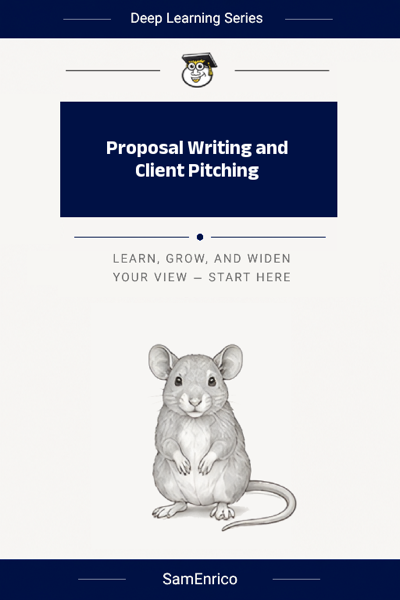
Non-FictionInformativeEducational
Proposal Writing and Client Pitching eBook
A Coursebook on Proposal Writing and Client Pitchi
by Manns Kenna
A Coursebook on Proposal Writing and Client Pitching
Formats
Free sample
Chapter 1: The Feature Funeral--The proposal that lost you your biggest deal last year didn't fail because of a typo. It didn't fail because your pricing was too high, your team bio was uninspiring, or because the client "just clicked better" with the incumbent. It failed for one reason and one reason only: you gave the client a feature list when they were desperate for a business case.I know this because I've written over three hundred proposals in my career. I've won some I had no business winning—against competitors with deeper relationships, bigger teams, and lower prices. And I've lost some that, by every logical measure, I should have won.
The difference between those wins and losses was never the quality of my writing, the beauty of my design, or the length of my case study library. The difference was whether I understood a single, brutal truth: clients do not read proposals. They calculate.Let me say that again because it is the foundation of everything that follows in this book. Your client will not read your proposal. The executive who makes the final decision will spend between ninety seconds and four minutes on your document.
The rest of the time, they will be on email, in meetings, or thinking about their dinner plans. In those ninety seconds, they are not looking for your methodology diagram, your clever tagline, or your list of happy customers. They are looking for one number: the answer to the question, "What is this going to do for me?"And if you do not put that number front and center—in the first sentence, on the first page, in language so plain that an eighth grader could understand it—you are not writing a proposal. You are writing a suicide note for your own deal.The $2.4 Million Mistake I learned this lesson the hard way. The very hard way.Seven years ago, I was running a small consulting firm.
We had thirty employees, a decent reputation, and a proposal template that I thought was the best in the industry. It was thirty-seven pages long, beautifully designed by a freelance graphic artist I'd paid two thousand dollars, and filled with everything I thought a "professional" proposal should contain. There was a two-page "About Us" section with glossy headshots of the leadership team. There was a methodology diagram that had taken my operations person three days to perfect—a complex flow of colored boxes connected by arrows that was supposed to demonstrate our "rigorous, data-driven approach." There were testimonials from five happy clients, each one praising our "reliability," our "partnership approach," and our "deep expertise."We were bidding on a two-million-dollar contract with a regional logistics company. Their problem, on the surface, was simple: twenty-three percent of their deliveries were arriving late, and their largest retail customer was threatening to cancel a contract worth eight million dollars annually.
The client had issued a formal Request for Proposals. Three firms had been invited to respond. We were one of them.I spent six weeks on that proposal. Six weeks of interviews with their team. Six weeks of data analysis.
Six weeks of writing, rewriting, designing, and perfecting. I was proud of what we created. It was, by every measure of traditional "quality," an excellent document. It was thorough. It was polished.
It was professional.We lost to a competitor who submitted a two-page PDF. Two pages. Not thirty-seven. Not beautifully designed. The document had no logo, no headshots, no methodology diagram.
It opened with five bullet points. The first bullet point read: "You are currently losing $2.4 million annually to late deliveries. Here is how we stop that in ninety days."That was it. That was the proposal. Two pages.
Five bullet points. One number.I was furious. I called the client—the VP of Operations who had run the selection process—and asked, as politely as I could manage, how they could possibly choose a two-page PDF over our thirty-seven-page masterpiece. His answer changed my career.He said, "I didn't read your proposal. I opened it, saw thirty-seven pages, and handed it to my analyst.
My analyst summarized it for me in fifteen minutes. The other proposal, I read on my phone between meetings. It told me what I needed to know in thirty seconds. So I went with them."That was the moment I understood. My beautiful, thorough, "professional" proposal was not a tool to help the client decide.
It was a barrier to their decision. I had made them work to understand my value. The competitor had handed them the answer on a silver platter.The Empty Pipeline Fallacy Before we go any further, I need to address the most common objection I hear when I tell this story. Someone in the back of the room always raises their hand and says, "But we have to respond to RFPs. We don't control the process.
The client asks for a proposal, and we have to give them what they ask for."This is the Empty Pipeline Fallacy, and it is the single most destructive belief in the entire proposal-writing profession.The Empty Pipeline Fallacy is the trap of waiting for a formal Request for Proposals before engaging with a client. It is the assumption that the RFP is the starting line—that until that document arrives in your inbox, there is nothing you can or should do. This fallacy is taught implicitly by every procurement department in the world, because procurement departments exist to make vendors interchangeable. The RFP process is designed to turn your unique solution into a commodity that can be compared on price and features alone.Here is the truth that procurement departments do not want you to know: by the time an RFP is released, the winner has already been decided eighty-three percent of the time. I am not making up that number.
It comes from a study of over seven hundred B2B transactions conducted by the Sales Management Association. In eighty-three percent of competitive bids, the client has already mentally selected a vendor before the RFP is even issued. The RFP process is not a search for the best solution. It is a bureaucratic requirement—a box to check—before signing a deal that was shaped weeks or months earlier.Who shapes the client's thinking before the RFP? The competitor who was proactive.
The competitor who did not wait for an invitation. The competitor who called the client when there was no RFP, asked questions no one else was asking, and helped the client understand their own problem before they even knew they had it.In my logistics company example, the competitor who won with the two-page PDF had been talking to the VP of Operations for three months before the RFP was issued. They had flown to the client's headquarters for a "strategy workshop" that was really a sales call. They had helped the client calculate their cost of inaction—that $2.4 million number—before anyone else even knew there was a bid coming. By the time I received the RFP, the deal was already over.
My thirty-seven-page proposal was not a bid to win. It was a courtesy to make the process look competitive.This is…
This is the end of the free sample. Get the eBook to keep going. Buy now
About this book
Details
- Author
- Manns Kenna
- Publisher
- SamEnrico
- Language
- English
- Genre
- Non-Fiction, Informative, Educational
- Released
- 2026-06-02
- Pages (approx.)
- 144
- Available as
- eBook, Audiobook

Read better in the ZLOADR app
Your eBooks on your phone or tablet. Sign in with your SamEnrico account and start reading.
More by Manns Kenna
 Empathy For Self Harm GuideManns Kenna$11.99
 New Parent Stress First Year GuideManns Kenna$11.99
 The Governor's Medicaid ExpansionManns Kenna$11.99
 Faecalibacterium PrausnitziiManns Kenna$11.99
 Complex Sleep Apnea GuideManns Kenna$11.99
 The Money Talk Couples WorkbookManns Kenna$11.99
 Notion Database MemoryManns Kenna$11.99
 Pomodoro For ResearchManns Kenna$11.99
 Naps Improve Recall MethodManns Kenna$11.99
 The Shadow of the Games: The Untold Story of the 18th-Century African Olympic PredecessorManns Kenna$11.99
 The Last Silent Star: How Mary Pickford Fought for SoundManns Kenna$11.99
 Entangled Minds: The Quantum Leap of Nikola Tesla’s Lost BlueprintManns Kenna$11.99
You may also like
 Hong Kong Handover 1997Dunn Johnnie$11.99
 Zumba For Postnatal Recovery CourseNeal Christian$11.99
 Zumba for BeginnersLadner Nikia$11.99
 YouTube Comment Mining GuideHumes Pandora$12.99
 Worry Box MeditationCarlin Rudy$11.99
 Workplace Stress MeditationNguyen Lynn$11.99
 Workplace Stress and Sleep RepairHawley Ivory$11.99
 Workplace Perfectionism CureDelaney Jeffry$11.99
 Workplace Injustice Anger GuideWallen Isabelle$11.99
 Work Addiction and Burnout LinkGreenwood Ester$11.99
 Women in Yoga and WellnessBeattie Galina$11.99
 Women in Stand Up ComedyChun Evangeline$11.99