
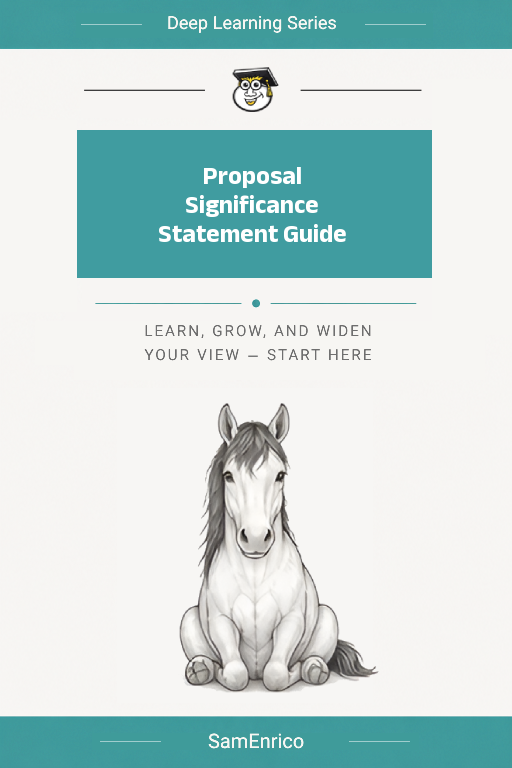
Proposal Significance Statement Guide eBook
Articulate why your research matters and what cont
by Liles Hassie
Articulate why your research matters and what contribution it will make to the field.
Formats
Free sample
Chapter 1: The Sixty-Second Execution...--–- You have sixty seconds. Maybe ninety, if the reviewer just had coffee. In that time, your proposal will be mentally classified as “fundable,” “maybe,” or “dead.” Not after they read your methods. Not after they evaluate your budget. Not even after they finish the first page.
Within the first sixty seconds of reading your title, your abstract, and the opening paragraph of your significance statement, a decision has already begun to form. Everything after that is either confirmation or a very steep uphill battle.This is not cynicism. This is cognitive psychology. Grant panels and journal editors are overworked, underpaid, and reading dozens of submissions in a single sitting. A typical NIH study section reviews fifteen to twenty proposals in a two-day meeting.
Each proposal runs fifteen to twenty pages. That is hundreds of pages of dense, technical prose. No human being reads every word. Instead, reviewers hunt. They hunt for a reason to reject you quickly, because rejecting is faster than funding.
They hunt for a reason to put your proposal in the “discuss” pile instead of the “unfundable” pile. And the single most efficient filter they have is your answer to one question: So what?If your significance statement does not answer that question convincingly in the first sixty seconds, the rest of your proposal does not matter. Your elegant experimental design, your rigorous statistical plan, your world-class collaborator—none of it will be read. Because the reviewer has already concluded that even if you succeed, the result will not matter. And a proposal that produces unimportant results, no matter how technically perfect, is a waste of money.This book exists because that outcome is avoidable.
Most scientists are trained to write descriptively: “The literature shows X. We hypothesize Y. We will test Z.” That is a topic. It tells the reviewer what you are curious about. It does not tell them why they should pay for it.
The difference between a topic and a mandate is the difference between a proposal that dies in sixty seconds and one that survives to the discussion round. A mandate answers the “So what?” question before it is asked. A mandate establishes stakes, names consequences, and makes the reviewer believe that if this work is not done, something bad will happen or something good will be delayed.This chapter will teach you to recognize the difference between a topic and a mandate. It will walk you through the psychology of the reviewer, the mechanics of the sixty-second rule, and a diagnostic exercise that will expose whether your current significance statement is already dead. By the end of this chapter, you will never look at your opening paragraph the same way again.The Reviewer Is Not Your Enemy.
The Reviewer Is Tired.Let us begin with a hard truth: the person reading your proposal does not want to reject you. They took this job because they believe in science. They believe in peer review. They want to fund good work. But they are also human.
They have their own grants to write, their own students to mentor, their own papers to review. Serving on a study section means reading fifteen dense proposals in two weeks, then sitting in a windowless hotel conference room for two days defending their scores. By the time they get to proposal number twelve, their eyes are glazing over. Their coffee is cold. Their back hurts.In that state, the reviewer is not looking for reasons to fund you.
They are looking for reasons to reject you efficiently. And the most efficient reason is: “The significance is unclear.” That phrase appears in more summary statements than any other. It is the reviewer’s polite way of saying, “I don’t care about this problem, and you didn’t make me care.”Notice what they are not saying. They are not saying your hypothesis is wrong. They are not saying your methods are flawed.
They are not saying you lack expertise. Those are all fixable problems. “The significance is unclear” is a death sentence because it is not fixable by better methods. It is fixable only by a better story. And most scientists have never been taught how to tell that story.The reviewer’s brain operates on a simple heuristic: important problems justify expensive solutions; unimportant problems do not.
If you have not convinced them that the problem is important in the first sixty seconds, they will assume it is not. And they will move on. This is not malice. This is pattern recognition. After reading ten proposals about incremental advances, they have learned that proposals which start with broad, urgent language tend to be the ones that matter.
Proposals which start with narrow, descriptive language tend to be the ones that do not. Correlation is not causation, but when you have fifteen proposals to score, correlation is enough.The Sixty-Second Rule: How Reviewers Actually Read Here is what happens in the first sixty seconds of a reviewer’s engagement with your proposal. They open the PDF. They read the title. Four to six seconds.
If the title is vague (“A study of X”), they already suspect the proposal is vague. If the title makes a claim (“X drives Y, and targeting it prevents Z”), they lean forward slightly.They read the abstract. Thirty to forty seconds. They are looking for four things, in order: (1) What is the problem? (2) What is the gap?
(3) What will you do? (4) Why does it matter? If the abstract buries any of these, especially number four, the reviewer mentally flags it. They are not taking notes yet. They are just forming a feeling.
That feeling is either “This seems important” or “This seems like more of the same.”They glance at the first paragraph of the Significance section. Ten to fifteen seconds. They are not reading closely. They are scanning for the first sentence. If the first sentence is background (“It has long been known that…”), they feel a small disappointment.
If the first sentence is a claim (“We have discovered that…” or “The field cannot make progress on Y until we solve X”), they feel a small relief. Relief is good. Relief means they can stop hunting for a reason to reject and start reading for understanding.That is the sixty-second rule. Before they have read your methods, before they have checked your citations, before they have evaluated your budget, they have already formed a preliminary score. That score is not final, but it is sticky.
Changing a reviewer’s mind from “maybe” to “yes” requires extraordinary evidence. Changing it from “dead” to “maybe” is nearly impossible.If you doubt this, try an experiment. Open the last three funded proposals you have access to—your own or a mentor’s. Read only the title, the abstract, and the first paragraph of the Significance section. Time yourself.
Sixty seconds. Now write down: what is the problem? What is the gap? Why does it matter? If you can answer all three easily, the author understood the sixty-second rule.
If you cannot, the author buried their significance under layers of background.Now do the same with three unfunded proposals. The…
This is the end of the free sample. Get the eBook to keep going. Buy now
About this book
Details
- Author
- Liles Hassie
- Publisher
- SamEnrico
- Language
- English
- Genre
- Non-Fiction, Student's Shortcut
- Released
- 2026-05-30
- Pages (approx.)
- 143
- Available as
- eBook, Audiobook

Read better in the ZLOADR app
Your eBooks on your phone or tablet. Sign in with your SamEnrico account and start reading.
More by Liles Hassie
 Bipolar ADHD Comorbidity GuideLiles Hassie$11.99
 The Nap for Toddlers GuideLiles Hassie$11.99
 Parent Loss Memoir Reading GuideLiles Hassie$11.99
 CrossFit Open PreparationLiles Hassie$11.99
 Pain Meditation TipsLiles Hassie$11.99
 The Chemo Chair CalmLiles Hassie$11.99
 Assertiveness For The Newly SoberLiles Hassie$11.99
 Appetite Loss During GriefLiles Hassie$11.99
 Amazon Exit Strategy GuideLiles Hassie$11.99
 Quantum Leap: The Day Time Itself FrozeLiles Hassie$11.99
 The Iron Spires of Prussia: Frederick the Great’s Military MachineLiles Hassie$11.99
 The Vanishing of the Sky People: The Last Flight of the 1937 Airship DisasterLiles Hassie$11.99
You may also like
 LSE Online Program LengthAgee Letisha$11.99
 Harvard Extension School for Working AdultsRoush Yer$11.99
 LSE Online Reading ListAshford Ludivina$11.99
 LSE Online Language RequirementsWhitten Daphine$11.99
 LSE Online Class SizeHughey Garret$11.99
 LSE Online Alumni MentorshipWild Lyla$11.99
 London School of Economics Alumni NetworkDutton Chantal$11.99
 Harvard Extension School Student SupportCantrell Christene$11.99
 Harvard Extension School Library AccessSantana Adah$11.99
 Harvard Extension School Degree CompletionBray Wyatt$11.99
 Harvard Extension School Course AuditingAbbott Craig$11.99
 Harvard Extension School Extension DiplomaNew Joane$11.99