
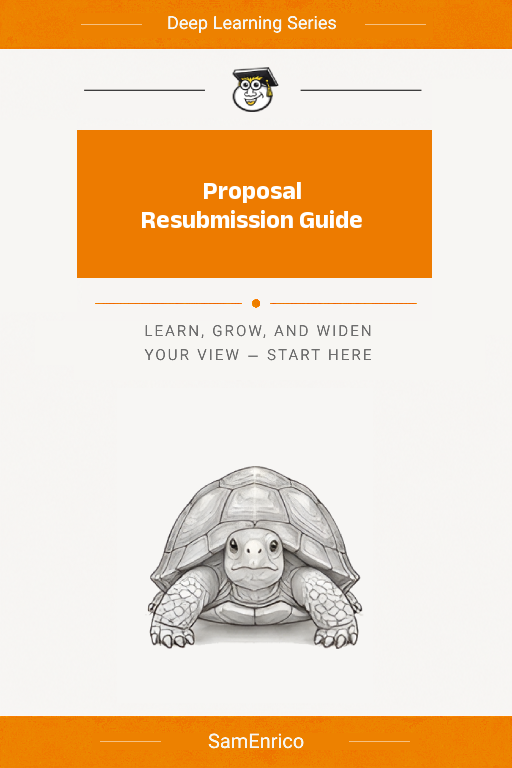
Non-FictionStudent's ShortcutResubmissionRevision Guide
Proposal Resubmission Guide eBook
Resubmit rejected research proposals with revised
Resubmit rejected research proposals with revised sections and response to reviewers document for second chance.
Formats
Free sample
Chapter 1: The Three-Week Pause...--–- The email arrives at 11:47 PM on a Tuesday. You have been waiting for six months. Your finger hovers over the subject line, and for one irrational moment, you consider not opening it. But you do. "We regret to inform you..." The rest blurs.
Your chest tightens. Your first thought is not about the science—it is about the reviewer who clearly did not understand your work, the editor who was biased, the funding agency that gave your brilliant idea to a less deserving competitor. You close the laptop. You do not sleep. And tomorrow, you will make a catastrophic mistake: you will start revising immediately.This chapter exists to stop you from making that mistake.
Before you touch a single word of your proposal, before you draft a single sentence of your response to reviewers, you will do something that feels counterintuitive. You will stop. You will wait. And you will learn to turn the most painful email of your professional life into your greatest strategic advantage.Rejection is not a verdict. It is a dataset.
But you cannot analyze data when your amygdala is on fire. This chapter provides the psychological reset, the timeline decision framework, and the emotional toolkit you need before any revision begins. You will learn the critical difference between a soft rejection and a hard rejection—and why confusing the two has killed more resubmissions than weak science ever has. You will complete a self-assessment checklist that determines whether you are emotionally ready to proceed or whether you need the full three-week detox. And you will make a conscious, strategic decision about your timeline: full detox, compressed five-day detox, or the emergency Panic Button for deadlines less than one week away.By the end of this chapter, you will not have revised a single sentence.
But you will have done something more important. You will have taken back control.The Anatomy of a Rejection Email Before you can respond to rejection, you must understand what you are actually reading. Most researchers treat the decision letter as a monolithic verdict—"they said no"—when in fact, rejection exists on a spectrum. Misreading where your proposal falls on that spectrum is the first and most expensive error in the resubmission process.Soft Rejection: The Gift Wrapped in Criticism A soft rejection is any decision that explicitly invites a revised submission. You will recognize it by specific phrases in the decision letter:"We would be willing to consider a revised version...""The reviewers have identified concerns that, if addressed, would make this proposal competitive...""Major revisions are required before we can reconsider...""Resubmission is encouraged after addressing the following points..."In funding contexts, a soft rejection might be labeled "Revise and Resubmit," "Revised Application Welcome," or simply "Not Funded but Encouraged to Resubmit." The key signal is not the word "rejection"—it is the explicit invitation to try again.
Soft rejections are not failures. They are conditional acceptances. The reviewers are essentially saying: "Your idea has merit, but you have not yet convinced us. Show us the missing evidence, and we will say yes."Approximately 60-70 percent of grant proposals that are ultimately funded receive at least one soft rejection first. Many receive two or three.
The NIH reports that the average R01 grant that is funded has been submitted 1.8 times. That is not a typo. The average funded grant was rejected once before finding success.Hard Rejection: The Door Closing (But Not the Building)A hard rejection is any decision that does not invite a resubmission to the same venue. You will recognize it by phrases like:"We cannot accept this manuscript for publication...""The proposal does not align with current priorities...""The reviewers have identified fundamental flaws..."No invitation to resubmit appears anywhere in the letter.Here is where most researchers make their second mistake. They read a hard rejection and conclude: "My proposal is dead." That is wrong.
A hard rejection from a specific journal or funding agency means only that you cannot resubmit to that same venue. It does not mean your proposal is unsound. It does not mean your science is bad. It means the fit was wrong, the timing was wrong, or the specific reviewers assigned to your proposal had irreconcilable objections.Consider this real example: A cancer biology proposal was rejected outright by a high-impact journal with the note "not of sufficient general interest." The principal investigator did not despair. She submitted the exact same proposal—with no revisions—to a specialized cancer journal.
It was accepted within six weeks. The proposal had not changed. The audience had.Hard rejections are often about fit, not quality. Chapter 11 of this book will teach you how to pivot to a different venue after a hard rejection, including how to disclose previous reviews ethically and how to reframe your response document for a new audience. For now, the only thing you need to know is this: a hard rejection is not a funeral.
It is a redirection.The Rejection Spectrum: A Quick Reference Decision Type Same Venue Resubmission Strategic Response Soft rejection (explicit invitation)Yes, strongly encouraged Full revision + response document (Chapters 2-10)Soft rejection (implicit, e.g., "major revisions")Usually yes Same as above Hard rejection (desk rejection, no invitation)No Pivot to new venue (Chapter 11) or abandon Hard rejection with encouraging language (rare)Sometimes—check policy Proceed with caution; may need to appeal first The most dangerous rejection is the ambiguous one: a letter that does not explicitly invite resubmission but also does not forbid it. In these cases, check the venue's official policy. If resubmission is not prohibited, consider sending a one-paragraph inquiry to the editor or program officer before investing time in revisions.The Emotional Hijack: Why You Cannot Trust Your Brain Right Now You are about to do something that feels productive but is actually destructive: you are going to start writing rebuttals in your head. "That reviewer clearly did not read my proposal." "The editor must have had a conflict of interest." "They gave funding to someone with less preliminary data."Stop. You are not being logical.
You are being emotional. And that is not a character flaw—it is neurobiology.The Science of Rejection When you experience a social or professional rejection, the same brain regions activate as when you experience physical pain. Neuroscientific studies using functional magnetic resonance imaging have shown that the dorsal anterior cingulate cortex—a region associated with the distressing aspect of physical pain—lights up when participants are excluded from a simple ball-tossing game. Your brain literally cannot distinguish between being told your grant was rejected and being punched in the stomach.At the same time, your amygdala—the brain's threat detection center—goes into overdrive. It floods your system with cortisol and adrenaline.
Your prefrontal cortex, responsible for rational planning and impulse control, is partially suppressed. This is not a metaphor. Your IQ literally drops in the hours and days following a significant rejection. One study found that cognitive performance can decrease by up to 13 points under acute social threat.This is why you cannot revise your proposal immediately. Not because you lack willpower.
Because your brain is not capable of doing the work well.The Defensive Anger Trap The most common emotional response to…
This is the end of the free sample. Get the eBook to keep going. Buy now
About this book
Details
- Author
- Juarez Coralie
- Publisher
- SamEnrico
- Language
- English
- Genre
- Non-Fiction, Student's Shortcut, Resubmission, Revision Guide
- Released
- 2026-06-01
- Pages (approx.)
- 152
- Available as
- eBook, Audiobook

Read better in the ZLOADR app
Your eBooks on your phone or tablet. Sign in with your SamEnrico account and start reading.
More by Juarez Coralie
 Achievement Hunter Recovery HandbookJuarez Coralie$11.99
 LBO Fund Model GuideJuarez Coralie$11.99
 EBITDA Adjustments DatabaseJuarez Coralie$11.99
 Bariatric Surgery Psychiatrist ConsultationJuarez Coralie$11.99
 FODMAP and Stress Management GuideJuarez Coralie$11.99
 Voltage Wars: The Tesla vs. Edison Feud That Lit the FutureJuarez Coralie$11.99
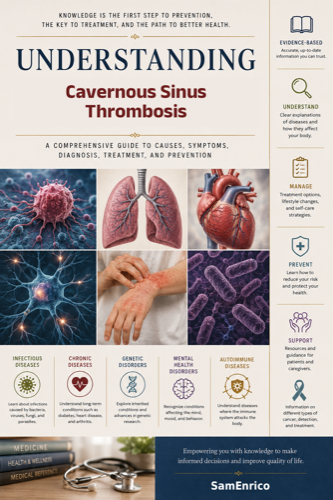 Understanding Cavernous Sinus ThrombosisJuarez Coralie$17.99
 How to Become a Insecticide MixerJuarez Coralie$11.99
 AI Financial Peer BenchmarkingJuarez Coralie$12.99
 DZ Delivery DriverJuarez Coralie$11.99
You may also like
 Hong Kong Handover 1997Dunn Johnnie$11.99
 Zumba For Postnatal Recovery CourseNeal Christian$11.99
 Zumba for BeginnersLadner Nikia$11.99
 YouTube Comment Mining GuideHumes Pandora$12.99
 Worry Box MeditationCarlin Rudy$11.99
 Workplace Stress MeditationNguyen Lynn$11.99
 Workplace Stress and Sleep RepairHawley Ivory$11.99
 Workplace Perfectionism CureDelaney Jeffry$11.99
 Workplace Injustice Anger GuideWallen Isabelle$11.99
 Work Addiction and Burnout LinkGreenwood Ester$11.99
 Women in Yoga and WellnessBeattie Galina$11.99
 Women in Stand Up ComedyChun Evangeline$11.99