
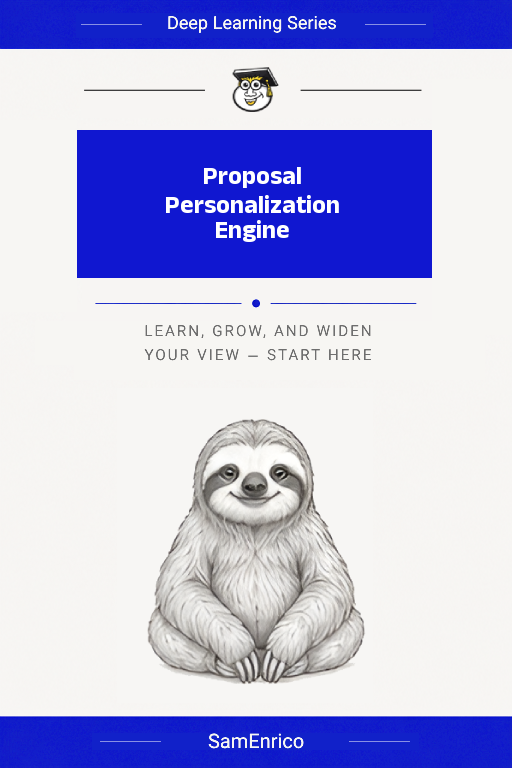
Non-FictionAI OperatorRevenue OperationsPersonalization Guide
Proposal Personalization Engine eBook
Tailor templated proposals to specific industries,
Tailor templated proposals to specific industries, personas, and pain points using AI at scale. Includes variable injection, example customization, and executive summary generation.
Formats
Free sample
Chapter 1: The $2 Trillion Blindspot--The email arrived at 11:47 PM on a Tuesday. Sarah had been staring at her screen for fourteen hours, jumping between eight different proposals, four personas, and three industries. Her company, a fast-growing B2B Saa S provider called Cloud Shield, was chasing a $2.3 million deal with a multinational logistics firm. The discovery calls had gone perfectly. The product-market fit was undeniable.
The champion inside the prospect’s organization had all but promised her the deal.But now, staring at the final proposal she had just pasted together from three different templates, Sarah felt sick. The executive summary still said "Acme Corporation" in two places. The case study she had included was for a retail client, not logistics. The pricing table reflected last quarter’s discounting policy. And the closing paragraph—the one she had used fifty times before—was identical to the proposal she had sent to a failed deal three weeks ago.She sent it anyway.
At 12:03 AM, exhausted and defeated by the math she couldn’t overcome.Seventy-two hours later, the prospect called. "Sarah, we loved your team. Your product is excellent. But your proposal felt... generic.
Like you didn’t really understand our specific supply chain challenges. We’re going with a competitor who clearly did their homework."The deal was gone. Not because of product. Not because of price. Because of a proposal that screamed "template" from the first paragraph.Sarah had just become a statistic.The 95% Rejection Reality Let me tell you something that every sales leader knows but rarely admits: the era of "spray and pray" proposals is over.
It didn’t end with a dramatic announcement or a software update. It ended quietly, deal by lost deal, as buyers became fluent in the language of boilerplate.Today, generic templated proposals face a rejection rate exceeding 95% in competitive bids. That is not a typo. Ninety-five percent. The remaining 5% that win?
They win despite the template, not because of it—usually due to pre-existing relationships, monopoly pricing power, or a buyer who simply needed a compliance checkbox.Why? Because buyers have become extraordinarily sophisticated at pattern recognition. A chief procurement officer at a Fortune 500 company told me, "I can spot a template within the first three sentences. The language is smooth but hollow. The promises are generic.
The examples never quite match my actual business. It feels like someone filled in the blanks rather than solved my problem."This is not a moral failing of salespeople. It is a mathematical impossibility masquerading as a performance problem.Consider the Math of Scaling. The average B2B sales organization targets 500 accounts per sales development representative (SDR) or account executive (AE) per quarter. Within those 500 accounts, you typically need to address at least 4 distinct buyer personas: the economic buyer (CFO), the technical buyer (CTO/CIO), the end-user buyer (department head), and the champion (your internal advocate).Now do the multiplication: 4 personas × 500 accounts = 2,000 uniquely tailored assets per salesperson per quarter.
That is 2,000 different proposals, executive summaries, pricing tables, case study selections, and follow-up sequences.Let me ask you a question. How many hours are in a quarter? For a full-time sales professional working 50-hour weeks (and most work more), that is approximately 650 working hours per quarter. To manually produce 2,000 personalized assets would require a new proposal every 19.5 minutes, twenty-four hours a day, seven days a week, with no meetings, no discovery calls, no internal syncs, and no sleep.The human brain cannot do this. The average sales team cannot do this.
No amount of "working harder" or "better time management" or "sales training" will ever bridge this gap because it is not a productivity problem. It is a scaling problem. And scaling problems require systems, not willpower.This book is that system.The $2 Trillion Opportunity Now for the good news. The same math that makes personalization impossible manually makes it extraordinarily valuable when automated.Economic modeling across the B2B technology, professional services, and manufacturing sectors reveals a stunning figure: the global market inefficiency caused by generic proposals totals approximately $2 trillion annually. That is two trillion dollars left on the table—not because products are inferior, not because prices are too high, but because proposals fail to convince.Where does this number come from?Consider the average enterprise sales cycle.
A typical B2B technology company generates $10 million in annual recurring revenue (ARR) with a 30% win rate on qualified opportunities. That means 70% of the deals they pursue—deals that passed initial discovery, budget checks, and technical validation—still die at the proposal stage or during final negotiation.Now multiply that 70% loss rate across the 500,000 B2B technology companies in North America and Europe. Factor in professional services firms losing consulting engagements to more persuasive proposals. Add manufacturing firms losing equipment contracts because their proposals felt "off the shelf." The total addressable loss approaches $2 trillion annually.But here is the critical insight: this is not a demand problem. It is a communication problem.
The buyers need the solution. The sellers have the solution. The proposal fails to connect them. And that failure is fixable.The 5 Promises Framework To understand what a winning proposal actually requires—before we build the engine to produce it—let me introduce the 5 Promises Framework. This is adapted from the groundbreaking work by Abraham and Edelman in Personalized, reframed specifically for the proposal stage of the buyer’s journey.A proposal is not a document.
A proposal is a set of promises. And every promise you break—or fail to make convincingly—gives the buyer permission to say no.Promise 1: Know Me The first promise a proposal must make is that you have done your homework. You know their industry. You understand their specific situation. You are not reading from a script.How do you keep this promise?
By referencing details that could only come from attentive listening. Mention the competitor they mentioned on the discovery call. Reference the challenge their CEO discussed in last quarter’s earnings report. Acknowledge the regulatory pressure their compliance officer mentioned in passing.Generic proposals assume ignorance. Winning proposals prove knowledge.Promise 2: Show Me The second promise is demonstration.
Not of your product’s features—those are table stakes—but of how your solution maps directly to their stated problems.This is where most proposals fail. They list features. They describe capabilities. They use passive voice and corporate jargon. What buyers actually want is a clear, logical chain: "You said X is your problem.
Here is how our solution addresses X. Here is what success looks like. Here is the timeline. Here is the investment."The "Show Me" promise is about translation. You translate your generic capability into their specific outcome.Promise 3: Delight Me The third promise is the one that separates transactional vendors from trusted partners.
Delight comes from unexpected relevance—the insight they didn’t ask for but immediately recognize as valuable.This might be a case study from an eerily similar company. It might be a risk mitigation strategy they hadn’t considered. It might be a novel pricing model that aligns with their cash flow constraints. Delight is not about flattery. It is about showing that you have thought about their business more deeply than they have…
This is the end of the free sample. Get the eBook to keep going. Buy now
About this book
Details
- Author
- Mallory Nelia
- Publisher
- SamEnrico
- Language
- English
- Genre
- Non-Fiction, AI Operator, Revenue Operations, Personalization Guide
- Released
- 2026-05-30
- Pages (approx.)
- 130
- Available as
- eBook, Audiobook

Read better in the ZLOADR app
Your eBooks on your phone or tablet. Sign in with your SamEnrico account and start reading.
More by Mallory Nelia
 Body Language for Sales SuccessMallory Nelia$11.99
 MBSR For Social Anxiety GuideMallory Nelia$11.99
 Financial Recovery After Burnout WorkbookMallory Nelia$11.99
 Malachi Prophet AccountMallory Nelia$11.99
 The Self Esteem for Highly Sensitive PeopleMallory Nelia$11.99
 Excalibur’s Last Guardian: The Forgotten Knight of the Round TableMallory Nelia$11.99
 Understanding Kousseff SyndromeMallory Nelia$17.99
 Anodizing TechnicianMallory Nelia$11.99
 SaaS Freemium Conversion GuideMallory Nelia$12.99
 How to Start a Hobby in ScootersMallory Nelia$11.99
You may also like
 Hong Kong Handover 1997Dunn Johnnie$11.99
 Zumba For Postnatal Recovery CourseNeal Christian$11.99
 Zumba for BeginnersLadner Nikia$11.99
 YouTube Comment Mining GuideHumes Pandora$12.99
 Worry Box MeditationCarlin Rudy$11.99
 Workplace Stress MeditationNguyen Lynn$11.99
 Workplace Stress and Sleep RepairHawley Ivory$11.99
 Workplace Perfectionism CureDelaney Jeffry$11.99
 Workplace Injustice Anger GuideWallen Isabelle$11.99
 Work Addiction and Burnout LinkGreenwood Ester$11.99
 Women in Yoga and WellnessBeattie Galina$11.99
 Women in Stand Up ComedyChun Evangeline$11.99