
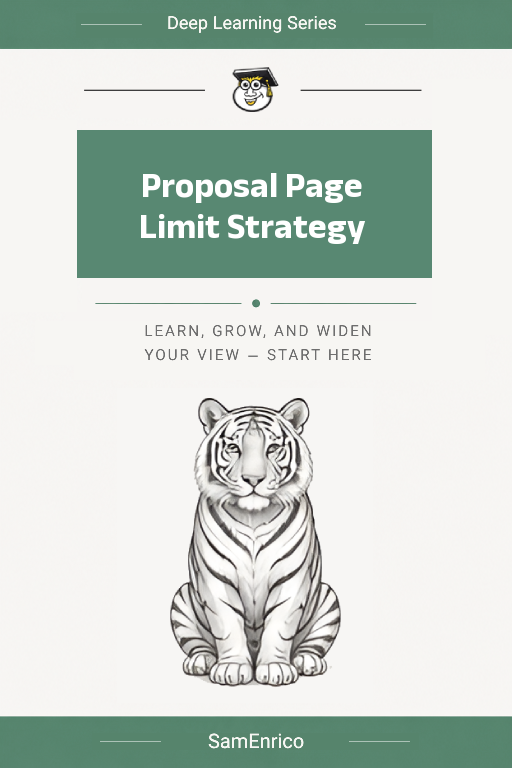
Non-FictionStudent's ShortcutPage LimitFormat Strategy
Proposal Page Limit Strategy eBook
Meet strict page limits for research proposals wit
Meet strict page limits for research proposals with formatting tricks and prioritizing essential content over nice to have.
Formats
Free sample
Chapter 1: The 5-Minute Prison--–- The first time you submit a research proposal, you believe the page limit is a bureaucratic nuisance. The second time, you suspect it is a test of endurance. By the third rejection, you realize the truth: the page limit is not about pages at all. It is about time. Specifically, it is about the five to fifteen minutes that a exhausted, overcommitted reviewer will spend on your document before assigning a score that determines the fate of years of your work.
This chapter reveals the single most important psychological shift you must make to master the page limit: stop thinking of the limit as a constraint on your writing and start thinking of it as a mirror of reviewer fatigue. Once you understand that the reviewer is not reading your proposal—they are skimming it under duress—you will never format or write the same way again.The Myth of the Attentive Reviewer Every new grant writer operates under a dangerous assumption: that the reviewer will read every word carefully, weigh each argument fairly, and follow every logical transition from start to finish. This assumption is polite, professional, and completely wrong. Data from the National Institutes of Health and the National Science Foundation, collected through reviewer surveys and time-tracking studies, paint a very different picture. The average reviewer is a tenured faculty member who has been assigned fifteen to twenty proposals to evaluate in a three-week window, alongside teaching, lab management, manuscript revisions, and committee meetings.
They are not reading your proposal in a quiet library with a cup of coffee. They are reading it at 11:00 PM on a Sunday, on a laptop, while their own grant deadline looms.The numbers are sobering. Studies of peer review panels consistently show that the initial screening of a proposal—the pass-fail decision that separates fundable from non-fundable—takes between five and fifteen minutes. In some disciplines, it is even faster. A 2018 analysis of NIH R01 reviews found that the average reviewer spent just under eight minutes on the first read of a proposal before forming an initial score.
The remaining time was spent justifying that score to the panel, not re-reading the science. This means that the first eight minutes of your proposal’s life are the only minutes that matter. If you have not convinced the reviewer in that window, no amount of brilliant data in the appendix will save you.This is what this book calls the 5-Minute Prison. The page limit is the bars of the cell. The reviewer’s fatigue is the lock.
And your only escape is to build a proposal that can be understood, evaluated, and scored in the time it takes to boil an egg.The Skim Test: Designing for the Inattentive Eye If the reviewer is not reading, what are they doing? They are skimming. Specifically, they are hunting for three things: Significance, Innovation, and Approach. These are the standard scoring criteria for nearly every major funding agency in the world, from the NIH and NSF to the European Research Council and the Wellcome Trust. The reviewer is not reading your beautiful prose.
They are scanning for keywords, section headers, and visual anchors that tell them whether you have met these three criteria.This leads to the first and most important tool in this book: the Skim Test. Before you submit any proposal, you must be able to hand it to a colleague who knows nothing about your field and ask them to point to the three sentences that state your significance, your innovation, and your approach—within thirty seconds. If they cannot, your proposal will fail.The Skim Test is not about dumbing down your science. It is about designing for the human brain. Reviewers, like all humans, have what psychologists call “banner blindness” when reading dense text.
They will skip long paragraphs entirely. They will ignore transitions. They will jump to bullet points, bolded text, and figure captions. Your job is to put your most important claims exactly where the reviewer’s eye naturally goes.Here is the anatomy of a skimmable page. Start with a strong section header in bold or a slightly larger font.
Follow it immediately with a topic sentence that contains a keyword from the review criteria—words like “significant,” “novel,” “unresolved,” “first,” “only,” “demonstrate.” Then use short paragraphs of no more than three to four sentences. Within those paragraphs, put your strongest claim at the beginning, not the end. The reviewer will read the first sentence of each paragraph and decide whether to continue. If the first sentence is fluff, the paragraph is dead.Consider two versions of the same paragraph. Version A: “In recent years, there has been considerable interest in the role of protein kinase B in cellular metabolism.
A number of studies have suggested that this pathway may be involved in insulin signaling, although the precise mechanisms remain unclear. Therefore, we propose to investigate the hypothesis that protein kinase B regulates glucose uptake through phosphorylation of the GLUT4 transporter.” Version B: “Protein kinase B controls glucose uptake. This is the central, unresolved question in metabolic regulation. We hypothesize that phosphorylation of GLUT4 by protein kinase B is the missing link.” Version B is shorter, clearer, and skimmable. The reviewer finds the significance (“controls glucose uptake”) in the first five words.
Version B passes the Skim Test. Version A does not.The Nice-to-Have Audit: A Psychological Exercise in Amputation The most painful part of mastering the page limit is not learning new formatting tricks. It is admitting that most of what you have written does not need to be there. Every grant writer falls in love with certain sentences—the elegant turn of phrase, the exhaustive literature review, the carefully nuanced caveat. These are your “darlings,” as the writing cliché goes.
And you must kill them.This book calls this process the Nice-to-Have Audit. Take your complete draft and print it out. Get a highlighter in a bright color—yellow or pink. Now read every sentence one by one and ask yourself a brutal question: “If I delete this sentence, does the reviewer lose the ability to understand my hypothesis, my methods, or my expected outcomes?” If the answer is no, highlight it. Those highlighted sentences are not essential.
They are nice to have. They are the literary equivalent of decorative throw pillows. And they are stealing space from the content that actually matters.The average researcher, when performing this audit for the first time, highlights between 30 and 40 percent of their draft. That is nearly half the proposal dedicated to sentences that could be removed without damaging the scientific argument. Think about what you could do with that reclaimed space.
You could add a preliminary data figure. You could expand your methods section to address reviewer concerns. You could include a second innovation paragraph. The space is not the enemy. Your attachment to non-essential sentences is the enemy.This audit is psychological because it forces you to confront your own fears.
The fear that if you do not cite every relevant paper, you will be seen as ignorant. The fear that if you do not acknowledge every possible limitation, you…
This is the end of the free sample. Get the eBook to keep going. Buy now
About this book
Details
- Author
- Murillo Idell
- Publisher
- SamEnrico
- Language
- English
- Genre
- Non-Fiction, Student's Shortcut, Page Limit, Format Strategy
- Released
- 2026-05-29
- Pages (approx.)
- 130
- Available as
- eBook, Audiobook

Read better in the ZLOADR app
Your eBooks on your phone or tablet. Sign in with your SamEnrico account and start reading.
More by Murillo Idell
 LBO Financial Sector GuideMurillo Idell$11.99
 Dividend Modeling GuideMurillo Idell$11.99
 Unrecovered Gem ListMurillo Idell$11.99
 Bariatric Surgery Taste Changes WorkbookMurillo Idell$11.99
 Lactose Free Cheese Making GuideMurillo Idell$11.99
 The Geometer's War: How a Farmer's Son Mapped the Unseen WorldMurillo Idell$11.99
 The Last Waltz: How a Single Song Changed the WorldMurillo Idell$11.99
 Understanding Caudal Regression SyndromeMurillo Idell$17.99
 How to Start a Potash Mine Business (Beginners Guide)Murillo Idell$11.99
 AI Financial KPI Monitoring GuideMurillo Idell$12.99
 Commercial Enterprise Installation TechnicianMurillo Idell$11.99
You may also like
 Hong Kong Handover 1997Dunn Johnnie$11.99
 Zumba For Postnatal Recovery CourseNeal Christian$11.99
 Zumba for BeginnersLadner Nikia$11.99
 YouTube Comment Mining GuideHumes Pandora$12.99
 Worry Box MeditationCarlin Rudy$11.99
 Workplace Stress MeditationNguyen Lynn$11.99
 Workplace Stress and Sleep RepairHawley Ivory$11.99
 Workplace Perfectionism CureDelaney Jeffry$11.99
 Workplace Injustice Anger GuideWallen Isabelle$11.99
 Work Addiction and Burnout LinkGreenwood Ester$11.99
 Women in Yoga and WellnessBeattie Galina$11.99
 Women in Stand Up ComedyChun Evangeline$11.99