
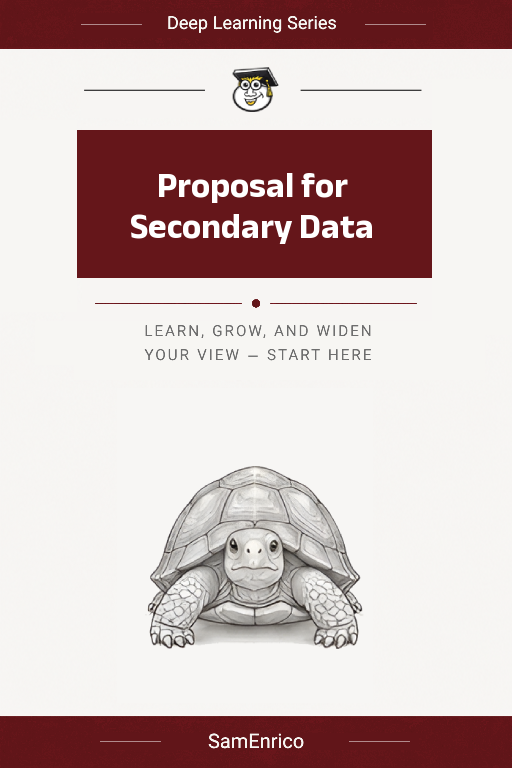
Non-FictionStudent's ShortcutSecondary Analysis
Proposal for Secondary Data Audiobook
Write proposals using existing datasets including
by Pinto Mavis
Write proposals using existing datasets including access plans, variable justification, and data limitations.
Formats
Free sample
Chapter 1: The Data Heist--Most researchers believe they need to collect their own data to make a meaningful contribution. They are wrong.This is not hyperbole. It is a systematic inefficiency that wastes billions of research dollars, delays discoveries by years, and burns out countless graduate students who spend eighteen months chasing survey responses only to discover their sample size is too small to detect any meaningful effect. The academic world has built a mythology around "original data collection" – the idea that real scientists write their own survey questions, recruit their own participants, and guard their own spreadsheets like dragons hoarding gold. But here is the truth that funded investigators already know: some of the most influential studies of the past decade were built entirely from data someone else collected, often for a completely different purpose.This book is about how to do that – ethically, rigorously, and persuasively.
It is about writing proposals that convince funders, review boards, and data stewards to let you use existing datasets to answer new questions. And it starts with a fundamental reframing: secondary data is not a consolation prize. It is a strategic advantage.The Great Misconception Walk into any graduate methods seminar and listen to how students talk about their projects. "I'm collecting my own data" carries a tone of legitimacy. "I'm using an existing dataset" is often said with a slight apology, as if the student is confessing to a shortcut.
This hierarchy is backward.The preference for primary data collection rests on three unexamined assumptions. First, that collecting your own data ensures it will perfectly fit your research question. Second, that primary data is somehow more "authentic" or "real" than reused data. Third, that the effort of collection is itself a mark of scholarly rigor. Each of these assumptions crumbles under scrutiny.Consider the fit problem.
When you design a survey from scratch, you face trade-offs between length, response rate, and question quality. Long surveys produce better measurement but lower completion rates. Complex skip patterns confuse respondents. You must decide on a sample size based on your budget, not statistical power. The result is almost always a dataset with significant limitations – just limitations you know intimately because you created them.
Secondary data comes with its own limitations, but they are documented limitations. Someone else has already done the hard work of testing reliability, validating measures, and publishing the sampling methodology.Consider authenticity. A…
This is the end of the free sample. Get the Audiobook to keep going. Buy now
About this book
Details
- Author
- Pinto Mavis
- Publisher
- SamEnrico
- Language
- English
- Genre
- Non-Fiction, Student's Shortcut, Secondary Analysis
- Released
- 2026-05-29
- Pages (approx.)
- 145
- Available as
- eBook, Audiobook

Listen in the VoxFlicks app
Audiobooks and audio dramas wherever you go. Sign in with your SamEnrico account and press play.
More by Pinto Mavis
 The 30 Minute Deep Body ScanPinto Mavis$11.99
 Loneliness Complete Self Help GuidePinto Mavis$11.99
 Environmental Testosterone KillersPinto Mavis$11.99
 Remote Work Isolation ManagementPinto Mavis$11.99
 Seams of Power: How a Designer Dress Took Down a DictatorPinto Mavis$11.99
 The Maestro of Shadows: How a Forgotten Filmmaker Defied CensorshipPinto Mavis$11.99
 Understanding Chanarin DiseasePinto Mavis$17.99
 How to Start a Rice Farming BusinessPinto Mavis$11.99
 Subclass 491 Regional Visa GuidePinto Mavis$12.99
 Data Visualization DeveloperPinto Mavis$11.99
You may also like
 Hong Kong Handover 1997Dunn Johnnie$11.99
 Zumba For Postnatal Recovery CourseNeal Christian$11.99
 Zumba for BeginnersLadner Nikia$11.99
 YouTube Comment Mining GuideHumes Pandora$12.99
 Worry Box MeditationCarlin Rudy$11.99
 Workplace Stress MeditationNguyen Lynn$11.99
 Workplace Stress and Sleep RepairHawley Ivory$11.99
 Workplace Perfectionism CureDelaney Jeffry$11.99
 Workplace Injustice Anger GuideWallen Isabelle$11.99
 Work Addiction and Burnout LinkGreenwood Ester$11.99
 Women in Yoga and WellnessBeattie Galina$11.99
 Women in Stand Up ComedyChun Evangeline$11.99