
Non-FictionHealth & WellnessRisk Reduction
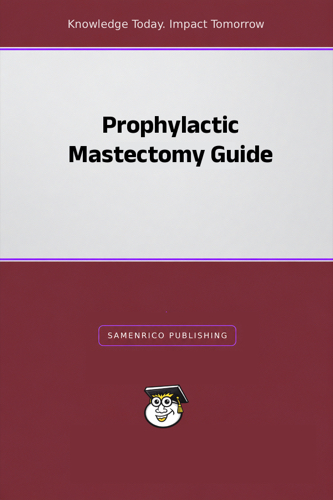
Prophylactic Mastectomy Guide eBook
Consider preventive breast removal for high-risk g
Consider preventive breast removal for high-risk gene carriers.
Formats
Free sample
Chapter 1: The Call You Never Expected--The phone rang on a Tuesday afternoon, and everything changed.For Jessica, a 34-year-old graphic designer and mother of two, the call came while she was chopping vegetables for dinner. The genetic counselor’s voice was measured, practiced, gentle—the kind of gentle that tells you bad news is coming. “Your results are back,” she said. “You have a mutation in the BRCA1 gene.” Jessica set down the knife, wiped her hands on her apron, and walked into the living room where her husband was reading to their daughter. She didn’t know what BRCA meant, but she knew her mother had died of ovarian cancer at forty-seven, and her grandmother had breast cancer twice.
The math in her head was instant and terrifying: I am next.Jessica’s story is not unique. Every day, thousands of people receive genetic test results that reshape their understanding of their bodies, their futures, and their families. Some, like Jessica, ordered testing because of a strong family history. Others discovered their status through direct-to-consumer tests like 23and Me, opening a Pandora’s box they never intended to touch. A few learned by accident—a research study, a routine blood draw, a curious click on a website.
Regardless of how the information arrives, the experience is almost universally described as a before-and-after moment. There is life before you know your genetic status, and there is life after. The two are never the same.This chapter is about that moment. It is about understanding what those letters and numbers actually mean—not in abstract statistical terms, but in the context of your body, your family, and your choices. We will decode the language of hereditary cancer syndromes, demystify the difference between sporadic and inherited cancers, and walk through the specific genes that matter most for prophylactic mastectomy decisions.
We will also address a population often overlooked in these conversations: men who carry BRCA mutations and face their own, different set of risks. By the end of this chapter, you will understand not just what your genetic test says, but what it means for the decision that lies ahead.The Language of Risk: What a Mutation Actually Means Let us start with a fundamental distinction that most patients never hear from their doctors: having a genetic mutation does not mean you will get cancer. It means you have a higher lifetime probability than someone without the mutation. This is the difference between deterministic genetics (one gene, one disease, 100% certainty, like Huntington’s disease) and probabilistic genetics (one gene, increased vulnerability, variable outcomes, like BRCA).The BRCA1 and BRCA2 genes are tumor suppressors. Think of them as the security guards of your breast and ovarian tissue.
Their job is to repair damaged DNA. When a cell divides and makes a copying error—which happens thousands of times per day in every human body—the BRCA proteins rush to the scene, fix the mistake, and allow the cell to continue functioning normally. But if you inherit a mutation in one copy of BRCA1 or BRCA2, your security guard is understaffed. One guard is missing. The remaining guard works overtime, but eventually, a critical error goes unrepaired.
That unrepaired error can lead to uncontrolled cell growth. That uncontrolled growth can become cancer.The key word is can. Not will. Not certainly. Not inevitably.
This probabilistic nature is both a curse and a gift. It is a curse because uncertainty is psychologically exhausting. It is a gift because you have time to act.For a woman with a BRCA1 mutation, the lifetime risk of breast cancer by age 70 ranges from 55 to 72 percent. For BRCA2, the range is 45 to 69 percent. These numbers come from large population studies, but they conceal enormous variation.
Your exact risk depends on which mutation you have (some are more aggressive than others), your family history (how many relatives actually developed cancer), your age (risk increases sharply after 40), your reproductive history (early pregnancy lowers risk, late pregnancy may increase it), and even your lifestyle factors (alcohol, obesity, smoking all play modifying roles).It is crucial to understand that the 55-72 percent figure is a lifetime cumulative incidence—meaning if you live to age 70, and nothing else kills you first, this is the probability that you will develop breast cancer at some point along the way. The same logic applies to ovarian cancer risk, which for BRCA1 carriers is 39-44 percent by age 70, and for BRCA2 carriers is 11-17 percent. These numbers do not add to a total cancer risk of over 100 percent because they represent competing risks. You cannot develop both breast and ovarian cancer in a way that makes the percentages sum. Instead, these are separate probabilities for separate organ systems.
Understanding this distinction is critical for the decision-making process that will unfold in later chapters, because it helps explain why some women choose to remove both breasts and both ovaries, while others remove only one set of organs or schedule them at different ages.Sporadic Versus Hereditary: The Two Faces of Breast Cancer Approximately 70 to 80 percent of all breast cancers are sporadic. This means they occur randomly, without a known inherited genetic cause. A woman with sporadic breast cancer may have no family history of the disease. She may have no identifiable genetic mutation. Her cancer is the result of bad luck—a combination of aging, environmental exposures, and random cellular errors that accumulate over time.The remaining 20 to 30 percent of breast cancers are hereditary.
These are caused by specific inherited gene mutations passed down through families in an autosomal dominant pattern. Autosomal dominant means you only need one copy of the mutated gene (inherited from either parent) to have increased risk. If your mother carries a BRCA mutation, each of her children has a 50 percent chance of inheriting it, regardless of the child’s sex.Hereditary cancers tend to have distinct features that distinguish them from sporadic cases. They occur at younger ages (often under 50, sometimes under 40). They are more likely to be bilateral (affecting both breasts).
They are associated with other cancers in the same individual or family (breast and ovarian, breast and pancreatic, breast and prostate, breast and melanoma). They recur at higher rates after treatment. And they follow predictable inheritance patterns across multiple generations.This is why family history matters so much. A genetic counselor will take a detailed family tree—called a pedigree—going back at least three generations on both sides of your family. They will ask about not just breast and ovarian cancer, but also pancreatic, prostate, melanoma, and colon cancer.
They will want to know ages of diagnosis, whether cancers were bilateral, and whether any relatives had multiple primary cancers. This information helps determine whether your family history fits a hereditary pattern, even before genetic testing is performed.Beyond BRCA: The Expanding Universe of High-Risk Genes When the general public thinks about genetic risk for breast cancer, they think of BRCA. Angelina Jolie’s 2013 op-ed in the New York Times brought these genes into the cultural mainstream, and for good reason—BRCA1 and BRCA2 are the most common and best-understood high-risk genes. But they are far from the only ones.In the years since the…
This is the end of the free sample. Get the eBook to keep going. Buy now
About this book
Details
- Author
- Street Dorthey
- Publisher
- SamEnrico
- Language
- English
- Genre
- Non-Fiction, Health & Wellness, Risk Reduction
- Released
- 2026-06-06
- Pages (approx.)
- 153
- Available as
- eBook, Audiobook

Read better in the ZLOADR app
Your eBooks on your phone or tablet. Sign in with your SamEnrico account and start reading.
More by Street Dorthey
 Values And Mission Alignment Culture AuditStreet Dorthey$11.99
 Food Addiction Self Assessment ToolsStreet Dorthey$11.99
 The Dental Pain Meditation GuideStreet Dorthey$11.99
 Pinterest VA For Home Decor BrandsStreet Dorthey$11.99
 The River of a Thousand Perils: Alfred Russel Wallace's Canoe OdysseyStreet Dorthey$11.99
 The Last Telegram: A Love Letter Across TimeStreet Dorthey$11.99
 Understanding Combined Hyperlipidemia, FamilialStreet Dorthey$17.99
 How to Become a Channel InstallerStreet Dorthey$11.99
 UK University System GuideStreet Dorthey$12.99
 Payment Processing GuideStreet Dorthey$12.99
 Fleet Sales ExecutiveStreet Dorthey$11.99
You may also like
 Hong Kong Handover 1997Dunn Johnnie$11.99
 Zumba For Postnatal Recovery CourseNeal Christian$11.99
 Zumba for BeginnersLadner Nikia$11.99
 YouTube Comment Mining GuideHumes Pandora$12.99
 Worry Box MeditationCarlin Rudy$11.99
 Workplace Stress MeditationNguyen Lynn$11.99
 Workplace Stress and Sleep RepairHawley Ivory$11.99
 Workplace Perfectionism CureDelaney Jeffry$11.99
 Workplace Injustice Anger GuideWallen Isabelle$11.99
 Work Addiction and Burnout LinkGreenwood Ester$11.99
 Women in Yoga and WellnessBeattie Galina$11.99
 Women in Stand Up ComedyChun Evangeline$11.99