
Non-FictionInformativeEducational
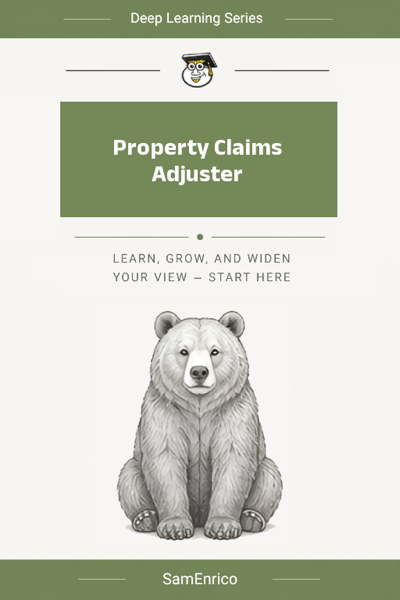
Property Claims Adjuster
A Coursebook on Property Claims Adjuster
A Coursebook on Property Claims Adjuster
Formats
About this book
Free sample
Chapter 1: The Legal Mirror...--–- The first time you stand in a burned-out living room, the smell of wet ash still clinging to the walls and a policyholder staring at you like you hold the keys to their entire life, you will realize something important: you are not a repairman. You are not a contractor. You are not even really a customer service representative, though you will do plenty of that. You are, first and foremost, a legal investigator wearing an adjuster’s badge. The difference between those two identities is the difference between writing a check and ending up in a deposition room explaining why you wrote that check.Every property claims adjuster operates inside a closed legal system.
That system has three distinct layers: contract law, tort law, and statutory regulation. Understanding how these layers interact is not academic. It is survival. Make a mistake in contract interpretation, and you overpay or underpay. Make a mistake in tort, and you create liability for your carrier.
Violate a statute, and you lose your license. This chapter builds the legal mirror: you will look at every claim and see reflected back the precise legal obligations and boundaries that define your role.The Three-Legged Stool of Claims Law Property insurance claims rest on three legal foundations. Think of them as a three-legged stool. Remove any one leg, and the entire structure collapses.Contract law governs the insurance policy itself. A policy is a contract of adhesion, meaning the insurer writes it, and the insured adheres to it.
This creates a special duty: because the insured has no power to negotiate terms, courts interpret ambiguities against the insurer. Every word you read in a policy matters because a judge will give the benefit of the doubt to the policyholder, not to you.Tort law governs civil wrongs outside of contracts. In claims adjusting, the most relevant tort is bad faith. Bad faith occurs when an insurer unreasonably denies or delays payment of a claim. Unlike a contract breach (which pays only what was owed), a bad faith tort can award consequential damages…
This is the end of the free sample. Get the eBook to keep going. Buy now
Contents
- Chapter 1
- Chapter 2
- Chapter 3
- Chapter 4
- Chapter 5
- Chapter 6
- Chapter 7
- Chapter 8
- Chapter 9
- Chapter 10
- Chapter 11
- Chapter 12
Details
- Author
- Rains Felicita
- Publisher
- SamEnrico
- Language
- English
- Genre
- Non-Fiction, Informative, Educational
- Released
- 2026-05-18
- Pages (approx.)
- 137
- Available as
- eBook, Audiobook

Read better in the ZLOADR app
Your eBooks on your phone or tablet. Sign in with your SamEnrico account and start reading.
More by Rains Felicita
 LinkedIn Publication EnvyRains Felicita$11.99
 UK Heat Pump Voucher UpdateRains Felicita$11.99
 Aligning Personal with Work OKRsRains Felicita$11.99
 Age Gap Relationship ConfidenceRains Felicita$11.99
 Workplace Confidential A Recovery GuideRains Felicita$11.99
 Orpheus Unbroken: The Lyre That Defied DeathRains Felicita$11.99
 Understanding Idiopathic Congenital Nystagmus, Dominant, X- LinkedRains Felicita$17.99
 AI Crop Disease Detection GuideRains Felicita$12.99
 EU VAT Import WorkbookRains Felicita$12.99
 Ultimate Handbook Guide to Tianmen : (China) Travel GuideRains Felicita$11.99
You may also like
 Hong Kong Handover 1997Dunn Johnnie$11.99
 Zumba For Postnatal Recovery CourseNeal Christian$11.99
 Zumba for BeginnersLadner Nikia$11.99
 YouTube Comment Mining GuideHumes Pandora$12.99
 Worry Box MeditationCarlin Rudy$11.99
 Workplace Stress MeditationNguyen Lynn$11.99
 Workplace Stress and Sleep RepairHawley Ivory$11.99
 Workplace Perfectionism CureDelaney Jeffry$11.99
 Workplace Injustice Anger GuideWallen Isabelle$11.99
 Work Addiction and Burnout LinkGreenwood Ester$11.99
 Women in Yoga and WellnessBeattie Galina$11.99
 Women in Stand Up ComedyChun Evangeline$11.99