
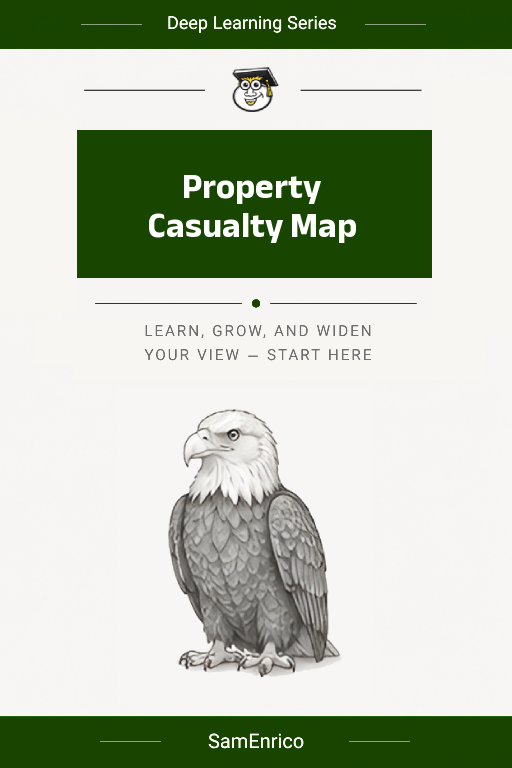
Non-FictionStrategic AtlasInsurance
Property Casualty Map eBook
Plot State Farm, Allstate, Progressive, and Geico
Plot State Farm, Allstate, Progressive, and Geico on auto versus home insurance specialization.
Formats
Free sample
Chapter 1: The Loyalty Penalty–- The letter arrived on a Tuesday, sandwiched between a pizza coupon and a credit card offer. Patricia from Columbus, Ohio, a fifty-two-year-old school bus driver with zero accidents in eleven years, opened her State Farm renewal notice and felt her stomach drop. Her six-month auto premium had jumped from 678to678 to 678to947 – a 39.7 percent increase. She had not filed a claim. She had not moved.
Her credit score had actually improved. The only thing that had changed was the calendar. When she called her agent of fourteen years, a man who had come to her daughter’s wedding, he explained that “rates are increasing across the board” and offered to shop around for her. That was the moment Patricia realized: her loyalty was not a virtue to be rewarded. It was a vulnerability to be exploited.This is the Loyalty Penalty.It is the single most important concept in modern insurance, yet almost no consumer has ever heard its name.
The Loyalty Penalty is the industry’s quiet, legal, and entirely rational practice of charging renewing customers more than new customers for identical coverage. It is not a bug in the system. It is a feature – one that has trained an entire generation to treat their insurance provider not as a trusted partner, but as a subscription to be canceled every six months. And it is the hidden engine driving every strategic decision made by the four giants of American property and casualty insurance: State Farm, Allstate, Progressive, and Geico.This book is about those four companies. It is about the trillion-dollar war they are fighting for your wallet, your data, and your loyalty.
It is about the map that explains where they stand, how they compete, and where they are going. But before we can read that map, we must understand the terrain. And the terrain begins with Patricia’s letter.The $1.95 Trillion Ocean The property and casualty insurance industry in the United States is a $1.95 trillion ocean of premiums, payouts, and profits. To put that number in perspective, it is larger than the entire economy of Canada. It employs nearly three million people.
It pays out more than half a trillion dollars in claims every year – enough to buy every home in Chicago twice over. And yet, for all its scale, the industry runs on a remarkably simple logic: collect premiums from millions of policyholders, pay claims for the unlucky few, and invest the float (the money sitting between when premiums come in and claims go out) to generate additional returns.The problem is that this logic only works if insurers can predict risk better than their competitors. And predicting risk has become exponentially harder over the past decade. Cars are more expensive to repair, thanks to sensors and cameras embedded in bumpers and windshields. Lawsuits are more frequent and more costly, with “nuclear verdicts” – jury awards exceeding ten million dollars – tripling since 2015.
And climate change has turned home insurance from a steady, predictable profit center into a volatile lottery where a single wildfire season can wipe out a decade of underwriting gains.In response, the four giants have diverged. They have placed very different bets on very different strategies. And the map that explains those bets is the central contribution of this book.The Quadrant Map: Plotting the Four Giants Imagine a two-by-two grid. On the vertical axis, we measure specialization in auto insurance – from low to high. On the horizontal axis, we measure specialization in home insurance – from low to high.
Where each giant falls on this grid tells you almost everything you need to know about their strategy, their strengths, and their vulnerabilities.State Farm: The Balanced Dominator (High Auto / High Home)State Farm sits in the upper-right quadrant. They are the only giant that is truly excellent at both auto and home insurance. With nearly eighteen percent of the auto market and a similar share of the home market, they are the 800-pound gorilla of American P&C. Their secret weapon is not technology or price – it is the agent network. Seventeen thousand agents in small towns and big cities across America serve as the human face of the company.
When a tree falls on your roof, you call your State Farm agent. When you have a teenager learning to drive, you call your State Farm agent. When you want to bundle your auto, home, and life policies into a single bill, you call your State Farm agent. That human connection generates loyalty that no algorithm can replicate – at least for now.Progressive: The Auto Outlier (Very High Auto / Low Home)Progressive sits in the upper-left quadrant, hugging the auto axis. They are the undisputed masters of car insurance, with a market share approaching fourteen percent and growing faster than any other giant.
Their innovation was not a product but a process: they made it easy to compare rates online, turning insurance from a purchase you dreaded into a commodity you could shop in your pajamas. Their telematics program, Snapshot, has more than four million active participants feeding the company real-time data on driving behavior. Progressive knows when you brake hard, when you drive late at night, and how many miles you log each week. That data allows them to price risk with surgical precision. The trade-off is that home insurance – where data is less granular and claims are more emotional – remains a distant afterthought.
Progressive writes home policies, but they do so reluctantly, and their market share is a fraction of State Farm’s.Geico: The Pure-Play Mover (High Auto / Medium-Low Home)Geico sits just below Progressive on the auto axis and slightly to the right on the home axis – but only slightly. Owned by Warren Buffett’s Berkshire Hathaway, Geico has built its empire on a single idea: efficiency. No agents. No brick-and-mortar offices. No handshakes.
Just a direct-to-consumer digital engine that undercuts rivals on price. Their overhead ratio is the lowest in the industry, allowing them to offer premiums that competitors cannot match. The trade-off is that Geico’s efficiency model works best for simple, standardized products – which auto insurance mostly is – and struggles with the complexity and emotion of home claims. They write home policies, but they do so reluctantly, often as an add-on to an auto policy rather than as a standalone offering.Allstate: The Hesitant Hybrid (High Auto / Medium Home)Allstate sits in the center-right, but drifting downward. They have strong auto market share – around ten percent – and a respectable home business.
But unlike State Farm, they lack a clear identity. Their brand recall is high: nearly every American has heard of Allstate and remembers the “good hands” slogan. But their emotional connection is low. In survey after survey, consumers rate Allstate as competent but forgettable – a utility, not a partner. This identity crisis has been exacerbated by climate change.
As wildfires and hurricanes make home insurance unprofitable, Allstate has been forced to pause new homeowner policies in California and Florida. This is not a strategic pivot. It is a forced reaction. And it is pushing Allstate back toward auto specialization, warping their position on the map and leaving them stranded between State…
This is the end of the free sample. Get the eBook to keep going. Buy now
About this book
Details
- Author
- Lindsay Helena
- Publisher
- SamEnrico
- Language
- English
- Genre
- Non-Fiction, Strategic Atlas, Insurance
- Released
- 2026-06-01
- Pages (approx.)
- 145
- Available as
- eBook, Audiobook

Read better in the ZLOADR app
Your eBooks on your phone or tablet. Sign in with your SamEnrico account and start reading.
More by Lindsay Helena
 Metta For Nature GuideLindsay Helena$11.99
 The No Budget ArtistLindsay Helena$11.99
 Assertiveness for Graduate StudentsLindsay Helena$11.99
 Deadline Anger ManagementLindsay Helena$11.99
 The Postpartum Constipation Relief GuideLindsay Helena$11.99
 The Gold Coast Conspiracy: The Inside Job That Shook South AfricaLindsay Helena$11.99
 Social Impact on One PageLindsay Helena$12.99
 Understanding Phocomelia Ectrodactyly Deafness Sinus ArrhythmiaLindsay Helena$17.99
 A-frame Sign Placement (Legal Compliance)Lindsay Helena$11.99
 How to Start a Hobby in VivariumsLindsay Helena$11.99
You may also like
 Hong Kong Handover 1997Dunn Johnnie$11.99
 Zumba For Postnatal Recovery CourseNeal Christian$11.99
 Zumba for BeginnersLadner Nikia$11.99
 YouTube Comment Mining GuideHumes Pandora$12.99
 Worry Box MeditationCarlin Rudy$11.99
 Workplace Stress MeditationNguyen Lynn$11.99
 Workplace Stress and Sleep RepairHawley Ivory$11.99
 Workplace Perfectionism CureDelaney Jeffry$11.99
 Workplace Injustice Anger GuideWallen Isabelle$11.99
 Work Addiction and Burnout LinkGreenwood Ester$11.99
 Women in Yoga and WellnessBeattie Galina$11.99
 Women in Stand Up ComedyChun Evangeline$11.99