
Non-FictionInformativeEducational
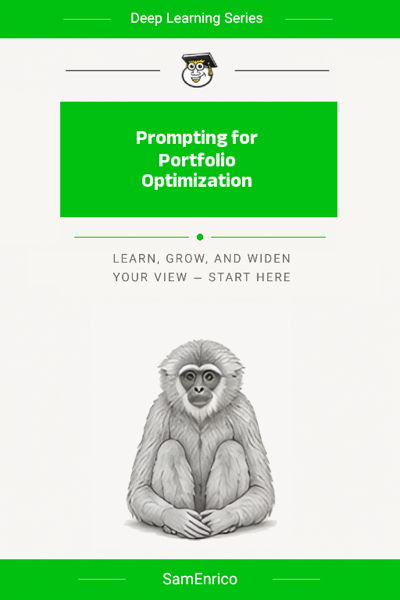
Prompting for Portfolio Optimization eBook
A Coursebook on Prompting for Portfolio Optimizati
by Jones Timmy
A Coursebook on Prompting for Portfolio Optimization
Formats
Free sample
Chapter 1: The Conversation Revolution–- For most of financial history, the portfolio manager’s toolkit has been rigid, deterministic, and unforgiving. You wrote code in languages like Python or R. You defined exact functions, precise loops, and immutable rules. You fed in clean, structured data—historical prices, covariance matrices, risk-free rates—and the computer returned an exact answer. If you wanted to incorporate a piece of qualitative information, such as “the Fed chair sounded dovish today” or “supply chain disruptions are easing,” you had to translate that nuance into a numerical proxy, often losing meaning in translation. This was the world of traditional portfolio optimization, and for decades, it worked reasonably well.But that world is crumbling.The explosion of unstructured data—news articles, earnings call transcripts, social media sentiment, geopolitical risk reports, and macroeconomic commentary—has overwhelmed the classical toolkit. Mean-Variance Optimization (MVO), Black-Litterman, and risk parity models are mathematically elegant, but they struggle to ingest the messy, ambiguous, and context-dependent information that increasingly drives asset prices. At the same time, a new class of artificial intelligence has emerged: Large Language Models (LLMs) like GPT-4, Claude, and Llama. These models do not compute exact answers; they generate plausible sequences. They do not follow rigid rules; they navigate probabilistic landscapes. They do not require clean numerical inputs; they thrive on messy human language.This chapter establishes the foundational thesis of this entire coursebook: the most significant shift in asset management since the advent of Modern Portfolio Theory is not a new optimization algorithm or a novel factor—it is the move from code to conversation. You will learn why traditional deterministic tools are brittle when faced with probabilistic human language, how LLMs fundamentally differ from Python scripts, and how to set up your personal “sandbox” environment for prompting. Most critically, you will learn why vague questions yield dangerous portfolios—and why precision in natural language is now your most valuable skill.The Hidden Cost of Deterministic Thinking Before we can embrace the conversational revolution, we must understand what we are leaving behind. Traditional portfolio optimization rests on a beautiful but fragile assumption: that all relevant information can be reduced to numbers and that relationships between assets can be captured by mathematical functions.Consider the classic Mean-Variance Optimization framework introduced by Harry Markowitz in 1952. You input expected returns for each asset, a covariance matrix of returns, and a risk-free rate. The optimizer outputs the set of weights that maximizes expected return for a given level of risk—the efficient frontier. This is deterministic. If you run the same inputs through the same optimizer twice, you get the same outputs. There is no ambiguity, no interpretation, no judgment.Now consider a real-world scenario: you are managing a $500 million portfolio on the morning of a Federal Reserve interest rate decision. The consensus forecast expects a 25 basis point hike. However, you have just read a Bloomberg article quoting a former Fed governor who suggests the committee might pause due to recent banking sector stress. You also notice that the two-year Treasury yield dropped 8 basis points in overnight trading. Meanwhile, a tweet from a reliable financial journalist indicates that three of the twelve voting members are known to be dovish.How do you incorporate this information into your MVO model?The traditional answer is painful: you might adjust your expected return for rate-sensitive sectors by a heuristic amount (say, +0.5% for banks, -0.3% for homebuilders). You might run a scenario analysis with three different rate paths. You might manually override the covariance matrix to reflect increased correlation during uncertainty. Each of these workarounds is imprecise, time-consuming, and introduces your own biases. The model cannot directly understand that “the former governor sounded worried” or that “overnight trading suggests repositioning.”This is the hidden cost of deterministic thinking. By forcing all information into a numerical straitjacket, you discard nuance, context, and timeliness. You also spend hours translating qualitative insight into quantitative inputs—hours that could be spent on higher-level analysis.Why Python Scripts Are Brittle (And LLMs Are Flexible)To understand the shift from code to conversation, we must contrast the two paradigms directly.Python scripts (and traditional quantitative tools) are deterministic. They execute exact instructions. If you write x = 2 + 2, the computer assigns 4 to x. Every time. This is wonderful for arithmetic, data cleaning, backtesting, and optimization—tasks where precision is paramount. But determinism becomes a liability when you need to interpret ambiguity.Consider this instruction to a Python script: “identify stocks that might benefit from falling interest rates.” How would you code that? You might define “falling rates” as a 50 basis point drop in the 10-year yield over 30 days. You might define “benefit” as a historical correlation below -0.5 between the stock’s returns and yield changes. You might then screen for stocks with that property. But your definition is arbitrary. What if the correlation is -0.45? What if the yield drop is 49 basis points? What if the stock would benefit, but only after a six-month lag? The script gives you a binary answer based on your rigid rules, and you miss the gray area where most opportunities live.LLMs are probabilistic and context-sensitive. They do not execute instructions; they generate completions based on patterns learned from billions of text examples. When you ask an LLM “Which stocks might benefit from falling interest rates?” it does not run a screen. Instead, it considers the context: the current interest rate environment (if provided), the definition of “falling” implied by recent news, the typical sectors that respond to rates (financials, real estate, utilities), and even the investment style implied by your question (growth-oriented, defensive, or speculative). The LLM returns a nuanced answer with reasoning, caveats, and examples.This flexibility is revolutionary. But it comes with a terrifying risk: LLMs can sound confident while being completely wrong. A Python script that returns the wrong covariance matrix because you fed it bad data is clearly your fault. An LLM that invents a stock price or a false correlation is not obviously wrong—it sounds authoritative. This hallucination problem is the single greatest danger in applying LLMs to finance, and we will solve it systematically in Chapter 3 with Retrieval-Augmented Generation (RAG). For now, understand that flexibility without grounding is worse than brittleness.From “Commanding” to “Conversational Engineering”The shift from code to conversation requires a fundamental change in your mindset. You are no longer a programmer writing commands for a deterministic machine. You are a conversational engineer designing prompts that guide a probabilistic reasoning engine.Commanding sounds like this:“Calculate the Sharpe ratio for these 10 assets.”“Run a Monte Carlo simulation with 10,000 paths.”“Output the efficient frontier weights as a CSV.”This language works for Python. It does not work for LLMs. When you command an LLM, you are ignoring its probabilistic nature. The LLM will try to comply, but it may misunderstand your intent, miss important context, or produce a result that is mathematically incoherent because it was never trained to do matrix inversion reliably.Conversational engineering sounds like this:“You are a quantitative analyst with expertise in risk-adjusted return metrics. Using the uploaded historical price data (monthly returns from January 2020 to December 2024), calculate the Sharpe ratio for each of the 10 assets. Assume a risk-free rate of 4.2% (the current 3-month T-bill yield). Show your step-by-step reasoning, and…
This is the end of the free sample. Get the eBook to keep going. Buy now
About this book
Details
- Author
- Jones Timmy
- Publisher
- SamEnrico
- Language
- English
- Genre
- Non-Fiction, Informative, Educational
- Released
- 2026-06-02
- Pages (approx.)
- 160
- Available as
- eBook, Audiobook

Read better in the ZLOADR app
Your eBooks on your phone or tablet. Sign in with your SamEnrico account and start reading.
More by Jones Timmy
 Scars on the EardrumJones Timmy$11.99
 Metta Walking Meditation GuideJones Timmy$11.99
 Immigrant Winery And Vineyard FounderJones Timmy$11.99
 Wholesaling Exit StrategiesJones Timmy$11.99
 Remedy Packages HandbookJones Timmy$11.99
 Hip Bursitis Recovery GuideJones Timmy$11.99
 Microscopic Fiber IdentificationJones Timmy$11.99
 Choice Architecture OfficeJones Timmy$11.99
 Adoption Self Worth JourneyJones Timmy$11.99
 The Frozen Crown: Britain's Forgotten Ice Skating PioneerJones Timmy$11.99
 The Last Transmission: The Titanic’s Wireless Room TragedyJones Timmy$11.99
 The Anatomy of Genius: Vesalius and the Birth of Modern MedicineJones Timmy$11.99
You may also like
 Hong Kong Handover 1997Dunn Johnnie$11.99
 Zumba For Postnatal Recovery CourseNeal Christian$11.99
 Zumba for BeginnersLadner Nikia$11.99
 YouTube Comment Mining GuideHumes Pandora$12.99
 Worry Box MeditationCarlin Rudy$11.99
 Workplace Stress MeditationNguyen Lynn$11.99
 Workplace Stress and Sleep RepairHawley Ivory$11.99
 Workplace Perfectionism CureDelaney Jeffry$11.99
 Workplace Injustice Anger GuideWallen Isabelle$11.99
 Work Addiction and Burnout LinkGreenwood Ester$11.99
 Women in Yoga and WellnessBeattie Galina$11.99
 Women in Stand Up ComedyChun Evangeline$11.99