
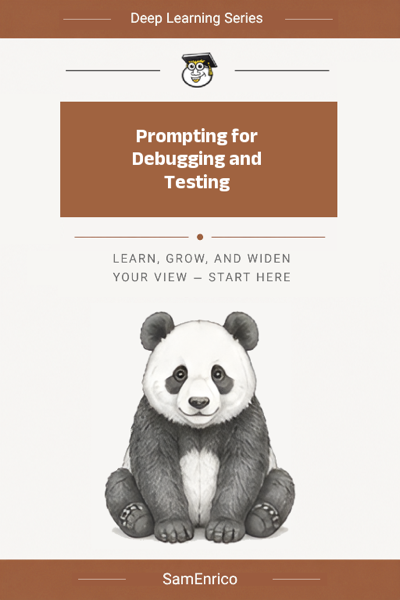
Non-FictionInformativeEducational
Prompting for Debugging and Testing Audiobook
A Coursebook on Prompting for Debugging and Testin
A Coursebook on Prompting for Debugging and Testing
Formats
Free sample
Chapter 1: The Cold Start...--– The first time I saw it happen, I didn’t believe it. A senior engineer on my team—fifteen years of experience, a master of C++ and Rust, the kind of person who could debug a kernel panic with a hex editor and a cup of coffee—spent eight hours hunting a null pointer exception. He stepped through stack traces, added logging, rolled back commits, and even rewrote a small module from scratch. At 4:47 PM, exhausted and defeat in his voice, he said, “I don’t understand. The pointer has a value at runtime.
The code is correct. The compiler is lying.”Our intern, a twenty-year-old who had been with us for three weeks, overheard. She opened a browser tab, typed a single prompt into an LLM, pasted the stack trace and the surrounding code block, and hit enter. Ninety seconds later, she had an answer: the pointer was being modified in a signal handler that wasn’t visible in the stack trace because the signal had been raised asynchronously. The senior engineer stared at her screen.
Then he stared at his own. Then he closed his laptop and went home early.That was the moment I realized debugging had fundamentally changed. Not incrementally. Not “we’ll add some AI autocomplete to our IDEs.” Fundamentally. Irreversibly.
The skill that had defined software engineering for decades—the ability to trace execution paths, to hold complex state in your head, to methodically isolate variables—was no longer the primary bottleneck. The new bottleneck was something else entirely: the quality of the question you ask the machine.The Hidden Cost of Traditional Debugging Before we can understand what makes prompting for debugging different, we need to understand what’s broken about the way we debug today. And I’m not talking about small inefficiencies. I’m talking about a workflow that, when you actually measure it, consumes between forty and sixty percent of most professional developers’ time.Let’s look at the traditional debugging loop:Reproduce the bug. Run the code, find the inputs or conditions that trigger the failure.Isolate the failure.
Add print statements, use a debugger, binary search through commits.Research the problem. Google the error message, search Stack Overflow, read documentation.Formulate a hypothesis. Guess what might be wrong based on your mental model.Implement a fix. Change the code.Test the fix. Run the code again.…
This is the end of the free sample. Get the Audiobook to keep going. Buy now
About this book
Details
- Author
- Willoughby Twana
- Publisher
- SamEnrico
- Language
- English
- Genre
- Non-Fiction, Informative, Educational
- Released
- 2026-05-06
- Pages (approx.)
- 156
- Available as
- eBook, Audiobook

Listen in the VoxFlicks app
Audiobooks and audio dramas wherever you go. Sign in with your SamEnrico account and press play.
More by Willoughby Twana
 The Theater Stage Manager StressWilloughby Twana$11.99
 Pelvic Floor Journal WorkbookWilloughby Twana$11.99
 Micronutrients For Hormone Balance GuideWilloughby Twana$11.99
 The Wishing Well ReleaseWilloughby Twana$11.99
 Pet Loss Insurance ClaimsWilloughby Twana$11.99
 Improv til I DieWilloughby Twana$11.99
 The IBS Massage ProtocolWilloughby Twana$11.99
 Tenant Screening Process GuideWilloughby Twana$11.99
 The Calculators of Timbuktu: Masters of the Mathematical UniverseWilloughby Twana$11.99
 The Silent Diplomat: How Michelle Obama Redefined Global InfluenceWilloughby Twana$11.99
 The Alchemists of the Industrial Age: From Lavoisier to NobelWilloughby Twana$11.99
 The Strategist's Guide to Brand LanguageWilloughby Twana$11.99
You may also like
 Hong Kong Handover 1997Dunn Johnnie$11.99
 Zumba For Postnatal Recovery CourseNeal Christian$11.99
 Zumba for BeginnersLadner Nikia$11.99
 YouTube Comment Mining GuideHumes Pandora$12.99
 Worry Box MeditationCarlin Rudy$11.99
 Workplace Stress MeditationNguyen Lynn$11.99
 Workplace Stress and Sleep RepairHawley Ivory$11.99
 Workplace Perfectionism CureDelaney Jeffry$11.99
 Workplace Injustice Anger GuideWallen Isabelle$11.99
 Work Addiction and Burnout LinkGreenwood Ester$11.99
 Women in Yoga and WellnessBeattie Galina$11.99
 Women in Stand Up ComedyChun Evangeline$11.99