
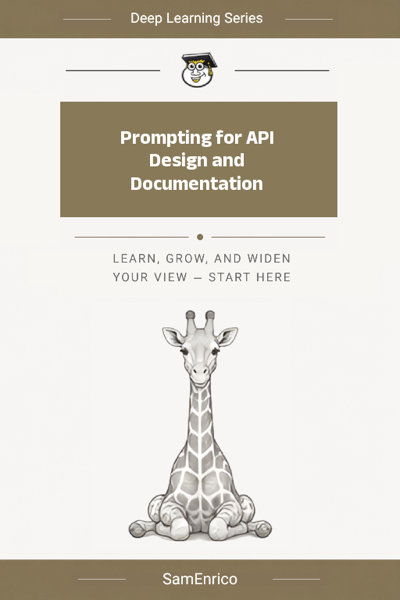
Non-FictionInformativeEducational
Prompting for API Design and Documentation eBook
A Coursebook on Prompting for API Design and Docum
A Coursebook on Prompting for API Design and Documentation
Formats
Free sample
Chapter 1: The Junior Who Read Everything--I spent three hours trying to get Chat GPT to design a simple books API. When it finally stopped hallucinating and gave me something usable, I had generated forty-two endpoints. Twelve of them didn't exist in my requirements. One was named /get All The Books And Also The Authors And Also The Reviews And Also The Publishers And Also. I wanted to throw my laptop out a window.This was not my first failure with AI.
It was my seventh that week.I had read the tweets. I had watched the tutorials. I had even bought a course on prompt engineering that promised to make me "10x more productive." But when I sat down to actually build an API—the thing I had been doing manually for eight years—the AI made me slower, not faster. Every response required fact-checking. Every Open API spec needed structural repairs.
Every code example had variable names that didn't match my schema.I was treating AI like an oracle. I was asking "design a books API" and expecting it to know my team's naming conventions, our pagination standards, our error response format, and which version of Open API we used. That is like handing a junior developer a blank whiteboard and saying "build Amazon." It was never going to work.Then I had a realization that changed everything.What if the problem wasn't the AI? What if the problem was me?This chapter is the story of that realization. It is the foundation upon which the rest of this book is built.
By the time you finish these pages, you will understand why API work is uniquely suited for AI collaboration, what AI can and cannot do for you, and—most importantly—the mental model that separates AI tourists from API professionals. You will learn the one principle that governs every successful AI-assisted API project, and you will never waste three hours on a bad prompt again.The Collaboration Crisis Let me tell you about Sarah. She is a senior API designer at a mid-sized fintech company. When I interviewed her for this book, she told me she had "tried AI once and it was terrible." She gave me an example.Sarah needed to design an endpoint for retrieving transaction histories. She typed into Chat GPT: "Design a REST endpoint for bank transactions." The AI returned a response with path parameters she didn't need, query parameters that violated her company's security policies, and example data that included real-looking credit card numbers (a compliance nightmare).
She closed the tab and never went back.Sarah is not alone. In my research for this book, I surveyed two hundred API practitioners. Sixty-three percent said they had tried using AI for API work. Of those, seventy-one percent said their first experience was "frustrating" or "actively harmful." Only twelve percent said they continued using AI regularly.Here is what Sarah missed. She did not give the AI any context.
She did not tell it about her company's security policies. She did not specify that transaction histories must be paginated, that date ranges are required, that amounts should be returned in both dollars and cents, or that credit card data must be masked. She asked a question that was impossible to answer correctly without the information only she possessed.The collaboration crisis is not that AI is bad at API work. The collaboration crisis is that we have not learned how to talk to AI about API work.This book solves that crisis. But before we get to the how, we need to understand the why.Why APIs Are Different I have used AI for many things.
I have used it to write emails, summarize documents, brainstorm product names, and debug Python scripts. In all of those domains, AI is helpful but not transformative. API work is different. API work is uniquely suited for AI collaboration for four specific reasons.Structured formats. APIs speak in schemas.
Open API, JSON Schema, Protocol Buffers—these are not natural languages. They are formal, predictable, and constrained. AI models excel at pattern recognition and constrained generation. When you ask an AI to generate an Open API spec, you are asking it to do something that plays directly to its strengths. It has seen millions of Open API documents during training.
It knows that a path item has certain fields, that a schema has certain properties, that a response must have a status code. This is not magic. It is pattern matching at scale.Clear success criteria. You know when an API endpoint is correct. Either it returns the right data or it does not.
Either the Open API validates or it does not. Either the documentation matches the implementation or it does not. This binary clarity is rare in creative work. When you ask an AI to write a marketing email, "good" is subjective. When you ask an AI to design a GET endpoint that returns a paginated list of books filtered by author, "good" is testable.
You can run the Open API through a validator. You can check that the parameters match the requirements. You can assert that the response schema contains the expected fields. This clarity makes AI a partner rather than a gamble.Repetitive patterns. I have designed hundreds of API endpoints.
I cannot remember a single project that did not need pagination, filtering, sorting, error responses, authentication, and rate limiting. These patterns are not unique to my APIs. They are universal. Every REST API has them. AI has seen these patterns thousands of times.
When you prompt AI to "add pagination using offset and limit," it does not need to invent something new. It needs to apply a pattern it has already learned. This is not creativity. This is productivity.Limited scope. AI models have context windows.
A typical model can handle between four thousand and two hundred thousand tokens at once. That is enough for several endpoints, but not for an entire enterprise API catalog. This limitation, which seems like a weakness, is actually a strength. It forces you to work at the right level of abstraction. You should not design fifty endpoints in one prompt.
You should design one endpoint, validate it, then move to the next. The AI's context limitation aligns perfectly with good API design practice: small, focused, verifiable units of work.These four characteristics—structured formats, clear success criteria, repetitive patterns, limited scope—make API work the ideal domain for human-AI collaboration. But only if you approach it correctly.The Hard Truth About What AI Cannot Do I am going to be honest with you. AI will hallucinate. It will invent endpoints you never requested.
It will add parameters that serve no purpose. It will create response fields that do not exist in your data model. It will confidently assert that your API supports OAuth 2.0 when you asked for API keys. These are not bugs in the AI. They are features of how generative models work.Let me explain what is actually happening when you prompt an AI.
The model is not thinking. It is not understanding. It is predicting the next most likely token based on the tokens it…
This is the end of the free sample. Get the eBook to keep going. Buy now
About this book
Details
- Author
- Martindale Drucilla
- Publisher
- SamEnrico
- Language
- English
- Genre
- Non-Fiction, Informative, Educational
- Released
- 2026-06-02
- Pages (approx.)
- 133
- Available as
- eBook, Audiobook

Read better in the ZLOADR app
Your eBooks on your phone or tablet. Sign in with your SamEnrico account and start reading.
More by Martindale Drucilla
 Breaking Opioid Dependency GuideMartindale Drucilla$11.99
 Imposter PTSD HypervigilanceMartindale Drucilla$11.99
 Rwandan Church SurvivorMartindale Drucilla$11.99
 LTC Insurance For Couples GuideMartindale Drucilla$11.99
 Gift Buying StrategyMartindale Drucilla$11.99
 All Nighters Memory DamageMartindale Drucilla$11.99
 The Sack of Rome 1527Martindale Drucilla$11.99
 Ceremonial Feast Leadership GuideMartindale Drucilla$11.99
 First Responder PTSD PreventionMartindale Drucilla$11.99
 The Last Letter: Agatha Christie’s Vanishing ActMartindale Drucilla$11.99
 The Iron Duke’s Gambit: Wellington’s Masterstroke at SalamancaMartindale Drucilla$11.99
 Echoes from the Dawn: Africa’s Cosmic Pioneers and the Birth of the UniverseMartindale Drucilla$11.99
You may also like
 Hong Kong Handover 1997Dunn Johnnie$11.99
 Zumba For Postnatal Recovery CourseNeal Christian$11.99
 Zumba for BeginnersLadner Nikia$11.99
 YouTube Comment Mining GuideHumes Pandora$12.99
 Worry Box MeditationCarlin Rudy$11.99
 Workplace Stress MeditationNguyen Lynn$11.99
 Workplace Stress and Sleep RepairHawley Ivory$11.99
 Workplace Perfectionism CureDelaney Jeffry$11.99
 Workplace Injustice Anger GuideWallen Isabelle$11.99
 Work Addiction and Burnout LinkGreenwood Ester$11.99
 Women in Yoga and WellnessBeattie Galina$11.99
 Women in Stand Up ComedyChun Evangeline$11.99