
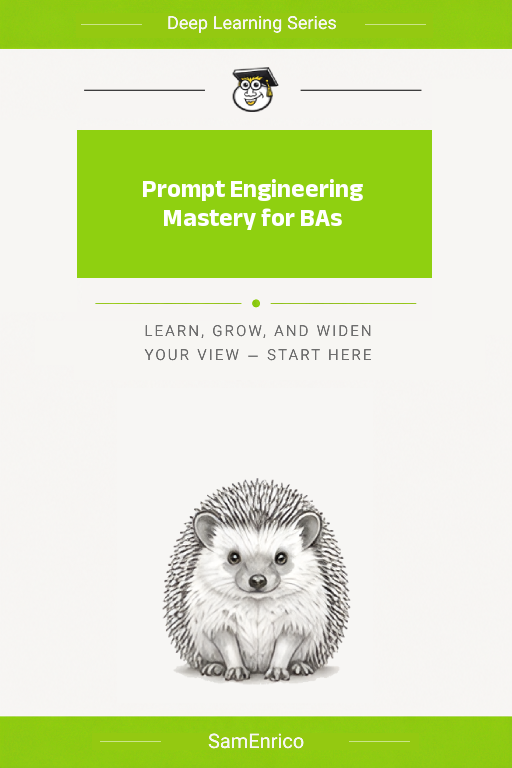
Non-FictionAI OperatorMastery Guide
Prompt Engineering Mastery for BAs eBook
Master all prompt engineering techniques for busin
Master all prompt engineering techniques for business analysts across the entire requirement lifecycle.
Formats
Free sample
Chapter 1: The Cognitive Architect--–- Every Business Analyst already knows how to prompt. They just don’t know they know.Consider the last time you sat across from a stakeholder who said, “We need a better user experience.” Those five words are a nightmare for any BA. Better how? For whom? Under what constraints? Measured by what? A junior BA might nod, write down “improve UX,” and disappear for two weeks only to return with something nobody wanted. But an expert BA does something else entirely. They lean forward. They ask: “When you say ‘better,’ what specific metric are you trying to move? Are we talking about reducing time-on-task, decreasing error rates, or improving satisfaction scores? And for which user segment?” The stakeholder blinks, then says, “Actually, I meant the approval workflow is confusing our managers.” In that moment, the BA didn’t just take an order. They extracted precision from ambiguity. They translated a vague wish into a structured problem. They elicited logic from a human who didn’t know they had it.Now replace “stakeholder” with “large language model.” Replace “We need a better user experience” with a vague prompt like “Write some requirements for a payment system.” The pattern is identical. The AI, like a junior BA, will produce something generic, shallow, and probably wrong. But the skilled prompter—the Cognitive Architect—leans in with structured questions, constraints, examples, and evaluation criteria. They extract precision from the model’s probabilistic haze. They translate a business need into a structured output. They elicit logic from a machine that doesn’t know it has any.This chapter dismantles the most expensive myth in business analysis today: that prompt engineering is a technical skill reserved for data scientists, ML engineers, or “AI natives.” In truth, prompt engineering is analytical rhetoric. It is the art of asking structured questions to produce structured answers. And Business Analysts have been doing this for decades—just with humans instead of machines. The only thing missing is the conscious transfer of skills. Once you see the parallel, you cannot unsee it. And once you internalize the Cognitive Architect mindset, you stop being a passive consumer of AI outputs and become an architect of AI reasoning.Why this reframing matters more than any specific prompting technique is simple: without it, you will use AI like a search engine. You will ask one question, accept the first answer, and move on. You will save tiny amounts of time on trivial tasks while missing the strategic leverage that separates AI-augmented BAs from those who will be replaced by someone who knows how to ask better questions. This chapter is the foundation. Everything else in this book—every framework, every technique, every template—rests on the single shift from user to architect.The Expensive Myth: Prompt Engineering Is Coding Walk into any tech company today and ask ten people what prompt engineering means. At least seven will describe something involving syntax, parameters, or “prompt hacking.” They will tell you about temperature settings, top-p sampling, and system prompts. They might even use the word “engineering” with a straight face. This is not entirely wrong—there are technical aspects to working with LLMs—but it is profoundly misleading for Business Analysts.The myth comes from a understandable place. The first people to publish about prompting were researchers and engineers who treated the model as a system to be controlled. They wrote about “prompt programming” because they were, in fact, programmers. They optimized for token efficiency and output determinism. They cared about API costs and latency. None of this is relevant to a BA trying to elicit requirements for a compliance workflow.Here is what actually happens when a BA treats prompt engineering as coding: they open Chat GPT, type “Write user stories for a login feature,” receive six generic stories, copy them into Jira, and declare victory. Two sprints later, the development team discovers the stories missed password recovery, multi-factor authentication, social login, and accessibility requirements. The BA blames the AI. The AI, of course, has no blame to assign—it simply responded to the prompt it was given. The failure was not technical. It was rhetorical.Now consider the alternative. A BA who treats prompting as elicitation writes: “Act as a senior BA for a regulated fintech. The compliance team requires audit trails for every authentication event. The user base includes visually impaired users who need screen reader compatibility. The system must support both SMS and authenticator app MFA. Given these constraints, write user stories for a login feature. Each story must include a unique ID, a specific actor, a measurable action, and a clear business value. Format as a markdown table. Before writing, list three edge cases a developer might miss.” The output will be dramatically different. Not because the AI became smarter, but because the BA became a better prompter.The myth persists because technical terminology sounds authoritative. “Prompt engineering” sounds like something you need a course for. “Elicitation” sounds like something BAs already do. The industry has invented a new label for an old skill, and BAs are uniquely positioned to claim it.The BA’s Hidden Superpower: You Already Know How to Do This Let us prove the point with an exercise. Read the following two exchanges and identify which one involves a human and which one involves an AI.Exchange A:Analyst: “Tell me about the approval process.”Stakeholder: “It’s pretty straightforward. The manager approves, then it goes to finance.”Analyst: “What happens if the manager is out of office?”Stakeholder: “Oh. Um, then it goes to the director. I think.”Analyst: “Does the director get notified automatically, or does the manager have to forward it?”Stakeholder: “I don’t know. Nobody’s ever been out that long.”Exchange B:Analyst: “Given this process description, list all exception paths not explicitly mentioned.”AI: “Based on the provided text, the following exception paths are implied but not specified: manager out of office, finance system unavailable, approval amount exceeds delegated authority, simultaneous submissions causing race conditions.”Analyst: “For the ‘manager out of office’ exception, what is the current undocumented behavior?”AI: “The text suggests manual forwarding, but no escalation policy or notification mechanism is described.”The first exchange is with a human stakeholder. The second is with GPT-4. But notice: the analyst’s skill set did not change. In both cases, they identified a gap, asked a clarifying question, and drilled down into ambiguity. The medium shifted, but the analytical muscle remained identical. This is the hidden superpower of Business Analysts. You have spent years learning how to extract structured information from unstructured conversation. You have developed pattern recognition for what is missing, not just what is present. You have built intuition for when someone is guessing versus when they are certain. All of this transfers directly to prompting AI models.The problem is that most BAs do not believe the transfer is possible. They see AI as a black box, fundamentally different from a human stakeholder. This belief is technically accurate but practically useless. Yes, an LLM does not have intentions, memories, or beliefs. But from a behavioral perspective, it responds to clarity, structure, and iteration in ways that are deeply familiar to anyone who has ever run a requirements workshop.Consider the specific BA skills that transfer directly to prompting:Active listening becomes prompt refinement. When a stakeholder says something unclear, you ask a follow-up. When an AI…
This is the end of the free sample. Get the eBook to keep going. Buy now
About this book
Details
- Author
- Shipman Aurora
- Publisher
- SamEnrico
- Language
- English
- Genre
- Non-Fiction, AI Operator, Mastery Guide
- Released
- 2026-05-30
- Pages (approx.)
- 158
- Available as
- eBook, Audiobook

Read better in the ZLOADR app
Your eBooks on your phone or tablet. Sign in with your SamEnrico account and start reading.
More by Shipman Aurora
 Social Media Manager Burnout CourseShipman Aurora$11.99
 The Mindfulness Stress TrackerShipman Aurora$11.99
 Ayurvedic Digestion Fire GuideShipman Aurora$11.99
 Perfectionist Teen RecoveryShipman Aurora$11.99
 Navigating Wedding and Event Guest TalksShipman Aurora$11.99
 The Silk Road's Secret Stitch: How a Byzantine Empress Revolutionized Fashion (6th Century CE)Shipman Aurora$11.99
 Ghana Payment Gateway IntegrationShipman Aurora$12.99
 Understanding Metaphyseal Chondrodysplasia Spahr TypeShipman Aurora$17.99
 Thenardite MiningShipman Aurora$11.99
 How to Become a Neon-tube PumperShipman Aurora$11.99
You may also like
 Hong Kong Handover 1997Dunn Johnnie$11.99
 Zumba For Postnatal Recovery CourseNeal Christian$11.99
 Zumba for BeginnersLadner Nikia$11.99
 YouTube Comment Mining GuideHumes Pandora$12.99
 Worry Box MeditationCarlin Rudy$11.99
 Workplace Stress MeditationNguyen Lynn$11.99
 Workplace Stress and Sleep RepairHawley Ivory$11.99
 Workplace Perfectionism CureDelaney Jeffry$11.99
 Workplace Injustice Anger GuideWallen Isabelle$11.99
 Work Addiction and Burnout LinkGreenwood Ester$11.99
 Women in Yoga and WellnessBeattie Galina$11.99
 Women in Stand Up ComedyChun Evangeline$11.99