
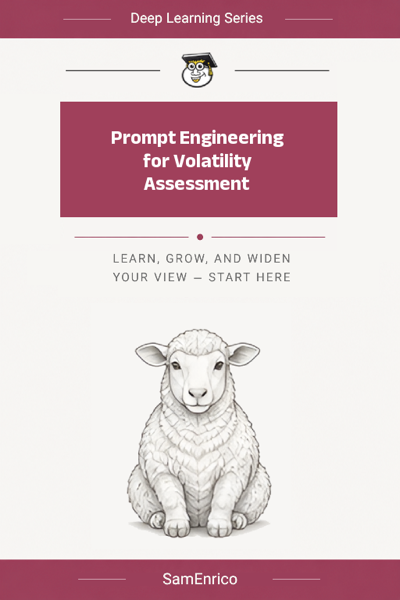
Non-FictionInformativeEducational
Prompt Engineering for Volatility Assessment
A Coursebook on Prompt Engineering for Volatility
A Coursebook on Prompt Engineering for Volatility Assessment
Formats
About this book
Free sample
Chapter 1: The $2 Trillion Blind Spot--–- On May 6, 2010, at 2:42 PM Eastern Time, a mutual fund manager in Kansas named Waddell & Reed executed a routine trade. He sold 75,000 E-Mini S&P 500 futures contracts as a hedge against market risk – something he had done hundreds of times before. Nothing about the trade was unusual. The size was normal. The timing was unremarkable.
The rationale was sound. Within 12 minutes, the Dow Jones Industrial Average would fall 998.5 points – nearly 1,000 points – the largest intraday drop in history at that time. Nearly $1 trillion in market value evaporated. And every single volatility model in every single investment bank, hedge fund, and proprietary trading desk on Wall Street said this was impossible.The models were not wrong in the way a typo is wrong. They were not slightly miscalibrated or operating with stale parameters.
They were catastrophically, foundationally, and embarrassingly wrong because they were blind to something obvious to any human trader who was watching the screens that afternoon: the story was changing. The narrative was shifting. And narrative volatility – the kind that comes from competing stories, linguistic ambiguity, and rapid shifts in market sentiment – does not appear in GARCH parameters, stochastic volatility surfaces, or implied volatility skews until after prices have already moved.This book is about teaching machines to read what those traditional models cannot see. It is about building prompts that extract narrative volatility from unstructured text – central bank statements, earnings call transcripts, news headlines, social media chatter – and turning that extracted signal into actionable volatility forecasts. And it begins with understanding why traditional models failed so dramatically on that May afternoon, and what that failure reveals about the future of volatility assessment.The Day the Models Went Silent Let us examine exactly what happened on May 6, 2010, because the details matter.
At 2:32 PM, the E-Mini S&P 500 futures contract was trading at 1,146. At 2:42 PM, Waddell & Reed executed its sell order. By 2:45 PM, the market had dropped 3 percent. By 2:47 PM, it had dropped 6 percent. By 2:50 PM, it had dropped 9 percent.
At 2:56 PM, the market hit its low – down nearly 10 percent from the previous day's close. Then, just…
This is the end of the free sample. Get the eBook to keep going. Buy now
Contents
- Chapter 1
- Chapter 2
- Chapter 3
- Chapter 4
- Chapter 5
- Chapter 6
- Chapter 7
- Chapter 8
- Chapter 9
- Chapter 10
- Chapter 11
- Chapter 12
Details
- Author
- Stinnett Livia
- Publisher
- SamEnrico
- Language
- English
- Genre
- Non-Fiction, Informative, Educational
- Released
- 2026-06-02
- Pages (approx.)
- 149
- Available as
- eBook, Audiobook

Read better in the ZLOADR app
Your eBooks on your phone or tablet. Sign in with your SamEnrico account and start reading.
More by Stinnett Livia
 Tenzing Family Climbing DynastyStinnett Livia$11.99
 Observation Without Judgment WorkbookStinnett Livia$11.99
 Restless Leg Syndrome And Pregnancy GuideStinnett Livia$11.99
 Trance For Emotional RegulationStinnett Livia$11.99
 Stress Circadian Rhythm GuideStinnett Livia$11.99
 Emotional Intelligence for DancersStinnett Livia$11.99
 Twelve Step Fears InventoryStinnett Livia$11.99
 Yosef Karo Code of Jewish LawStinnett Livia$11.99
 Working Capital OptimizationStinnett Livia$11.99
 The Alchemists of the Royal Society: Turning Lead to Gold in the Age of ReasonStinnett Livia$11.99
 Operation Gladio: The Secret War Beneath EuropeStinnett Livia$11.99
 The Iron Stallions of Prussia: Cavalry and Discipline in the Age of Frederick the GreatStinnett Livia$11.99
You may also like
 Hong Kong Handover 1997Dunn Johnnie$11.99
 Zumba For Postnatal Recovery CourseNeal Christian$11.99
 Zumba for BeginnersLadner Nikia$11.99
 YouTube Comment Mining GuideHumes Pandora$12.99
 Worry Box MeditationCarlin Rudy$11.99
 Workplace Stress MeditationNguyen Lynn$11.99
 Workplace Stress and Sleep RepairHawley Ivory$11.99
 Workplace Perfectionism CureDelaney Jeffry$11.99
 Workplace Injustice Anger GuideWallen Isabelle$11.99
 Work Addiction and Burnout LinkGreenwood Ester$11.99
 Women in Yoga and WellnessBeattie Galina$11.99
 Women in Stand Up ComedyChun Evangeline$11.99