
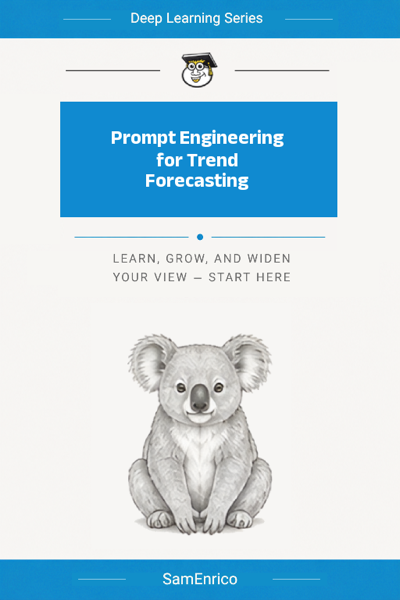
Non-FictionInformativeEducational
Prompt Engineering for Trend Forecasting eBook
A Coursebook on Prompt Engineering for Trend Forec
by Bivens Logan
A Coursebook on Prompt Engineering for Trend Forecasting
Formats
Free sample
Chapter 1: The Tyranny of the Rearview Mirror--Most forecasters are driving a high-speed car while only looking in the rearview mirror. They believe that the road ahead is a straight continuation of the road behind. Then they crash.If you have ever opened a spreadsheet, run a linear regression, or plotted a three-month moving average to predict next quarter’s sales, you have been guilty of this. You are not alone. The vast majority of quantitative forecasting—from Wall Street earnings models to supply chain demand planning—operates on a single, dangerous assumption: the future will look like the past.It will not.This is not a philosophical statement.
It is a mathematical, historical, and practical reality. The COVID-19 pandemic erased five years of retail trend data in eight weeks. The launch of Chat GPT made thousands of “future of work” forecasts obsolete overnight. A single regulatory decision, a viral social media post, or an engineering breakthrough in a lab you have never heard of can render your carefully calibrated time-series model useless before you have finished writing the report.And yet, the dominant paradigm of forecasting remains stubbornly backward-looking. We worship at the altar of historical data because it is clean, measurable, and comfortable.
But comfort is the enemy of foresight.This book offers a fundamentally different approach—not a replacement for statistical rigor, but a partnership with a new kind of intelligence. Large Language Models (LLMs) like GPT-4, Claude, and Gemini do not predict the future by extrapolating the past. They reason by analogy, detect weak signals across disconnected domains, and generate multiple plausible futures rather than a single confident line.But they are not magic. They cannot do arithmetic reliably. They hallucinate.
They inherit the biases of their training data. And they will confidently tell you nonsense if you ask them the wrong way.The art—and the science—of modern trend forecasting lies in the marriage of two very different intelligences: the statistical precision of traditional models and the pattern-matching genius of LLMs. This chapter introduces why that marriage is necessary, why most forecasters will resist it, and why you will not.The Quiet Crisis in Forecasting Let us start with an uncomfortable truth. The forecasting industry has a credibility problem.A landmark study by researchers at the University of Pennsylvania analyzed over 150,000 forecasts made by professional economists, analysts, and strategists over a twenty-year period. The results were devastating.
For horizons beyond twelve months, professional forecasters were no more accurate than random chance. For horizons beyond three years, they were worse than simple extrapolations of the most recent data point.Why? Because the world is not a straight line.Traditional forecasting methods—ARIMA, exponential smoothing, linear regression—are built on a foundation of stationarity. They assume that the statistical properties of the past (mean, variance, seasonality) will persist into the future. When the world is stable, these methods work beautifully.
When the world shifts, they fail catastrophically.Consider the retail industry. For decades, holiday shopping patterns were remarkably predictable. Sales spiked on Black Friday, surged again in the week before Christmas, and collapsed in January. Retail forecasters built elaborate models around these patterns. Then came 2020.
Supply chains fractured. Consumers shifted online. Holiday shopping started in October. The models broke.Or consider energy markets. For years, crude oil prices followed reasonably predictable seasonal patterns.
Then fracking technology matured, OPEC changed its strategy, and a global pandemic destroyed demand. Every model trained on pre-2020 data was worthless.This is not a failure of statistical technique. It is a failure of the underlying assumption. The assumption that the future will resemble the past is not just sometimes wrong. It is increasingly wrong in a world of accelerating change.The Three Ways Forecasts Fail Through decades of studying forecasting failures—from missed recessions to unexpected product successes—researchers have identified three distinct ways that predictions go wrong.
Understanding these failure modes is essential before we can understand how LLMs might help.Failure Mode One: The Structural Break A structural break occurs when the relationship between variables fundamentally changes. Before the break, X causes Y. After the break, X causes Z, or nothing at all.The 2008 financial crisis was a structural break. Before 2008, housing prices and mortgage defaults had a predictable relationship. After 2008, that relationship broke because the entire financial system had changed.
Any model trained on pre-2008 data would have been dangerously wrong.LLMs cannot predict structural breaks either—no one can. But they can identify the preconditions for breaks by scanning across domains. An LLM reading thousands of mortgage industry documents in 2006 might have surfaced the weak signals of excessive leverage and predatory lending that human analysts ignored because they did not fit their models.Failure Mode Two: The Black Swan Nassim Nicholas Taleb popularized the term “black swan” for events that are rare, impactful, and only predictable in retrospect. The COVID-19 pandemic was a black swan. So was the 9/11 attacks.
So was the invention of the i Phone.By definition, you cannot predict a black swan. No model, no matter how sophisticated, can foresee the unforeseeable.But you can prepare for them. And LLMs can help by identifying vulnerabilities, dependencies, and cascades. An LLM analyzing global supply chains in late 2019 might have surfaced the concentration of mask production in Wuhan, the just-in-time inventory practices that left hospitals vulnerable, and the pandemic exercise reports that warned of exactly this scenario—all signals that were publicly available but never connected.Failure Mode Three: The Slow Drift The most dangerous failure mode is also the most subtle. Slow drifts are gradual changes that individual data points do not register as significant but that accumulate into transformation over years.The decline of traditional television viewership among young adults was a slow drift.
Each quarter, the numbers dropped by only one or two percent—within the margin of error. Forecasters adjusted their models slightly and moved on. But over a decade, the cumulative change was massive. Anyone still forecasting based on 2010 television ratings in 2020 was catastrophically wrong.LLMs excel at detecting slow drifts because they can process vast amounts of text and identify subtle semantic shifts. When language changes slowly—when “sharing a car” becomes “ridesplitting,” when “working from home” becomes “distributed work”—an LLM can surface those changes long before they show up in quantitative metrics.What LLMs Actually Do (And Do Not Do)Before we go further, we need to be clear about what LLMs are and are not.
The marketing hype around artificial intelligence has created enormous confusion. Let me clear it up.An LLM is a machine that has been trained on a very large collection of text—much of the public internet, plus books, academic papers, and other sources. During training, it learns statistical patterns: which words tend to follow which other words, how concepts relate to each other, and what kinds of arguments are persuasive.When you give an LLM a prompt, it is not “thinking” in any human sense. It is generating the most statistically likely continuation of your prompt based on the patterns it learned during training. It is, in the technical jargon, a “next token predictor” operating at enormous scale.This sounds limiting.
In practice, it is magical.Because the training data includes so much of human knowledge, the LLM has internalized an astonishing…
This is the end of the free sample. Get the eBook to keep going. Buy now
About this book
Details
- Author
- Bivens Logan
- Publisher
- SamEnrico
- Language
- English
- Genre
- Non-Fiction, Informative, Educational
- Released
- 2026-06-02
- Pages (approx.)
- 146
- Available as
- eBook, Audiobook

Read better in the ZLOADR app
Your eBooks on your phone or tablet. Sign in with your SamEnrico account and start reading.
More by Bivens Logan
 The Financial Stress Reduction WorkbookBivens Logan$11.99
 Stack Overflow Reputation TrapBivens Logan$11.99
 Earplug Sleep Meditation GuideBivens Logan$11.99
 First Term Mayor Survival GuideBivens Logan$11.99
 Sleep Apnea Cheat SheetBivens Logan$11.99
 Empathy In Customer Service GuideBivens Logan$11.99
 Waititi JojoBivens Logan$11.99
 Samsung Reminder App GuideBivens Logan$11.99
 Pomodoro For Gratitude PracticeBivens Logan$11.99
 The Ghost of Flight 182: The CIA’s Secret War in LebanonBivens Logan$11.99
 Love and Gunpowder: A Huguenot's Last LetterBivens Logan$11.99
 The Leviathan’s Lullaby: The Forgotten Song of the DeepBivens Logan$11.99
You may also like
 Hong Kong Handover 1997Dunn Johnnie$11.99
 Zumba For Postnatal Recovery CourseNeal Christian$11.99
 Zumba for BeginnersLadner Nikia$11.99
 YouTube Comment Mining GuideHumes Pandora$12.99
 Worry Box MeditationCarlin Rudy$11.99
 Workplace Stress MeditationNguyen Lynn$11.99
 Workplace Stress and Sleep RepairHawley Ivory$11.99
 Workplace Perfectionism CureDelaney Jeffry$11.99
 Workplace Injustice Anger GuideWallen Isabelle$11.99
 Work Addiction and Burnout LinkGreenwood Ester$11.99
 Women in Yoga and WellnessBeattie Galina$11.99
 Women in Stand Up ComedyChun Evangeline$11.99