
Non-FictionInformativeEducational
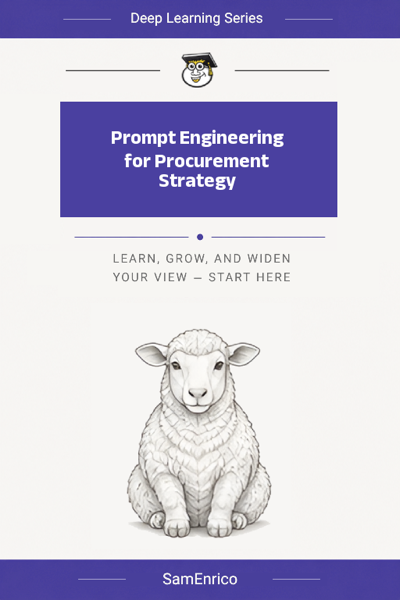
Prompt Engineering for Procurement Strategy eBook
A Coursebook on Prompt Engineering for Procurement
A Coursebook on Prompt Engineering for Procurement Strategy
Formats
Free sample
Chapter 1: The Obituary Not Written--The Wall Street Journal doesn’t run obituaries for departments that still exist. But if you know where to look—inside the quarterly earnings calls, the whispered conversations at procurement conferences, the sudden budget reallocations—you can already see the tombstone being carved. It reads something like this:“Here lies the Procurement Department. Born in the era of purchase orders and paper. Died because it asked the wrong questions at the worst possible time.
It will be remembered for its spreadsheets. It will not be missed by its CFO.”That obituary hasn’t been published yet. But it has been drafted. And the only thing that will stop it from running is you—and a fundamental shift in how you talk to machines.This is not a book about artificial intelligence. This is a book about strategic dialogue—the lost art of asking the right question in the right way to an entity that knows more than any human ever could, but understands less than a reasonably competent intern.
Large language models are savants with the social awareness of a goldfish. They have ingested the entirety of human procurement knowledge—every textbook, every case study, every negotiation playbook ever digitized. And yet, if you ask one “Find me three suppliers of steel tubes,” it will happily return three names, confident and wrong, because you gave it a grocery list when you needed a strategic analyst.The gap between what AI can do and what procurement professionals ask it to do is the single largest source of untapped value in corporate purchasing today. This chapter closes that gap by burning down a comfortable lie: that effective AI use is simply asking better keyword-based questions. It is not.
It is a complete reorientation of how you think about dialogue itself.The Comfortable Lie That Is Costing You Your Career Most procurement professionals approach AI the way they approached their first search engine in 1998. They type a few keywords, hit enter, and hope for the best. “Find me suppliers of aluminum.” “Compare shipping costs.” “Summarize this contract.” These are transactional queries—the linguistic equivalent of a vending machine. You put in a few words, and you expect a predictable snack to fall out.But Generative AI is not a vending machine. It is an infinitely capable, deeply erratic, highly impressionable junior analyst who has read every procurement book ever written but has never actually bought anything.
It does not know what you mean. It knows what you say. And if you say something vague, it will fill in the gaps with something plausible—which is not the same as something correct.Consider the difference between these two prompts:Transactional (weak): “Find me three suppliers of lithium-ion batteries.”Strategic (strong): “Act as a senior category manager for electric vehicle components. Analyze the global lithium-ion battery market, focusing on suppliers with production facilities outside of China. Consider recent tariffs, raw material price volatility for lithium and cobalt, and each supplier’s track record on forced labor compliance.
Output a table comparing three suppliers on cost, delivery reliability, geographic risk, and ESG compliance. Then provide a one-paragraph recommendation for which supplier to pursue first.”The first prompt will return three names. The second will return a strategic recommendation backed by reasoning. Both take the same amount of typing. One is a dead end.
The other is a career accelerant.The difference is not the AI. The difference is the prompt architecture—the structure of the question itself. And that architecture follows a simple, learnable pattern that this book calls strategic dialogue.The Three Pillars of Strategic Dialogue Every effective procurement prompt rests on three invisible pillars. If any pillar is missing, the output will be incomplete, misleading, or actively dangerous. These pillars are Role, Constraints, and Format.
Master these, and you have mastered 80 percent of prompt engineering for procurement.Pillar One: Role (The Persona You Assign)AI has no identity. It has no memory of who you are or what you need. You must give it a persona—a specific job title, experience level, and area of expertise—or it will default to a generic, unhelpful voice.A weak prompt assigns no role: “Analyze these bids.”A strong prompt assigns a specific role: “Act as a procurement director with 15 years of experience in pharmaceutical cold chain logistics. You have negotiated contracts with CDMOs in Ireland, Switzerland, and Singapore. You are skeptical of quality claims without audit data.”The role does three things.
First, it activates the correct subset of the AI’s training data (it has read thousands of procurement director memos). Second, it sets a tone (direct, skeptical, data-driven). Third, it gives the AI permission to make assumptions that would otherwise be inappropriate (e.g., using industry jargon like “CDMO” and “cold chain”).Rule of thumb: The more specific the role, the better the output. “Act as a buyer” is barely better than nothing. “Act as a senior category manager for indirect spend in a mid-sized European manufacturing company who has just been told to cut logistics costs by 15 percent without sacrificing delivery reliability” is excellent.Pillar Two: Constraints (The Boundaries You Set)AI, left to its own devices, will hallucinate.
It will invent suppliers that do not exist. It will cite case studies it cannot produce. It will recommend strategies that violate your budget, your timeline, or your ethics. Constraints are the fences that keep the AI in productive pasture.Constraints include:Budget caps: “Do not recommend any solution exceeding $500,000 total landed cost.”Timelines: “Delivery must be completed within 8 weeks of purchase order.”Compliance requirements: “All suppliers must comply with EU Conflict Minerals Regulation and UK Modern Slavery Act.”Geographic restrictions: “Prefer suppliers with manufacturing in NATO-aligned countries only.”Risk thresholds: “Exclude any supplier with a Dun & Bradstreet failure score above 5.”Without constraints, the AI will optimize for the wrong variable—usually cost, because cost is the most common variable in its training data. With constraints, the AI is forced to find solutions that fit your actual business reality, not an idealized version of it.Critical insight: Constraints are not limitations.
They are leverage. A prompt with ten constraints will produce a more useful output than a prompt with one constraint, because each constraint eliminates a swath of irrelevant possibilities. The AI’s job becomes easier, not harder, when you tell it what not to do.Pillar Three: Format (The Container You Demand)AI will default to paragraphs. Paragraphs are useful for storytelling and useless for decision-making. Procurement professionals need tables, scorecards, risk matrices, executive summaries, and action plans.
You must demand a specific format, or you will receive a wall of text that you will have to reformat yourself.A weak prompt specifies no format: “Tell me about these suppliers.”A strong prompt specifies an exact format: *“Output the following, in this order: (1) A one-paragraph executive summary suitable for a CFO who has 30 seconds to read it. (2) A weighted scoring table with five suppliers as rows and six criteria as columns. (3) A risk heatmap showing each supplier’s financial, operational, and geopolitical risk as High/Medium/Low. (4) A recommended negotiation sequence: which supplier to approach first, what concession to…
This is the end of the free sample. Get the eBook to keep going. Buy now
About this book
Details
- Author
- Crowe Clarita
- Publisher
- SamEnrico
- Language
- English
- Genre
- Non-Fiction, Informative, Educational
- Released
- 2026-06-01
- Pages (approx.)
- 140
- Available as
- eBook, Audiobook

Read better in the ZLOADR app
Your eBooks on your phone or tablet. Sign in with your SamEnrico account and start reading.
More by Crowe Clarita
 International Networking Protocol GuideCrowe Clarita$11.99
 Loneliness Dance Fitness GuideCrowe Clarita$11.99Loneliness Dance Fitness GuideCrowe Clarita$11.99
 The Focus Mirror MethodCrowe Clarita$11.99
 Washington GeneralCrowe Clarita$11.99
 Asking for MentorshipCrowe Clarita$11.99
 Senior Change AdaptationCrowe Clarita$11.99
 Control Release TranceCrowe Clarita$11.99
 The Recovery Movement GuideCrowe Clarita$11.99
 Magnetic Hands InductionCrowe Clarita$11.99
 The Day the Music Burned: The Lost Tapes of the National Recording RegistryCrowe Clarita$11.99
 The Black Rider of the CarpathiansCrowe Clarita$11.99
You may also like
 Hong Kong Handover 1997Dunn Johnnie$11.99
 Zumba For Postnatal Recovery CourseNeal Christian$11.99
 Zumba for BeginnersLadner Nikia$11.99
 YouTube Comment Mining GuideHumes Pandora$12.99
 Worry Box MeditationCarlin Rudy$11.99
 Workplace Stress MeditationNguyen Lynn$11.99
 Workplace Stress and Sleep RepairHawley Ivory$11.99
 Workplace Perfectionism CureDelaney Jeffry$11.99
 Workplace Injustice Anger GuideWallen Isabelle$11.99
 Work Addiction and Burnout LinkGreenwood Ester$11.99
 Women in Yoga and WellnessBeattie Galina$11.99
 Women in Stand Up ComedyChun Evangeline$11.99