
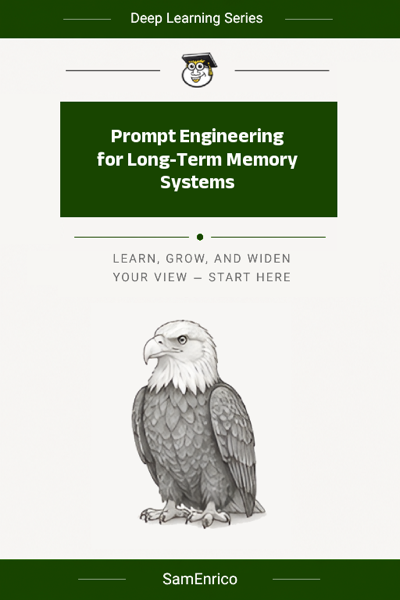
Non-FictionInformativeEducational
Prompt Engineering for Long-Term Memory Systems eBook
A Coursebook on Prompt Engineering for Long-Term M
A Coursebook on Prompt Engineering for Long-Term Memory Systems
Formats
Free sample
Chapter 1: The Memory Lie--–- Every AI developer eventually hears the whisper. It starts as a small frustration—a chatbot that asks for your name for the third time in five minutes, a coding assistant that forgets which function you just wrote, a customer support agent that cannot remember the ticket you opened yesterday. The whisper grows louder with each repetition: Why doesn't this thing remember anything?The answer, delivered in hushed tones at conferences and buried in obscure blog posts, is the best-kept secret in artificial intelligence. Your AI has amnesia. Not the poetic, forgetful-grandfather kind of amnesia, but a fundamental, architectural, stateless emptiness where memory should live.
Every time you send a message to an LLM, you are speaking to a stranger. That helpful assistant you spent thirty minutes training on your preferences? It forgot everything the moment you closed the browser tab. That support bot that finally understood your problem after seven back-and-forth exchanges? It will greet you tomorrow like it has never seen your face.This is the Memory Lie.
And almost everyone believes it.The lie has two parts. First, that large language models inherently "remember" things from previous conversations. Second, that if they do not remember, simply giving them a larger "context window" will solve the problem. Both are wrong. Both are costing you money, frustrating your users, and preventing your AI from ever achieving the one quality that separates a toy from a tool: continuity.This chapter dismantles the Memory Lie.
We will explore why LLMs forget everything after every interaction, why throwing more tokens at the problem is like buying a bigger bucket for a boat with a hole in it, and how thinking about AI memory requires a completely different framework—one borrowed from cognitive science and adapted for the strange, stateless world of transformer models. By the end of this chapter, you will understand why your AI has amnesia, and you will be ready to build the cure.The Stateless Paradox Let us perform a simple experiment. Open your favorite chatbot interface—Chat GPT, Claude, Gemini, whatever you use. Type this message: "My name is Alex. Remember that." The AI will respond affirmatively, perhaps saying "Nice to meet you, Alex" or "I've noted your name." Then close the browser tab.
Open a fresh tab. Start a new conversation. Type "What is my name?"The AI will not know. It will apologize. It will ask you to reintroduce yourself.
This is not a bug. It is not a failure of engineering. It is a feature of how LLMs work, and understanding why is the first step toward fixing it.Every time you send a prompt to a standard LLM API, you are making a stateless request. The server receives your input, processes it through the neural network, generates a response, and then—crucially—discards everything. The model does not have a "memory" section in its architecture.
It does not have a database of past conversations. It does not have a scratchpad that persists between requests. It is, in the purest sense of the word, stateless.The only reason your chatbot seems to remember anything during a single conversation is the context window. The context window is a temporary buffer that holds the current conversation history. When you send a message, you also resend all previous messages in that conversation.
The LLM sees the entire history up to that point and uses it to generate the next response. But the moment the conversation ends, or the context window fills up, or the server restarts, that history vanishes.Think of the context window as a whiteboard. You can write on it, erase parts, add new notes. But when you leave the room, someone wipes the whiteboard clean. Every.
Single. Time.This is the Stateless Paradox: LLMs are brilliant at processing language in a single interaction, but they are fundamentally incapable of remembering anything across interactions without external help. The very architecture that makes them powerful—their lack of built-in state—is also what makes them forgetful.Why "Longer Context" Is Not Memory In 2024 and 2025, a seductive solution emerged. Companies like Google (with Gemini 1.5) and Anthropic (with Claude 3's 200K token window) began offering massive context windows. Gemini 1.5 boasts a 2 million token context window—enough to hold the entire Lord of the Rings trilogy several times over.
The marketing suggests that larger context windows solve the memory problem. They do not.Let us be precise about why.First, cost scales linearly with context size. Every token in the context window is processed for every generation. If you maintain a 2 million token conversation history, each subsequent message costs as much as processing 2 million tokens of fresh input. For a busy application with thousands of users, this becomes financially impossible within weeks.
I have consulted for startups that burned through $10,000 in API credits in a single month because they naively appended every message to an ever-growing context window.Second, models struggle with the "lost in the middle" problem. Research from papers like "Lost in the Middle: How Language Models Use Long Contexts" (Liu et al., 2024) demonstrates that LLMs pay far more attention to the beginning and end of long contexts than to the middle. A piece of information buried in the middle of a 100,000 token conversation is effectively invisible to the model. You can store the user's name on turn five, but by turn fifty, the model has forgotten it exists—not because the information was deleted, but because the model's attention mechanism simply did not look there.Third, latency increases with context size. Each generation requires processing the entire context.
For real-time applications like voice assistants or gaming NPCs, waiting several seconds for a response is unacceptable. Users will not tolerate a customer support bot that takes ten seconds to answer because it is scanning a year of conversation history.Fourth, longer contexts postpone forgetting; they do not prevent it. Even with a 2 million token window, you will eventually hit the limit. What happens then? You have two choices: discard the oldest messages (truncation) or summarize them (compression).
Both are forms of memory management. Both require you to make decisions about what to keep and what to forget. A larger window just delays the decision; it does not eliminate it.The companies selling massive context windows know this. They are not lying, exactly. They are selling you a bigger boat.
But you still have to navigate the same ocean, and eventually, you will need a system for deciding what stays and what goes.Introducing Mem GPT: The Surgical Alternative If brute force (larger context windows) is the wrong approach, what is the right one? The answer comes from a surprising place: operating systems.In 2023, researchers at UC Berkeley introduced Mem GPT (Memory-augmented Generative Pre-trained Transformer), a system that treats the LLM's context window like a computer's limited RAM and external storage (vector databases, SQL, key-value stores) like a hard drive. The LLM learns to "page" information in and out of its context window, retrieving relevant memories from external storage when needed and discarding them when they are no longer useful.Here is the key insight: your AI does not need to remember everything all the time. It…
This is the end of the free sample. Get the eBook to keep going. Buy now
About this book
Details
- Author
- Belton Cassidy
- Publisher
- SamEnrico
- Language
- English
- Genre
- Non-Fiction, Informative, Educational
- Released
- 2026-06-03
- Pages (approx.)
- 133
- Available as
- eBook, Audiobook

Read better in the ZLOADR app
Your eBooks on your phone or tablet. Sign in with your SamEnrico account and start reading.
More by Belton Cassidy
 Perfectionism HypnosisBelton Cassidy$11.99
 Senior Grief Esteem GuideBelton Cassidy$11.99
 Networking Approach AnxietyBelton Cassidy$11.99
 Networking for People with DisabilitiesBelton Cassidy$11.99
 Loneliness Martial Arts DojoBelton Cassidy$11.99
 Stress Liver Disease LinkBelton Cassidy$11.99
 The Prevention Habit TrackerBelton Cassidy$11.99
 Lincoln LeadershipBelton Cassidy$11.99
 Melanoma Skin SurvivorBelton Cassidy$11.99
 Ghost in the Firewall: The Stuxnet Heist That Changed CyberwarBelton Cassidy$11.99
 Bakunawa: The Celestial Serpent of Philippine StormsBelton Cassidy$11.99
 The Fall of the Colombian Hip-Hop Pioneers: How Violence Silenced a RevolutionBelton Cassidy$11.99
You may also like
 Hong Kong Handover 1997Dunn Johnnie$11.99
 Zumba For Postnatal Recovery CourseNeal Christian$11.99
 Zumba for BeginnersLadner Nikia$11.99
 YouTube Comment Mining GuideHumes Pandora$12.99
 Worry Box MeditationCarlin Rudy$11.99
 Workplace Stress MeditationNguyen Lynn$11.99
 Workplace Stress and Sleep RepairHawley Ivory$11.99
 Workplace Perfectionism CureDelaney Jeffry$11.99
 Workplace Injustice Anger GuideWallen Isabelle$11.99
 Work Addiction and Burnout LinkGreenwood Ester$11.99
 Women in Yoga and WellnessBeattie Galina$11.99
 Women in Stand Up ComedyChun Evangeline$11.99