

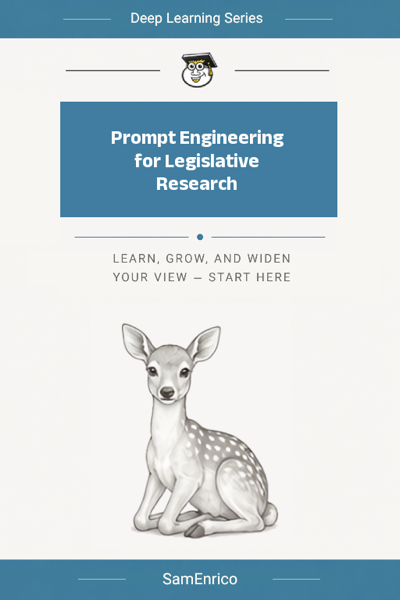
researchInformativeEducational
Prompt Engineering for Legislative Research eBook
A Coursebook on Prompt Engineering for Legislative
by Meeks Otha
A Coursebook on Prompt Engineering for Legislative Research
Formats
Free sample
Chapter 1: The Quiet Crisis--– The senior partner’s email arrived at 11:47 PM on a Sunday. “Need a preemption analysis on the new Florida data privacy law by 9 AM. Compare with GDPR and CCPA. Flag any conflicts with federal banking regulations. Bill 4 hours.” The associate, a third-year lawyer at a mid-sized firm, had two options.
Option one: spend the next six hours toggling between Westlaw, Lexis, and PDFs, manually reading statutes, copying excerpts into a Word document, and praying she did not miss a critical conflict. Option two: paste the statutes into Chat GPT and ask for a quick comparison. She chose option two. By 3 AM, she had a beautiful, twelve-page memo with perfect citations, clear reasoning, and a confident conclusion. She filed it at 8:55 AM.
The partner never noticed the problem. Opposing counsel did. Four of the six federal banking regulations cited in the memo did not exist. The judge issued an order to show cause. The associate was publicly sanctioned.
The firm lost the client. The associate’s career never recovered.This story is not hypothetical. It is a composite of real events following the now-infamous Mata v. Avianca sanctions order of 2023, where two lawyers submitted a brief containing six fabricated cases generated by Chat GPT. The judge called it “an unprecedented circumstance.” It was not unprecedented.
It was the first time a court caught it. Since then, similar sanctions have been issued in at least a dozen jurisdictions. And for every case that results in a sanctions order, hundreds more never get caught—or get caught too late, after a bad settlement, a lost motion, or a client who will never trust you again.This book exists because the legal profession is facing a quiet crisis. Conversational AI tools like Chat GPT, Claude, Gemini, and legal-specific LLMs are not going away. They are already embedded in the workflows of early-adopting firms, solo practitioners, and even some judges.
Yet the vast majority of lawyers have received zero training on how to use these tools effectively and safely. The result is a growing chasm: on one side, lawyers who treat AI as a magic wand and risk professional ruin; on the other, lawyers who reject AI entirely and risk being left behind. There is a third path, and this book is it.The Fundamental Shift You Have Already Missed If you learned legal research more than three years ago, you were trained in the Boolean paradigm. You learned about terms and connectors, proximity operators, field restrictions, and the careful art of crafting a Westlaw query that returned exactly the right fifteen cases. Boolean searching is precise, unforgiving, and reliant on controlled vocabulary.
It is also dying.Conversational AI represents a complete inversion of the research model. Instead of telling the database how to search (using AND, OR, NOT, /p, /s), you tell the AI what you want to know. You ask a question. The AI attempts to answer it. This is called semantic search—search based on meaning rather than keyword matching.
It is faster, more intuitive, and often more comprehensive. But it is also statistically fuzzy, deeply opaque, and prone to a failure mode that Boolean search never had: hallucination.Consider the difference. A Boolean search for “preemption AND ‘data privacy’” on Westlaw returns zero results if you misspell “preemption” or if the database uses a different indexing term. The failure is obvious and immediate. You get no results, and you know you need to try again.
A conversational AI, when asked “What does the Florida data privacy law say about preemption of local ordinances?” will always return something. Even if the answer is completely wrong, even if the statute has no preemption provision at all, the AI will produce a fluent, confident, and utterly plausible response. The failure is invisible. It looks like success. That is what makes it so dangerous.The lawyers in Mata v.
Avianca did not ask Chat GPT to fabricate cases. They asked it to find cases. And it did—just not real ones. The AI generated citations that followed the correct format, cited the correct court, and used the correct volume numbers. Any human lawyer glancing at the citations would have recognized them as authentic.
A closer look revealed that the case numbers did not exist, the purported quotations could not be found, and the legal reasoning was nonsensical. But the lawyers did not look closer. They trusted the tool.What This Book Will Teach You That No Other Book Does There are dozens of books about prompt engineering. There are hundreds of books about legal research. There is almost no book that bridges the two.
This one does. Specifically, this book will teach you:First, how AI actually works when processing legal text. You cannot prompt effectively if you do not understand the machine you are commanding. Chapter 2 explains tokenization, context windows, and the statistical nature of next-token prediction—concepts that directly explain why AI hallucinates and how to prevent it.Second, a structured framework for legal prompting. Chapter 3 introduces the RICER model—Role, Instruction, Context, Example, Structure Check—which transforms vague questions into precise, verifiable commands.
This framework is not theoretical. It is built from analyzing thousands of successful and failed legal prompts.Third, task-specific techniques for every major legislative research function. Statutory interpretation (Chapter 4). Temporal versioning and amendment tracing (Chapter 5). Legislative intent (Chapter 6).
Regulatory tracking (Chapter 7). Chain-of-Thought reasoning for complex analysis (Chapter 8). Retrieval-Augmented Generation or RAG for closed-domain research (Chapter 9). Agentic workflows for large-scale projects (Chapter 10).Fourth, the ethics and liability framework you must follow to avoid sanctions. Chapter 11 is not optional.
It covers the Ethics Audit Prompt, data privacy rules, and the decision matrix for when AI output is usable versus when it is poison.Fifth, what comes next. Chapter 12 looks ahead to reasoning models, multi-agent simulations, and the evolving standard of care for legal AI use.Every chapter includes exercises, prompt templates, and verification workflows. By the end of this book, you will not be an AI expert—no such person exists. But you will be a skilled, skeptical, and safe user of AI for legislative research. You will know when to trust the output, when to verify it, and when to ignore it entirely.The Core Problem: Constraining Creativity AI language models are designed to be creative.
That is their strength and their danger. When you ask an AI “What is the penalty for violating 18 U.S.C. § 924(c)?”, the AI is not looking up the answer in a database. It is playing the world’s most sophisticated game of “what word usually comes next?” It has seen, in its training data, thousands of examples of lawyers discussing Section 924(c). It has seen phrases like “mandatory minimum sentence,” “consecutive term,” and “first offense.” It assembles these statistically probable tokens into a response that looks like an answer.
Most of the time, that response is correct. Sometimes, terrifyingly, it is not.The problem is that the AI does not know the difference. It has no internal fact-checker. It cannot distinguish between a real statute and a hallucinated one because both are just patterns of tokens to the model. When the AI generates “United States v.
Smith, 123 F.4th 456 (9th Cir. 2023)” as a citation, that string of characters follows the statistical patterns of real…
This is the end of the free sample. Get the eBook to keep going. Buy now
About this book
Details
- Author
- Meeks Otha
- Publisher
- SamEnrico
- Language
- English
- Genre
- research, Informative, Educational
- Released
- 2026-05-06
- Pages (approx.)
- 152
- Available as
- eBook, Audiobook

Read better in the ZLOADR app
Your eBooks on your phone or tablet. Sign in with your SamEnrico account and start reading.
More by Meeks Otha
 Recall Class Action SettlementMeeks Otha$11.99
 The Beginner's Waiting Room PracticeMeeks Otha$11.99
 NYC Pop Up Build Out CostsMeeks Otha$11.99
 Dreams About Being LostMeeks Otha$11.99
 The Calcutta Madrasa MutinyMeeks Otha$11.99
 Czechoslovakian Velvet EscapeMeeks Otha$11.99
 Body Image Workbook for TeensMeeks Otha$11.99
 Work Addiction And Self WorthMeeks Otha$11.99
 GLP 1 Agonists GuideMeeks Otha$11.99
 The Tower That Broke the Sky: How the Burj Khalifa Defied Gravity and EconomicsMeeks Otha$11.99
 Pandamonium: The Great Zoo Heist of 1975Meeks Otha$11.99
 The Billion-Dollar Betrayal: How a Tech Titan Toppled His Own EmpireMeeks Otha$11.99
You may also like
 Scientific Research On TM GuideMartens Nathanial$11.99
 Research Proposal Methodology Section MasteryPauley Debroah$11.99
 Research Proposal Appendix CompilationRaines Tyisha$11.99
 Academic Researcher Distraction GuideFord Virgil$11.99
 TM Research and ScienceCovert Nicki$11.99
 Social Anxiety Research ReviewRoberge Cole$11.99
 Research Proposal Significance Section GuideBock Tory$12.99
 Research Proposal Reviewer PsychologyLugo Tawanda$11.99
 Research Proposal Research Questions DesignLara Robbi$11.99
 Research Proposal References and CitationsPatten Shanice$11.99
 Research Proposal Mixed Methods DesignCameron Omega$11.99
 Research Proposal Data Management PlanAnderson Roberto$12.99