
Non-FictionInformativeEducational
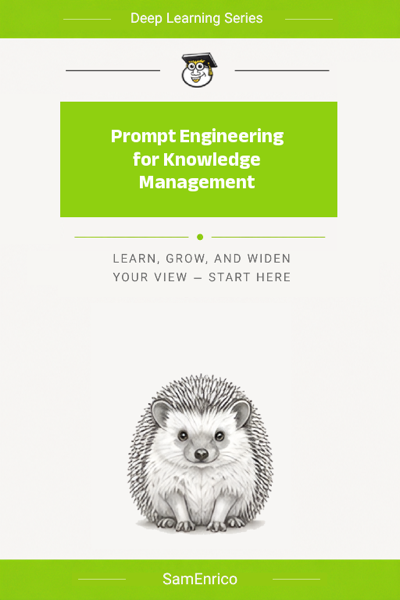
Prompt Engineering for Knowledge Management eBook
A Coursebook on Prompt Engineering for Knowledge M
A Coursebook on Prompt Engineering for Knowledge Management
Formats
Free sample
Chapter 1: The Buried Wisdom--–- Every organization of significant size sits atop a graveyard of buried wisdom. The engineering fix that took three weeks to discover, typed once into a ticket system and never seen again. The sales insight that closed the company's largest deal, trapped in the departing rep's email archive. The compliance interpretation that cost fifty thousand dollars in outside counsel fees, memorialized in a Power Point slide that no one can find. This is not hyperbole.
It is the normal state of knowledge work in the twenty-first century, and it is strangling productivity, innovation, and employee satisfaction.The problem is not that organizations lack information. They are drowning in it. The average enterprise generates more data in a single day than a medieval scholar encountered in a lifetime. The problem is that information and knowledge are not the same thing. Information is raw, unstructured, and silent.
Knowledge is structured, actionable, and speaks when asked. The gap between the two—between the petabytes of information an organization possesses and the insights its employees can actually use—is what this book calls the Knowledge Bottleneck, and it is the single largest source of waste in modern business.Traditional Knowledge Management promised to solve this problem. It failed. Not because the goal was wrong, but because the tools were designed for a world that no longer exists: a world of patient users who would learn complex search syntax, a world of stable taxonomies that could be built once and used forever, a world where tacit knowledge could be captured through documentation rather than conversation. That world has crumbled.
What replaces it is not a better document repository or a more detailed taxonomy. What replaces it is a fundamentally different way of interacting with information—a new discipline called prompt engineering for knowledge management.This chapter diagnoses why traditional KM collapsed, introduces the economic logic that makes prompt engineering essential, and defines the new role that will determine which organizations thrive in the age of AI: the Knowledge Engineer.The Three Failures of Traditional Knowledge Management Traditional Knowledge Management emerged in the 1990s as a corporate response to a real and pressing problem. The baby boomer generation was approaching retirement, and organizations faced the prospect of decades of accumulated expertise walking out the door. The solution, in theory, was straightforward. Build centralized repositories.
Hire taxonomists to organize content into logical hierarchies. Train subject matter experts to document their knowledge. Create search interfaces that allow employees to find what they need. The cycle of capture, store, retrieve, and learn would continue forever, and institutional memory would never fade.In practice, the theory collapsed under its own weight. Three structural failures doomed traditional KM from the start, and understanding these failures is essential because they explain why prompt engineering is not just an improvement but a genuine revolution.Failure One: The Taxonomy Trap The first failure is the most seductive because it feels like progress.
Organizations hire consultants or internal experts to build a taxonomy—a hierarchical classification of every concept relevant to the business. Products are organized into categories. Policies are grouped by department. Procedures are filed under processes. The result looks professional, rigorous, and useful.Then the business changes.
A new product launches that does not fit any existing category. A regulation shifts, rendering an entire branch of the taxonomy obsolete. A competitor emerges, introducing a new concept that the taxonomy has no way to represent. The taxonomy is already outdated, but nobody wants to admit it because rebuilding it would cost months of work and thousands of dollars. So the organization lives with a classification system that actively misleads users, filing new content into categories that no longer fit because the cost of reorganization is prohibitive.This is the Taxonomy Trap: the mistaken belief that knowledge can be frozen into a permanent hierarchy.
It cannot. Knowledge is dynamic, emergent, and contextual. A classification that makes perfect sense for a manufacturing engineer may be useless for a supply chain analyst. A hierarchy that works for a startup with three products collapses under a multinational with three thousand. Traditional KM tools had no solution to this problem because they were built on the assumption of stability.
Prompt engineering, as you will see in Chapter 5, solves it by generating taxonomies dynamically, on demand, from the actual content in your knowledge base.Failure Two: The Search Tax The second failure is the one that kills user adoption. Traditional knowledge bases require users to pay what this book calls the Search Tax: the cognitive and temporal cost of translating a question into a query that the system can understand. Users must learn Boolean operators (AND, OR, NOT). They must understand metadata fields and how to filter by them. They must scan through dozens of search results, clicking into documents, reading paragraphs, and synthesizing information manually.
The Search Tax is real, and it is high.Research consistently shows that knowledge workers spend nearly twenty percent of their workweek hunting for information. That is one full day out of every five, spent not on analysis, not on decision-making, not on creativity, but on the sheer mechanical act of finding things. Even worse, the same research shows that when faced with a choice between spending five minutes searching the knowledge base or asking a colleague for a two-minute answer, most employees choose the colleague. The knowledge base becomes a last resort, used only when the colleague is unavailable. The result is that the same questions get answered hundreds of times by hundreds of different people, and the organization never captures the pattern.Traditional KM tools had no answer to the Search Tax because they were built on the assumption that users would be patient and skilled.
They are neither. Prompt engineering eliminates the Search Tax entirely by shifting the unit of value from the document to the answer. Instead of searching for documents and reading them, users ask questions and receive direct answers with citations. The cognitive load drops from high to near zero. Adoption follows.Failure Three: The Tacit Knowledge Gap The third failure is the most fundamental because it concerns the very nature of knowledge itself.
Philosophers have long distinguished between explicit knowledge, which can be written down and transferred through documents, and tacit knowledge, which is personal, context-dependent, and difficult to articulate. Knowing how to ride a bicycle is tacit knowledge. You cannot learn it from a manual. You learn it by falling, adjusting, and feeling. The same is true for most of what experts know: the intuition that a certain approach will fail, the pattern recognition that flags an emerging risk, the judgment that weighs competing priorities.Traditional KM tools had no mechanism for capturing tacit knowledge because capturing it requires conversation, not documentation.
It requires asking the right questions, following tangents, and extracting insights that the expert does not even know they possess. A document repository cannot interview a retiring engineer. A search engine cannot ask clarifying questions. A taxonomy cannot follow an unexpected thread.Prompt engineering, combined with large language models, changes this fundamentally. As you will learn in Chapter 8, a well-designed prompt can simulate a conversation with an expert, asking probing…
This is the end of the free sample. Get the eBook to keep going. Buy now
About this book
Details
- Author
- Mcwilliams Cathern
- Publisher
- SamEnrico
- Language
- English
- Genre
- Non-Fiction, Informative, Educational
- Released
- 2026-06-03
- Pages (approx.)
- 146
- Available as
- eBook, Audiobook

Read better in the ZLOADR app
Your eBooks on your phone or tablet. Sign in with your SamEnrico account and start reading.
More by Mcwilliams Cathern
 Mindful Communication GuideMcwilliams Cathern$11.99
 Wholesaling Marketing AutomationMcwilliams Cathern$11.99
 Metta For Adoptive ParentsMcwilliams Cathern$11.99
 Eisenhower Whiteboard SystemMcwilliams Cathern$11.99
 Shaheed Smarak InterpretationMcwilliams Cathern$11.99
 Hamstring Strain Recovery ProtocolMcwilliams Cathern$11.99
 Forged by FireMcwilliams Cathern$11.99
 Assertiveness For WomenMcwilliams Cathern$11.99
 Gambler Fallacy BusinessMcwilliams Cathern$11.99
 Whispers of the Oracle: The Lost Prophecies of the SibylsMcwilliams Cathern$11.99
 The Visionary and the Game: How David Dein Reshaped English FootballMcwilliams Cathern$11.99
 Echoes from the Void: The Wow! Signal's Lasting MysteryMcwilliams Cathern$11.99
You may also like
 Hong Kong Handover 1997Dunn Johnnie$11.99
 Zumba For Postnatal Recovery CourseNeal Christian$11.99
 Zumba for BeginnersLadner Nikia$11.99
 YouTube Comment Mining GuideHumes Pandora$12.99
 Worry Box MeditationCarlin Rudy$11.99
 Workplace Stress MeditationNguyen Lynn$11.99
 Workplace Stress and Sleep RepairHawley Ivory$11.99
 Workplace Perfectionism CureDelaney Jeffry$11.99
 Workplace Injustice Anger GuideWallen Isabelle$11.99
 Work Addiction and Burnout LinkGreenwood Ester$11.99
 Women in Yoga and WellnessBeattie Galina$11.99
 Women in Stand Up ComedyChun Evangeline$11.99