
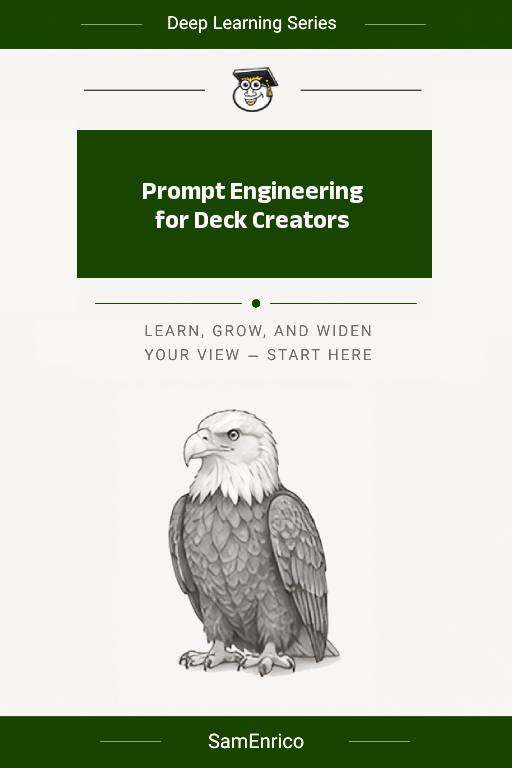
Non-FictionAI OperatorPrompt Design
Prompt Engineering for Deck Creators eBook
Craft prompts that generate compelling slide struc
Craft prompts that generate compelling slide structures and visuals. Includes real-world examples for pitch decks, quarterly reviews, training modules, and webinars.
Formats
Free sample
Chapter 1: The 3 AM Deck Emergency--–- The cursor blinks on an empty slide. It is 2:47 AM. Your executive summary is due at 9:00 AM, and you have just realized that the thirty slides you spent all week building tell three different stories. Slide 4 says growth is accelerating. Slide 12 says you missed the forecast.
Both cannot be true. You have coffee, regret, and a growing suspicion that you have wasted your entire week.This is not a failure of effort. It is a failure of prompting.You have been using AI wrong. Not a little wrong—fundamentally, structurally, embarrassingly wrong. You have been treating artificial intelligence like a search engine that sometimes draws pictures.
You type "Make a slide about Q3 results" and receive something that looks professional but says nothing. The fonts are clean. The chart is colorful. The narrative is nonsense. And now you are staring at an empty slide at an hour when only insomniacs and failing founders are awake.The problem is not the AI.
The problem is that nobody taught you how to speak to it.This book exists because that silence has cost you hours. It has cost you sleep. It has cost you the confidence that comes from walking into a boardroom knowing your slides are not just beautiful but bulletproof. Prompt engineering for deck creation is not about learning a list of magic phrases. It is about understanding something far more valuable: what a slide actually needs to do to change a mind.The Myth of the Single Prompt Here is the lie that every AI company wants you to believe: type something simple, get something brilliant.
The demos show a founder asking for a pitch deck and receiving ten flawless slides in seconds. The marketing copy promises that AI will handle the "grunt work" so you can focus on the "strategy." What they do not show is the garbage those simple prompts produce when real people try them with real data.I have watched hundreds of professionals attempt to prompt their way to a deck. The pattern is always the same. They begin with hope, type something like "Create a pitch deck for my Saa S company," and receive a template so generic it could apply to a dog-walking startup or a nuclear reactor. They try again, adding "make it compelling," and receive the same template with different stock photos.
They give up, convinced that AI is overhyped, and return to rearranging bullet points manually at 2:47 AM.The tragedy is that they were never taught the difference between a command and a prompt.A command is what you give to a machine. "Turn left." "Calculate 2+2." "Make a slide." Commands work when you are speaking to software that has no agency, no context, and no need to understand your intent. A prompt, properly understood, is what you give to a collaborator. It contains not just instructions but goals, constraints, and the unspoken rules that transform generic output into strategic communication.The AI is not a machine. Not anymore.
When you prompt GPT-4 or Claude or Gemini, you are speaking to a system that has ingested more examples of human communication than any person could read in a thousand lifetimes. It has seen pitch decks that raised billions and pitch decks that died in spam folders. It has seen QBR slides that saved careers and QBR slides that ended them. The knowledge is there, embedded in the weights of the model. Your job is not to command.
Your job is to provoke that knowledge into appearing.Most people fail because they prompt for the wrong thing. They describe the output they want to see—"a slide with three columns and a chart"—instead of describing the thinking they want the AI to do. This is the equivalent of asking a chef for "a plate" instead of "a meal that will make my in-laws forgive me for burning Thanksgiving." The chef can give you a plate. It will be empty. You will still be hungry and ashamed.The Four Failures of Generic Prompts To understand why simple prompts fail, we must examine what they actually produce.
I have analyzed over five hundred deck-related prompts submitted by professionals in consulting, venture capital, marketing, and operations. The failures fall into four predictable categories.Failure One: No Audience Awareness The most common failure is also the most deadly. A generic prompt contains no information about who will view the deck, what they already believe, or what they need to do after seeing it. The AI therefore assumes a generic audience: moderately intelligent, moderately patient, moderately interested in the topic. This audience does not exist.Your board of directors is not moderately patient.
They are scanning for reasons to say no so they can get to the next presentation. Your potential investors are not moderately interested. They have seen five thousand pitch decks and can smell a lazy narrative from the title slide. Your sales team is not moderately intelligent about your product—they live inside it every day, and they will reject any slide that insults their expertise with oversimplified explanations.When you prompt without audience specification, the AI defaults to the mean. The mean is useless.
Every successful deck is designed for a specific audience with specific biases, specific time constraints, and a specific decision to make. Your prompt must name that audience and describe what keeps them up at night.Failure Two: Missing Context The second failure is the assumption that the AI knows anything about your situation. It does not. It has never seen your previous decks. It does not know that your last QBR was a disaster and you are fighting to restore credibility.
It has no idea that your competitor just launched a feature that makes your value proposition look weak.Context is the difference between a slide that lands and a slide that confuses. Consider two versions of the same data point: "Revenue grew 15% this quarter." Without context, this is neutral information. With context—"Revenue grew 15% this quarter, accelerating from 8% last quarter and exceeding our revised forecast by 3% despite the supply chain constraints that bankrupted two competitors"—the same number becomes a triumph. The AI cannot invent this context. You must provide it.Failure Three: Absence of Constraints The third failure is the most counterintuitive.
People believe that giving the AI fewer restrictions will produce more creative output. The opposite is true. Constraints are not limitations on creativity; they are the scaffolding that makes creativity possible.When you say "Make any kind of slide," the AI must choose from an infinite possibility space. It will choose the most statistically common option, which is also the most generic and forgettable. When you say "Make a slide with exactly twelve words, a single data point, and a provocative question that challenges the reader's assumption about market growth," the AI has something to work against.
Constraints force specificity. Specificity forces relevance.Think of constraints as the banks of a river. Without banks, water spreads into a featureless swamp. With banks, it flows with power and direction. Your prompt banks are audience, context, goal, and format.
The AI needs all four to generate anything worth presenting.Failure Four: Vague Goals The fourth failure is the most easily…
This is the end of the free sample. Get the eBook to keep going. Buy now
About this book
Details
- Author
- Calabrese Anamaria
- Publisher
- SamEnrico
- Language
- English
- Genre
- Non-Fiction, AI Operator, Prompt Design
- Released
- 2026-05-29
- Pages (approx.)
- 152
- Available as
- eBook, Audiobook

Read better in the ZLOADR app
Your eBooks on your phone or tablet. Sign in with your SamEnrico account and start reading.
More by Calabrese Anamaria
 Academic Probation Recovery WorkbookCalabrese Anamaria$11.99
 Failure Fear for Gifted KidsCalabrese Anamaria$11.99
 Carson Contrarian Woman Persona GuideCalabrese Anamaria$11.99
 Patsy Cline Falling Star MemoirCalabrese Anamaria$11.99
 APOE4 Genetic Risk ManagementCalabrese Anamaria$11.99
 Frozen Hearts: The Arctic Love Story of Roald Amundsen and Hjalmar JohansenCalabrese Anamaria$11.99
 Whispers in the Wisteria: The Cursed Bride of KyotoCalabrese Anamaria$11.99
 Ultimate Handbook Guide to Warangal : (India) Travel GuideCalabrese Anamaria$11.99
 AI Budget Monitoring GuideCalabrese Anamaria$12.99
 Understanding Fox–fordyce DiseaseCalabrese Anamaria$17.99
 Water SommelierCalabrese Anamaria$11.99
You may also like
 Hong Kong Handover 1997Dunn Johnnie$11.99
 Zumba For Postnatal Recovery CourseNeal Christian$11.99
 Zumba for BeginnersLadner Nikia$11.99
 YouTube Comment Mining GuideHumes Pandora$12.99
 Worry Box MeditationCarlin Rudy$11.99
 Workplace Stress MeditationNguyen Lynn$11.99
 Workplace Stress and Sleep RepairHawley Ivory$11.99
 Workplace Perfectionism CureDelaney Jeffry$11.99
 Workplace Injustice Anger GuideWallen Isabelle$11.99
 Work Addiction and Burnout LinkGreenwood Ester$11.99
 Women in Yoga and WellnessBeattie Galina$11.99
 Women in Stand Up ComedyChun Evangeline$11.99