
Non-FictionInformativeEducational
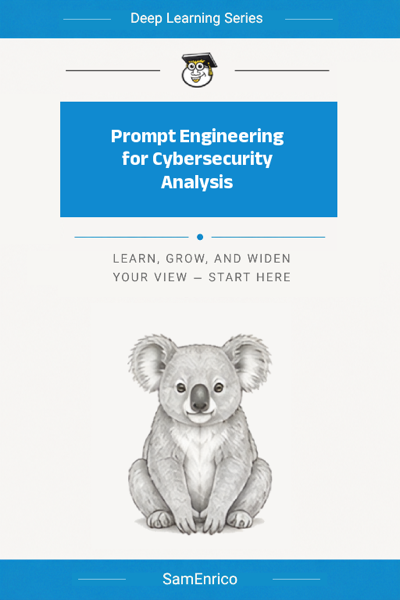
Prompt Engineering for Cybersecurity Analysis eBook
A Coursebook on Prompt Engineering for Cybersecuri
by Mccurdy Suzy
A Coursebook on Prompt Engineering for Cybersecurity Analysis
Formats
Free sample
Chapter 1: The 4,722-Alert Nightmare--–- The screen glowed an angry amber. Sarah Chen, Senior Security Analyst at a regional healthcare network, had been staring at her SIEM dashboard for forty-three minutes. It was 3:17 AM on a Tuesday. Her coffee had gone cold two hours ago. Her team of six covered three shifts, but tonight, she was alone in the SOC, the hum of cooling fans her only companion.The alert counter read 4,722.Four thousand seven hundred twenty-two potential threats.
Every single one demanding her attention. Every single one carrying the implicit threat: If you miss me, patient data ends up on the dark web. Ransomware locks the ICU. You lose your job. Maybe worse.She had approximately forty-five seconds per alert if she wanted to clear the queue before her shift ended at 7 AM.
Forty-five seconds to distinguish a true positive from noise. Forty-five seconds to stop a breach that had, according to the log timestamps, already been inside her network for eleven days.Sarah didn't know that yet. But the reader of this book will learn exactly how she could have known—and how prompt engineering would have turned those 4,722 alerts into a manageable, actionable triage list in under fifteen minutes.This chapter diagnoses the crisis that makes Sarah's nightmare the new normal. It explains why traditional security tools are failing, how attackers are using AI to scale their operations, and what the "AI-Augmented Analyst" looks like in practice. By the end, you will understand not just why prompt engineering matters for cybersecurity, but why it has become the single most important skill you can develop to survive—and thrive—in the modern Security Operations Center.The Great Alert Flood: How We Got Here To understand why prompt engineering is essential, you must first understand how the Security Operations Center (SOC) broke.Fifteen years ago, a typical SOC team received perhaps a few hundred alerts per day.
Firewalls logged denied connections. Antivirus software flagged known malware signatures. Intrusion detection systems (IDS) matched traffic patterns against a modest database of attack signatures. A skilled analyst could reasonably investigate every alert, or at least every alert that passed a basic severity filter.Three trends shattered that model.Trend One: The Explosion of Telemetry Modern organizations generate staggering amounts of security data. A mid-sized enterprise with 5,000 employees might produce:50 GB of Windows Event Logs per day200 GB of network flow data10 GB of DNS query logs25 GB of email gateway logs100 GB of cloud API call logs (AWS Cloud Trail, Azure Monitor, GCP Audit Logs)Endpoint detection and response (EDR) telemetry from every workstation and server Collectively, this amounts to millions—sometimes billions—of discrete events per day.
Most SIEM platforms ingest this data dutifully, then apply correlation rules to reduce the firehose to a "manageable" stream of alerts. But "manageable" still means thousands per day.Trend Two: The Alert Correlation Ceiling Traditional security tools rely on a fundamental assumption: malicious activity can be described using deterministic rules. Boolean logic. AND, OR, NOT. "If source IP is in threat intelligence feed AND destination port is 445 AND file creation event occurs within 5 seconds, raise alert."This works well for known threats with clear signatures.
It fails catastrophically for everything else.Consider a living-off-the-land (LOLBin) attack. The attacker uses legitimate system tools—Power Shell, WMIC, certutil, mshta—that are already present on the endpoint. There is no malware binary to signature. There is no anomalous executable to block. The attacker's commands look, to a naive rule, exactly like administrative activity.A rule-based SIEM sees a Power Shell process spawning.
That's normal. It sees an outbound network connection. That's normal. It sees a registry key modification. That's also normal.
Only when you connect these three events across time, understand their sequence, and recognize that the specific combination is unusual do you realize an attack is occurring.Traditional Boolean logic cannot make that connection. It has no memory of events beyond its narrow correlation window. It has no ability to reason about intent. It simply matches patterns.Trend Three: The Attacker's AI Advantage The most alarming trend is the most recent. Attackers now use generative AI to scale their operations in ways that defeat traditional detection.Phishing emails are no longer riddled with grammatical errors and awkward phrasing.
Generative AI produces convincing, personalized messages at scale, tailored to each target using OSINT scraped from social media and corporate websites.Malware is no longer static. AI-generated polymorphic code rewrites itself with each infection, changing its hash, its API call sequence, even its control flow graph, while preserving malicious functionality. Signature-based detection—already struggling—becomes useless.Attackers are also using LLMs to automate reconnaissance, generating custom exploitation paths based on publicly disclosed infrastructure-as-code repositories, and even crafting social engineering scripts that adapt based on the target's responses.The playing field is not level. Defenders are still playing Boolean logic. Attackers are playing generative AI.The Syntax Trap: Why Your KQL Isn't Saving You Let me be direct: the query languages you spent months mastering are not obsolete, but they are no longer sufficient.
Kusto Query Language (KQL), Sigma rules, Splunk Search Processing Language (SPL), Elastic Query DSL—these are powerful tools for asking precise questions when you already know what you're looking for.But cybersecurity is no longer about looking for known things. It is about finding unknown things hiding within known noise.Consider a real-world example. A threat hunter suspects an attacker is using DNS tunneling to exfiltrate data. In KQL, they might write:text Copy Download Device Network Events | where Remote Port == 53 | where Remote IP !in (known_dns_servers) | summarize Packets Per Domain = count() by Query String | where Packets Per Domain > 100 | order by Packets Per Domain desc This query does three things: (1) filter for DNS traffic on port 53, (2) exclude known good DNS servers, (3) count queries per domain and flag those with more than 100 packets.What does it miss? Everything the analyst didn't explicitly think to include.It misses slow-and-low exfiltration using fewer than 100 queries per domain.
It misses tunneling that uses legitimate DNS servers as forwarders. It misses domains that rotate rapidly to avoid packet-count thresholds. It misses detection entirely if the analyst forgets to filter out internal DNS servers or misconfigures the packet threshold.The query is brittle. It encodes exactly one hypothesis. Every other hypothesis requires a different query, written from scratch, with its own blind spots.Now consider what a generative AI can do with a well-engineered prompt.
Given the same raw network logs and the instruction:"Analyze this DNS traffic for potential data exfiltration. Consider: (1) domains with unusually high query volume, (2) domains with subdomains containing encoded data (Base64, hex, or entropy patterns), (3) domains that resolve to suspicious IPs, (4) temporal patterns suggesting beaconing, (5) ANY other anomaly you identify. Rank findings by confidence."The AI does not need a pre-written query for every hypothesis. It generates its own analytical path based on the data and the instruction. It can notice patterns the analyst never considered—because the prompt asks it to find any anomaly, not just pre-specified ones.This is the difference between discriminative and generative security analysis.Discriminative vs.
Generative: The Critical Shift Discriminative security answers the question: "Does this specific indicator match a known threat pattern?" It is…
This is the end of the free sample. Get the eBook to keep going. Buy now
About this book
Details
- Author
- Mccurdy Suzy
- Publisher
- SamEnrico
- Language
- English
- Genre
- Non-Fiction, Informative, Educational
- Released
- 2026-06-02
- Pages (approx.)
- 152
- Available as
- eBook, Audiobook

Read better in the ZLOADR app
Your eBooks on your phone or tablet. Sign in with your SamEnrico account and start reading.
More by Mccurdy Suzy
 The Old Oak Tree RestMccurdy Suzy$11.99
 The Cybersecurity Analyst StressMccurdy Suzy$11.99
 Group Hypnosis Script WritingMccurdy Suzy$11.99
 Chloride Electrolyte Balance GuideMccurdy Suzy$11.99
 Founder Vesting StudyMccurdy Suzy$11.99
 The Toastmasters CompanionMccurdy Suzy$11.99
 OCD Apps GuideMccurdy Suzy$11.99
 Time Blocking For RetirementMccurdy Suzy$11.99
 The Silk Throne: How a Female Crime Boss Ruled Hong Kong’s UnderworldMccurdy Suzy$11.99
 The Unseen Hand: The Mysterious Disappearance of Louis Le PrinceMccurdy Suzy$11.99
 Third Party Endorsement During ScandalMccurdy Suzy$12.99
 Employer Obligations for LLC GuideMccurdy Suzy$12.99
You may also like
 Hong Kong Handover 1997Dunn Johnnie$11.99
 Zumba For Postnatal Recovery CourseNeal Christian$11.99
 Zumba for BeginnersLadner Nikia$11.99
 YouTube Comment Mining GuideHumes Pandora$12.99
 Worry Box MeditationCarlin Rudy$11.99
 Workplace Stress MeditationNguyen Lynn$11.99
 Workplace Stress and Sleep RepairHawley Ivory$11.99
 Workplace Perfectionism CureDelaney Jeffry$11.99
 Workplace Injustice Anger GuideWallen Isabelle$11.99
 Work Addiction and Burnout LinkGreenwood Ester$11.99
 Women in Yoga and WellnessBeattie Galina$11.99
 Women in Stand Up ComedyChun Evangeline$11.99