
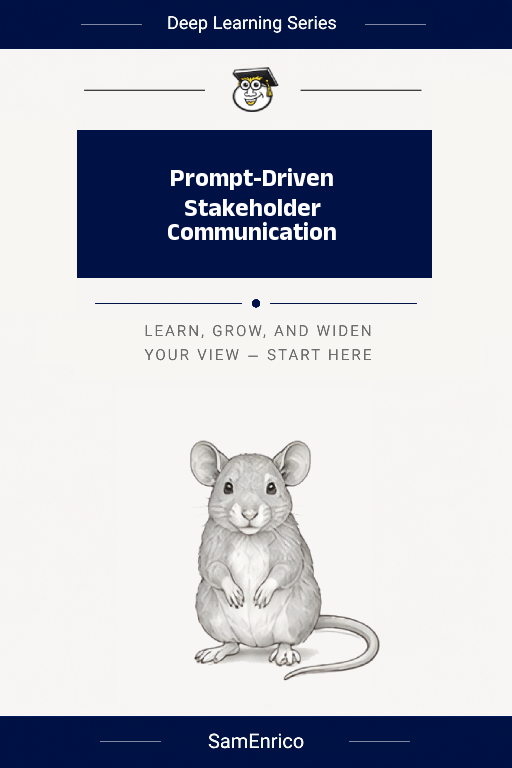
Non-FictionAI OperatorBusiness CommunicationProfessional Guide
Prompt-Driven Stakeholder Communication eBook
Design persuasive prompt sequences that translate
by Cronin Lea
Design persuasive prompt sequences that translate technical findings into executive summaries, impact analyses, and recommendation decks with consistent business language.
Formats
Free sample
Chapter 1: The Translation Trap–- The email arrived at 11:47 PM on a Tuesday. Maria, a senior data scientist at a mid-sized fintech company, had spent three weeks building a churn prediction model. Her random forest had achieved an AUC of 0.89. She had validated it on holdout data. She had documented the SHAP values, the confusion matrix, the precision-recall curve, and the calibration plot.
At 11:48 PM, she hit send on a twelve-page Jupyter notebook export to her executive team. The subject line read: "Q3 Churn Model – Final Technical Specifications."At 11:52 PM, her phone buzzed. A text from the VP of Product: "What am I supposed to do with this?"At 8:14 AM the next morning, the CEO replied to all: "Can someone translate this into English?"Maria was not incompetent. She was not lazy. She was not wrong about the data.
She had fallen into what this book calls the Translation Trap – the costly, career-limiting habit of presenting technical excellence as if it were a decision in itself.The Pain That Launched a Thousand Misunderstandings The Translation Trap is everywhere. It lives in the Slack channel where an analyst posts a pandas dataframe and calls it an update. It lives in the boardroom where a machine learning engineer explains cross-validation to a CFO who has never written a line of code. It lives in the email thread where someone writes "the coefficient is 1.2 with a standard error of 0.4 and a p-value of 0.03" and expects a business leader to know whether to invest, pause, or pivot.Here is the brutal truth that separates effective technical professionals from the ones who stay in the basement forever: Your stakeholders do not need your math. They need your meaning.Not because they are anti-intellectual.
Not because they hate data. But because their job is to make decisions under uncertainty with limited attention. Every minute they spend decoding a confusion matrix is a minute they are not spending on strategy, negotiation, or execution. When you hand them raw complexity, you are not being thorough. You are being a Diminisher – a term borrowed from Liz Wiseman's Multipliers, which this book draws upon alongside Drucker, Kahneman, Voss, and other giants of effective communication.The Diminisher Trap works like this: you have valuable insights.
You want to be rigorous. So you show everything. The feature importance chart, the ROC curve, the residual plot, the code comments. You think you are building trust. In reality, you are building noise.
And noise, as every executive knows, is the enemy of action.What This Chapter Will Do For You By the end of this chapter, you will understand why the Translation Trap is not a technical problem but a communication architecture problem. You will learn a framework called the Ladder of Abstraction that will forever change how you look at your own outputs. You will be introduced to the Drucker Audit, a set of five questions that separate efficient communication (fast to produce) from effective communication (drives decisions). And you will meet the Prompt Stack – the foundational concept that makes all subsequent chapters possible.But first, a confession: this book is not about teaching you to write better emails. It is about teaching you to build prompt sequences that force rigor, enforce business language, and drive decisions.
The difference between a good communicator and a great one is not charisma. It is repeatability. And repeatability comes from systems, not heroics.The Diminisher Trap: Why Raw Data Destroys Authority Let us dissect Maria's mistake – not to shame her, but because her mistake is your mistake, my mistake, the mistake of every technical professional who has ever been trained to value precision over clarity.When Maria sent that Jupyter notebook, she was acting on deeply ingrained professional values: show your work, be transparent, let the data speak for itself. These values are correct for peer review. They are catastrophic for executive review.An executive reading a SHAP value explanation thinks: "I don't know what SHAP stands for, and now I feel stupid.
This person is either showing off or hiding something. Either way, I am not making a decision based on this."The psychology here is not mysterious. Kahneman's Thinking, Fast and Slow – a cornerstone text for this book's second chapter – teaches us that human beings (including executives) rely on System 1 thinking: fast, intuitive, emotional. When you present raw complexity, you trigger System 2: slow, analytical, effortful. And busy people avoid effortful thinking whenever possible.
They do not become more analytical. They become more dismissive.The Diminisher Trap has three distinct stages:Stage One: The Avalanche. You bury the stakeholder in more information than they can process. Pages of code. Dozens of metrics.
Multiple scenarios without prioritization.Stage Two: The Shrug. The stakeholder, overwhelmed, asks a vague question or says nothing at all. Silence is mistaken for agreement. It is actually confusion.Stage Three: The Blame Cycle. You assume the stakeholder is not smart enough or not interested enough.
The stakeholder assumes you do not understand the business. Trust erodes. Communication stops.This cycle repeats in organizations every single day. And it is entirely preventable.The Ladder of Abstraction: Your Map Out of the Trap The most useful framework I have ever encountered for understanding communication breakdowns is the Ladder of Abstraction – a concept adapted from linguist S.I. Hayakawa and applied here to data storytelling.Imagine a ladder with ten rungs.
At the bottom rung – rung one – are raw, unprocessed data points. A timestamp. A transaction ID. A sensor reading. At rung two are aggregated metrics: counts, sums, averages.
At rung three are statistical outputs: p-values, confidence intervals, error rates. At rung four are model outputs: coefficients, SHAP values, feature importance charts.This is where most technical professionals stop. They climb to rung four and declare victory.But look up. At rung five are patterns and trends: "Churn is increasing among users who joined in the last 90 days." At rung six are business interpretations: "This churn pattern represents 2.1millioninannualrecurringrevenueatrisk."Atrungsevenare∗∗implications∗∗:"Ifwedonothing,wewillmissourquarterlyretentiontarget."Atrungeightare∗∗recommendations∗∗:"Launchthetargetedretentioncampaignby Friday."Atrungnineare∗∗decisions∗∗:"Weareallocating2.1 million in annual recurring revenue at risk." At rung seven are **implications**: "If we do nothing, we will miss our quarterly retention target." At rung eight are **recommendations**: "Launch the targeted retention campaign by Friday." At rung nine are **decisions**: "We are allocating 2.1millioninannualrecurringrevenueatrisk."Atrungsevenare∗∗implications∗∗:"Ifwedonothing,wewillmissourquarterlyretentiontarget."Atrungeightare∗∗recommendations∗∗:"Launchthetargetedretentioncampaignby Friday."Atrungnineare∗∗decisions∗∗:"Weareallocating50,000 to this campaign." And at rung ten – the top – are outcomes: "Customer retention improved by 12%."Your job, as a prompt-driven stakeholder communicator, is to build prompts that climb this ladder for you. You do not need to write the climb.
You need to architect the climb. And that is what the Prompt Stack enables.The Drucker Audit: Efficiency vs. Effectiveness Before we build anything, we need a way to measure whether our communication is working. Peter Drucker, the father of modern management theory, drew a crucial distinction in The Effective Executive: efficiency is doing things right. Effectiveness is doing the right things.Most technical communication is efficient but not effective.
You can write a perfect Jupyter notebook in thirty minutes. That is efficient. But if no one reads it or acts on it, it is not effective.The Drucker Audit asks…
This is the end of the free sample. Get the eBook to keep going. Buy now
About this book
Details
- Author
- Cronin Lea
- Publisher
- SamEnrico
- Language
- English
- Genre
- Non-Fiction, AI Operator, Business Communication, Professional Guide
- Released
- 2026-05-30
- Pages (approx.)
- 154
- Available as
- eBook, Audiobook

Read better in the ZLOADR app
Your eBooks on your phone or tablet. Sign in with your SamEnrico account and start reading.
More by Cronin Lea
 Student Exam InsomniaCronin Lea$11.99
 Morning Meditation for Night SleepCronin Lea$11.99
 20 Minutes Twice Daily CommitmentCronin Lea$11.99
 Politics Stress Relationship GuideCronin Lea$11.99
 WhatsApp Status Comparison GuideCronin Lea$11.99
 Neuropathic Pain PodcastsCronin Lea$11.99
 LSAT Logical Reasoning LociCronin Lea$11.99
 Israel Remote Tax GuideCronin Lea$11.99
 Bipolar Mania Creative ChannelingCronin Lea$11.99
 The Unlikely Hero of the 1980 Miracle on IceCronin Lea$11.99
 Tycho Brahe and the Celestial Revolution: A Danish Astronomer's LegacyCronin Lea$11.99
 Payment Systems for Online PlatformsCronin Lea$11.99
You may also like
 Hong Kong Handover 1997Dunn Johnnie$11.99
 Zumba For Postnatal Recovery CourseNeal Christian$11.99
 Zumba for BeginnersLadner Nikia$11.99
 YouTube Comment Mining GuideHumes Pandora$12.99
 Worry Box MeditationCarlin Rudy$11.99
 Workplace Stress MeditationNguyen Lynn$11.99
 Workplace Stress and Sleep RepairHawley Ivory$11.99
 Workplace Perfectionism CureDelaney Jeffry$11.99
 Workplace Injustice Anger GuideWallen Isabelle$11.99
 Work Addiction and Burnout LinkGreenwood Ester$11.99
 Women in Yoga and WellnessBeattie Galina$11.99
 Women in Stand Up ComedyChun Evangeline$11.99