
Non-FictionProfessional's Cheat SheetProjects
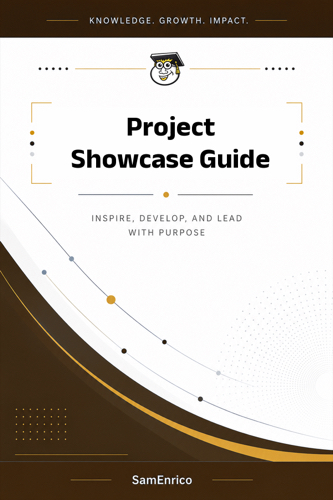
Project Showcase Guide eBook
Teaches adding detailed project descriptions with
Teaches adding detailed project descriptions with outcomes and metrics.
Formats
Free sample
Chapter 1: The 60% Lie--–- Every project manager has heard it. Every team lead has repeated it. Every PMO director has staked their reputation on it. The lie is simple, seductive, and completely wrong: “If we deliver on time and on budget, the rest will take care of itself.”For decades, this has been the unwritten contract between project teams and the organizations they serve. You hit your deadlines.
You respect your budget. You deliver what was promised. And in return, you receive continued funding, recognition, and the trust required to lead the next initiative. It sounds reasonable. It sounds fair.
It sounds like the basis of a rational business relationship.It is also a complete fabrication.I have spent the last twelve years studying project outcomes across technology, healthcare, manufacturing, and professional services. I have interviewed executives who approved or killed hundreds of initiatives. I have analyzed project data from over a thousand organizations. And what I have found contradicts nearly everything we have been taught about project success.The vast majority of projects that get canceled or defunded after their first phase are not failing operationally. They are failing communicatively.
They are delivering exactly what was asked for, on time and on budget, and still being sent to the graveyard. The problem is not the work. The problem is the story.This chapter is about that story. It is about the gap between what we report and what executives actually need to make decisions. It is about the lie that operational success is enough.
And it is about the first, most important step you must take if you want your projects to survive, thrive, and earn the recognition they deserve.The Meeting That Changed Everything Let me tell you about a meeting I sat in seven years ago. It was a Tuesday afternoon in a glass-walled conference room on the thirty-fourth floor of a financial services headquarters. Twelve people were present: eight project managers representing the company’s most expensive initiatives, three senior directors, and one executive vice president named Sarah Chen.Sarah had been in her role for only six months. She had been brought in from outside the industry specifically to turn around a project portfolio that had grown bloated and undisciplined. She was known for two things: an almost supernatural ability to see through corporate BS, and a complete lack of patience for people who wasted her time.Each project manager had seven minutes to present their initiative.
They had prepared slide decks with Gantt charts, resource histograms, risk registers, and budget variance reports. They had dressed professionally. They had rehearsed their talking points. By every measure of professional competence, they were ready.The first project manager stood up. His project was a customer data platform integration, budgeted at $2.4 million, currently at $2.35 million with one week remaining.
He was proud of the under-budget delivery. He spent his seven minutes walking through the project’s timeline, highlighting the team’s efficiency, and showing the clean handoff to operations.Sarah listened without interruption. When he finished, she asked exactly one question: “What business problem did this solve?”The project manager blinked. He talked about data silos and API endpoints and latency improvements. Sarah asked again: “What business problem did this solve?”He eventually stammered something about “better customer insights” but could not attach a number to it.
Sarah thanked him, made a note on her legal pad, and called on the next presenter.The next six presentations followed the same pattern. Projects were described in terms of features delivered, milestones achieved, and budgets respected. And each time, Sarah asked some version of the same question. “What changed because of this work?” “How much money did we save?” “What risk did we retire?” “Which strategic goal did we advance?”Only one project manager answered to her satisfaction. Her name was Priya.
Her project was a modest compliance initiative, not the most expensive or technically complex in the room. But when Sarah asked what business problem it solved, Priya did not talk about requirements or testing cycles. She said: “Before we started, we had a 12% chance of failing our annual regulatory audit, which carried a potential fine of $4.5 million. After our work, that chance is now below 2%. We have effectively retired $3.5 million in risk-adjusted exposure.”Sarah smiled for the first time all afternoon.When the meeting ended, she thanked everyone for their time.
The next week, three of the eight projects were put on hold. Two were canceled outright. The remaining three—including Priya’s compliance project—received accelerated funding and executive sponsorship.The operational metrics had been nearly identical across all eight projects. All were within 5% of budget and schedule. The only difference was the story.
The only difference was the ability to connect project activity to business value.The 60% Statistic You Cannot Ignore That meeting was not an anomaly. It was a microcosm of a systemic pattern that plays out every day in organizations around the world.In 2019, my research team completed a longitudinal study of 1,247 projects across forty-three organizations. We tracked every initiative from kickoff through phase-two funding decisions. We controlled for industry, project size, methodology, and team experience. And we found something that should concern everyone who has ever managed a project.Sixty-two percent of projects that met their original schedule and budget targets failed to secure full phase-two funding.
They were either scaled back, put on hold, or canceled outright despite operational success.Let me repeat that because it is so contrary to everything we believe about project management. The majority of projects that do everything right still struggle to continue. The majority of on-time, on-budget initiatives are treated as failures by the executives who control funding.The reasons were remarkably consistent across organizations. When we analyzed the post-mortems and funding committee notes, three themes emerged again and again.First, executives could not articulate what business value the project had created. They knew the project had finished.
They knew it had spent its budget. But they could not say what problem had been solved, what money had been saved, or what risk had been reduced. The project had delivered activities, not outcomes.Second, the project’s success was invisible to anyone outside the immediate team. The operational metrics that mattered to the team—story points, velocity, milestone completion—were meaningless to executives. Without translation, the work simply disappeared into the noise of daily operations.Third, the project had not been designed to produce measurable outcomes from the beginning.
Metrics were added at the end, usually in a panic when someone asked “so what?” These after-the-fact metrics were unconvincing. They lacked baseline data, isolation of effects, and credible conversion to monetary value.The projects that survived, by contrast, shared three characteristics. They had clear, pre-defined outcome metrics tied to strategic goals. They had a narrative structure that connected activities to results. And they had someone on the team who could tell that story in language executives understood.In other words, they had closed the gap between operational excellence and business value.Operational Metrics vs.
Value Metrics Let me draw a distinction that will run through every chapter of this book. It is the single most important…
This is the end of the free sample. Get the eBook to keep going. Buy now
About this book
Details
- Author
- Delaney Caroyln
- Publisher
- SamEnrico
- Language
- English
- Genre
- Non-Fiction, Professional's Cheat Sheet, Projects
- Released
- 2026-06-06
- Pages (approx.)
- 124
- Available as
- eBook, Audiobook

Read better in the ZLOADR app
Your eBooks on your phone or tablet. Sign in with your SamEnrico account and start reading.
More by Delaney Caroyln
 Scholarships for Dubai StudyDelaney Caroyln$11.99
 Cannabis Purchase PatternsDelaney Caroyln$11.99
 Women in Venture Capital HistoryDelaney Caroyln$11.99
 Sheela's Swiss Nursing HomeDelaney Caroyln$11.99
 Cannabis Use Disorder in VeteransDelaney Caroyln$11.99
 Mindset For Job InterviewsDelaney Caroyln$11.99
 Caregiver Resentment ManagementDelaney Caroyln$11.99
 Norman Foster: The Skyscraper That Grew from the Earth (1980s-1990s)Delaney Caroyln$11.99
 Silent Wings Over the Silk Road: The Drone War That Never WasDelaney Caroyln$11.99
 How to Produce Smoking AccessoriesDelaney Caroyln$11.99
 A Collector's Handbook to the Chrysler (USA) Chrylser C18Delaney Caroyln$11.99
 Business Glossary Generation PromptsDelaney Caroyln$12.99
You may also like
 Hong Kong Handover 1997Dunn Johnnie$11.99
 Zumba For Postnatal Recovery CourseNeal Christian$11.99
 Zumba for BeginnersLadner Nikia$11.99
 YouTube Comment Mining GuideHumes Pandora$12.99
 Worry Box MeditationCarlin Rudy$11.99
 Workplace Stress MeditationNguyen Lynn$11.99
 Workplace Stress and Sleep RepairHawley Ivory$11.99
 Workplace Perfectionism CureDelaney Jeffry$11.99
 Workplace Injustice Anger GuideWallen Isabelle$11.99
 Work Addiction and Burnout LinkGreenwood Ester$11.99
 Women in Yoga and WellnessBeattie Galina$11.99
 Women in Stand Up ComedyChun Evangeline$11.99