
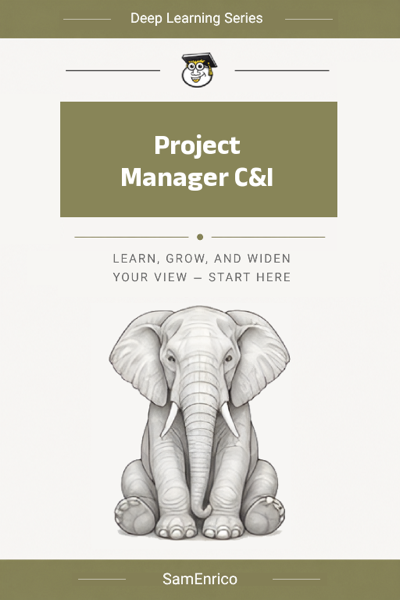
Non-FictionInformativeEducational
Project Manager C&I eBook
A Coursebook on Project Manager C&I
A Coursebook on Project Manager C&I
Formats
Free sample
Chapter 1: The Iron Lie--–- Every project manager remembers the day they learned the Iron Triangle. Cost. Scope. Time. Pick two.
The third suffers. It is taught as gospel in every certification course, every MBA program, every PMI bootcamp. It is simple, elegant, and for the world of commercial and industrial projects, it is a lie.Not a small lie. Not a harmless simplification. A dangerous, career-ending, money-losing lie.The Iron Triangle assumes that quality is a function of the three vertices.
In C&I—Commercial and Industrial project management—quality is not an output. Quality is an input. Safety is not a constraint. Safety is the container within which all work must fit. And compliance is not a checklist.
Compliance is the difference between a profitable project and a bankruptcy that happens three years after the ribbon-cutting ceremony.This chapter will dismantle the comfortable lies you have been taught and replace them with the actual anatomy of C&I project management. You will learn what makes a C&I project fundamentally different from software development, from event planning, from residential construction. You will understand why a change order that costs fifty thousand dollars in commercial construction can trigger a cascade of consequences that exceed five million. And you will walk away with a framework that has been tested on projects ranging from billion-dollar chemical plants to hundred-million-dollar manufacturing lines.If you are coming from the world of agile software, prepare to have your assumptions challenged. If you are coming from traditional project management certification, prepare to have your vocabulary expanded.
And if you are already working in C&I, prepare to see your daily struggles reflected in a structure that finally makes sense.Let us begin with a story.The Twelve-Month Slide In 2019, a mid-sized engineering firm won a contract to design and install a automated palletizing system for a food manufacturer. The project value was forty-two million dollars. The timeline was eighteen months. The contract was fixed price, which meant every dollar over budget came out of the engineering firm's profit margin.The project manager assigned to the job had a PMP certification, ten years of experience in commercial construction, and a reputation for delivering on time. She created a beautiful work breakdown structure.
She built a detailed critical path schedule. She ran weekly status meetings with color-coded dashboards.She also failed.Eight months into the project, a change request arrived from the client. The client wanted to relocate a safety light curtain by eighteen inches. In software, this would be a two-line code change. In commercial construction, this would be a field order and a few hours of electrician time.In C&I, this change required: engineering approval to verify the new location still met OSHA and ANSI safety standards, a revision to the control logic because the light curtain's signal path would change, requalification of the safety rating for the entire zone, updated documentation for the electrical drawings, a change order to the subcontractor responsible for mounting brackets, a revised permit application for the local building department, and a rework of the factory acceptance test procedure.That eighteen-inch move added twelve weeks and three hundred thousand dollars to the project.The project manager did not anticipate this because she was thinking in the language of the Iron Triangle.
She saw a scope change that would add some time and some cost. She did not see that safety and compliance were not vertices of a triangle but the floor beneath it. When you move a safety device, you are not changing scope. You are rebuilding the floor.The project eventually delivered at twenty-six months and fifty-seven million dollars. The engineering firm lost its profit margin and then some.
The project manager was terminated.This is not a story about incompetence. This is a story about a framework that failed the person using it.What Exactly Is a C&I Project?Before we can manage C&I projects, we must define them with surgical precision. A C&I project is not simply a large construction project or an industrial engineering effort. It is a specific category of work characterized by three non-negotiable attributes.First, high capital expenditure (CAPEX). C&I projects typically require investments measured in millions or tens of millions of dollars.
This is not money that can be borrowed against future subscription revenue or funded through operating budgets. This is capital that must be allocated, approved, depreciated, and justified against other investment opportunities. A fifty-million-dollar manufacturing line competes for funding against a new headquarters building, an acquisition, or a dividend payout. The cost of capital matters. The payback period matters.
The internal rate of return matters.Second, physical or heavy engineered deliverables. You cannot push a hotfix to a conveyor belt. You cannot roll back a chemical reactor to the previous version. Physical assets have inertia in every sense of the word. They take time to fabricate, ship, install, and commission.
They have weight, volume, and momentum. When a physical deliverable is wrong, you cannot simply rewrite code. You cut steel, weld repairs, replace components, or demolish and rebuild.Third, long-term liability exposure. The consequences of a C&I project extend years beyond the handover date. A weld that fails five years after commissioning can cause an explosion.
A control logic error that manifests only under specific conditions can injure operators. A design flaw discovered a decade later can trigger litigation that outlives the careers of everyone involved. Liability in C&I is measured in decades, not months.Let us test this definition against examples. A solar farm built for a utility company is a C&I project: high CAPEX (hundreds of millions), physical deliverables (panels, inverters, racking), and long-term liability (performance guarantees, environmental compliance). A mobile app for tracking work orders is not a C&I project.
A warehouse expansion might be C&I if it involves automated material handling systems. A single-family home is not C&I, but a residential tower with building automation systems might be.The boundary matters because the management practices that work for one category fail for another.The Commercial Versus Industrial Distinction Within C&I, there is a further split that many project managers ignore to their detriment. The split is between Commercial and Industrial environments, and confusing the two is a quick path to failure.Commercial projects are client-facing, profit-margin-driven, and contract-bound. The primary objective is to deliver what the contract specifies while protecting or improving margin. The client is an active participant, often with its own project management team.
Change orders are a revenue opportunity. The relationship is transactional, even when friendly. Examples include: building a distribution center for a retail client, installing a solar array for a corporate campus, or constructing a spec office building.Industrial projects are uptime-focused, safety-critical, and asset-intensive. The primary objective is to deliver a system that can operate continuously, safely, and efficiently. The client is often the owner-operator who will live with the asset for decades.
Change orders are disruptions to be minimized. The relationship is collaborative because both parties share the long-term risk. Examples include: adding a production line to a food plant, upgrading controls at a water treatment facility…
This is the end of the free sample. Get the eBook to keep going. Buy now
About this book
Details
- Author
- Leblanc Marcell
- Publisher
- SamEnrico
- Language
- English
- Genre
- Non-Fiction, Informative, Educational
- Released
- 2026-06-02
- Pages (approx.)
- 154
- Available as
- eBook, Audiobook

Read better in the ZLOADR app
Your eBooks on your phone or tablet. Sign in with your SamEnrico account and start reading.
More by Leblanc Marcell
 Self Esteem Communication SkillsLeblanc Marcell$11.99
 Mindful Couples MBSRLeblanc Marcell$11.99
 Video Game Streaming AddictionLeblanc Marcell$11.99
 Bjargtroll’s Last Bargain: The Troll Who Outsmarted the FishermenLeblanc Marcell$11.99
 The Elephants That Predict Earthquakes: Africa's Silent GuardiansLeblanc Marcell$11.99
 Understanding Hemophilia ALeblanc Marcell$17.99
 How to Become a Classification-control ClerkLeblanc Marcell$11.99
 Hirable MOOC Certificate GuideLeblanc Marcell$12.99
 E-Commerce Customer Acquisition OutlookLeblanc Marcell$12.99
You may also like
 Hong Kong Handover 1997Dunn Johnnie$11.99
 Zumba For Postnatal Recovery CourseNeal Christian$11.99
 Zumba for BeginnersLadner Nikia$11.99
 YouTube Comment Mining GuideHumes Pandora$12.99
 Worry Box MeditationCarlin Rudy$11.99
 Workplace Stress MeditationNguyen Lynn$11.99
 Workplace Stress and Sleep RepairHawley Ivory$11.99
 Workplace Perfectionism CureDelaney Jeffry$11.99
 Workplace Injustice Anger GuideWallen Isabelle$11.99
 Work Addiction and Burnout LinkGreenwood Ester$11.99
 Women in Yoga and WellnessBeattie Galina$11.99
 Women in Stand Up ComedyChun Evangeline$11.99