
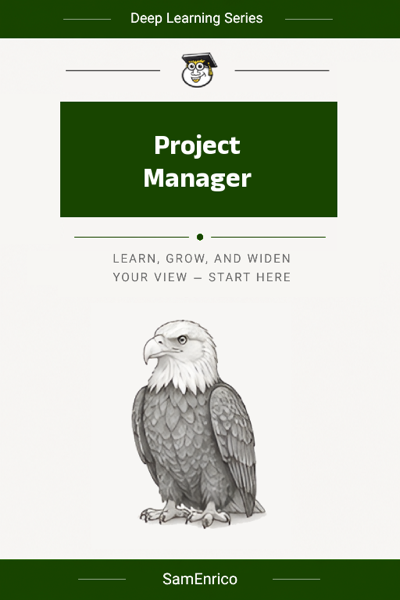
Project Manager eBook
A Coursebook on Project Manager
A Coursebook on Project Manager
Formats
Free sample
Chapter 1: The Ambush of Certainty...--You are three weeks into a nine‑month project to roll out a new customer relationship management system across forty‑two retail locations. The executive sponsor shook your hand at the kickoff and said, “This is straightforward. Just follow the schedule.” You built a beautiful Gantt chart. You identified your stakeholders. You secured budget approval.
Yesterday, the lead developer quit. Today, the finance director announced a 15% budget cut. And the marketing VP just emailed a list of “small scope additions” that would take six weeks.You are not behind schedule yet. You have not overspent. No one is shouting.
But you feel it—that low, humming anxiety that something has already gone wrong before you even started. That feeling is not failure. That feeling is the first honest signal that you have been managing a fantasy, not a project.Most project managers learn this lesson the hard way: the project does not fail when the Gantt chart turns red. It fails the moment someone believes the Gantt chart is true. This chapter is about why that happens, and how to stop it before the first task is ever written down.1.
The lie of the tidy beginning Every project begins in ambiguity. Yet almost every project plan pretends otherwise. We write schedules as if we know exactly how long each task will take, exactly which dependencies will hold, and exactly what the customer will want six months from now. This is not planning. This is prophecy dressed in spreadsheets.Consider a real example.
In 2016, a large European bank launched a project to replace its core trading platform. The business case was impeccable: reduce latency, cut maintenance costs, and improve compliance. The project team spent four months building a flawless plan. They identified 1,200 tasks, assigned durations to the hour, and created a critical path that ended on a specific Thursday in June. They even added a 10% contingency buffer because they were “conservative.”Nine months later, the project had consumed 200% of its budget and delivered nothing.
The post‑mortem revealed the real cause: the team had planned as if uncertainty did not exist. They assumed requirements would not change. They assumed every dependency would align perfectly. They assumed that the act of writing down a date made that date achievable. In other words, they fell for the single most destructive cognitive bias in project management: the illusion of certainty.Definition – The Illusion of Certainty: The systematic overconfidence in our ability to predict future outcomes, particularly when we have created the prediction ourselves.
It is why estimates are almost always optimistic. It is why schedules are almost always wrong. And it is the primary reason projects fail before they begin.The illusion of certainty has a second, more insidious effect. Once a plan exists on paper, it becomes a social contract. Everyone who approved it becomes invested in its accuracy—not because they believe it, but because admitting uncertainty would require admitting that they approved an uncertain plan.
So they double down. They call delays “unforeseen” even when they were entirely foreseeable. They call scope changes “surprises” even when the business environment was clearly shifting. The plan becomes a trap, and the project manager becomes the jailer of a fiction.This book exists because that trap is avoidable. But to avoid it, you must first understand what a project actually is—and is not.2.
What a project really is (and is not)Most definitions of a project are technically correct and practically useless. For example: “A temporary endeavor undertaken to create a unique product, service, or result.” That definition comes from the PMBOK® Guide, and it is not wrong. But it leaves out the most important word: uncertainty.A project is not merely a set of tasks with a start and end date. A project is a temporary organization designed to deliver value under conditions of uncertainty. The tasks and the schedule are not the project.
They are the hypotheses about how value might be delivered. That shift in framing—from “the plan is reality” to “the plan is a hypothesis”—is the single most important mental model you will learn from this book.Let us test this with a simple distinction that will resurface throughout every chapter. Compare two activities:Activity Repetitive?Uncertainty?Known dependencies?Type Running a factory shift Yes Low Yes Operation Processing monthly payroll Yes Very low Yes Operation Launching a new mobile app No High Partial Project Building a bridge in a swamp No Very high Partial Project Implementing a new tax regulation No Medium (legal interpretation)Partial Project Operations are about efficiency. You know what to do, you know how long it takes, and you can optimize repetition. Projects are about learning.
You do not know exactly what to do, you do not know how long it will take, and your job is to reduce uncertainty while delivering value.Here is the painful implication: most organizations manage projects as if they were operations. They apply efficiency metrics—utilization rates, task completion percentages, variance from schedule—to activities that are inherently uncertain. Then they wonder why the numbers never tell the truth. A factory line that completes 95% of its daily tasks is efficient. A software project that completes 95% of its planned tasks on time is almost certainly hiding something, because that level of accuracy is impossible when the tasks themselves were guesses.The Adaptive Cycle framework, introduced fully in Chapter 6, begins with this single question: How uncertain is this project?
The answer determines everything else—your methodology, your team structure, your communication cadence, and your definition of success. But before you can answer that question, you need to understand the one tool that almost everyone misuses: the constraint model.3. The quadruple constraint (and why triple is dangerous)If you have taken any project management training, you have seen the triple constraint diagram: a triangle with Time, Cost, and Scope at the corners. The idea is simple: you cannot change one without affecting the others. Want to add scope?
Time or cost must increase. Want to cut cost? Scope or quality must decrease.The triple constraint is not wrong. It is incomplete. And its incompleteness has destroyed thousands of projects.The missing element is Quality and Value.
In the triple constraint model, quality is implicit—treated as a derivative of scope, or worse, as something that can be sacrificed when the triangle gets squeezed. But quality is not a lever; it is a baseline. And value is not a constraint; it is the entire reason the project exists.The Unified Constraint Model (Quadruple Constraint):text Copy Download SCOPE ▲ /|\ / | \ / | \ / | \ TIME ◄----+----► COST \ | / \ | / \ | / \|/ QUALITY / VALUE (baseline, not lever)Here is how the four elements actually relate:Scope: What you will deliver. Expressed as requirements, features, or deliverables.Time: When you will deliver it. Expressed as milestones, duration, or deadlines.Cost: How much resources you will consume.
Expressed as budget, labor hours, or materials.Quality/Value: The standards your deliverables must meet and the benefit they must generate. Expressed as acceptance criteria, performance metrics, or ROI.The critical rule: Quality and Value are not negotiable downward. You can trade scope against time or cost. You can trade time against scope…
This is the end of the free sample. Get the eBook to keep going. Buy now
About this book
Details
- Author
- Nicholson Kacie
- Publisher
- SamEnrico
- Language
- English
- Genre
- Non-Fiction, Informative, Educational
- Released
- 2026-05-11
- Pages (approx.)
- 158
- Available as
- eBook, Audiobook

Read better in the ZLOADR app
Your eBooks on your phone or tablet. Sign in with your SamEnrico account and start reading.
More by Nicholson Kacie
 Richard Ramirez Teeth EvidenceNicholson Kacie$11.99
 Home Office Pomodoro MethodNicholson Kacie$11.99
 Franchising Your Local Brand Across Borders BlueprintNicholson Kacie$11.99
 Pregnancy Stretch RoutineNicholson Kacie$11.99
 Disappointment Proof ParentingNicholson Kacie$11.99
 The Bench of Broken Promises: The Ruth Bader Ginsburg and Antonin Scalia FriendshipNicholson Kacie$11.99
 The Anatomy of a Phantom: Dissecting the Mind of the Cleveland Torso MurdererNicholson Kacie$11.99
 Understanding Criss Cross SyndromeNicholson Kacie$17.99
 Annual IP Budget CalendarNicholson Kacie$12.99
 Email Follow Up ScriptsNicholson Kacie$12.99
 How to Start a Case Hardening Business (Beginners Guide)Nicholson Kacie$11.99