
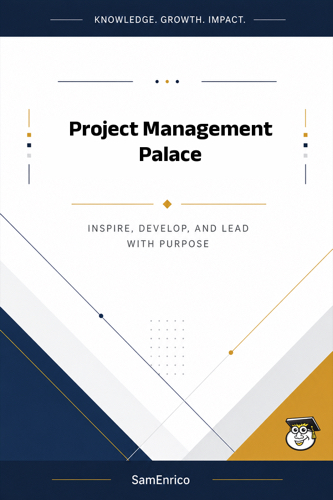
Non-FictionSelf-HelpProject Management
Project Management Palace eBook
Store methodologies like Agile, Waterfall, and Scr
Store methodologies like Agile, Waterfall, and Scrum in office loci.
Formats
Free sample
Chapter 1: The $47 Million Mistake--–- The FAA auditor didn't knock. She just walked in, her heels clicking against the polished concrete floor like a countdown timer. My team of eighteen engineers, developers, and compliance officers looked up from their standing desks, their faces shifting from confusion to dread. On the wall behind them, a beautiful Jira dashboard glowed on a seventy-inch monitor—green bars showing our "velocity," burndown charts trending beautifully downward, and a neat column of "completed" stories labeled DONE.The auditor pointed at the monitor. "Show me the signed requirements traceability matrix for engine control module version 4.2."I opened my mouth.
Nothing came out.We didn't have one. We hadn't had one for six months. Because six months ago, our new CEO—a charismatic Silicon Valley transplant who had read two blog posts about Agile—had declared all documentation "waste." He ordered us to burn our binders, delete our Jira attachments, and "just ship." We were building software for a commercial jet engine. The kind that keeps two hundred people alive at thirty-seven thousand feet.The auditor pulled out a notepad. "I'm going to need a list of every changeset deployed since your last audit.
And I'll need to see your change control board minutes. And your test signatures. And your..."She kept talking. I stopped hearing. Because I already knew what was coming.Six months.
Eighteen million dollars in sunk engineering costs. Another twenty-nine million in projected delays. And a regulatory shutdown that would make national news.Forty-seven million dollars. Gone. Because we had built a palace for the wrong king.The Day We Forgot Why Methods Exist Let me tell you something that will sound heretical in today's project management world: Agile is not always the answer.
Waterfall is not always the enemy. And your methodology is probably killing your project—not because you chose the wrong one, but because you're trying to run it in a space designed for something else.That auditor's visit taught me a brutal lesson. We had tried to run a Waterfall project—one with fixed requirements, regulatory oversight, and zero tolerance for post-launch change—using Agile rituals in an open office designed for "collision." The result wasn't Agile. It was chaos with a burndown chart.This book is the story of how I learned to match methodology to environment. But more than that, it's the story of how I learned that where you work determines how you work.
And that the single most expensive mistake a leader can make is confusing a throne room for a town square.The Three Questions That Would Have Saved Us $47 Million Looking back, I could have prevented the entire disaster by asking three questions before we ever wrote a line of code. I now call these the Gateway Questions, and they are the foundation of every chapter in this book.Question One: Can we afford to change requirements once execution begins?If the answer is no—because of safety regulations, physical construction, or contracts that lock scope—you need a Waterfall locus. You need a Chamber of Requirements (what I now call the Throne Room). You need documentation, signatures, and phase gates. Not because you're bureaucratic, but because the cost of change is astronomical.If the answer is yes—because you're exploring a new market, building software with no safety-critical components, or running a marketing campaign—you need an Agile locus.
You need a Town Square. You need flexibility, iteration, and collocation.Our answer on the engine project should have been no. But we pretended it was yes. And that lie cost us forty-seven million dollars.Question Two: Where does your team physically sit right now?Walk into your office. Look around.
Do you see high-walled cubicles and closed doors? You're in a Waterfall building, whether you know it or not. Do you see open benches, whiteboards on every wall, and no assigned seats? You're in an Agile building.The problem is that most offices are architectural hybrids—built for one era, retrofitted for another. Our office had been designed in 1998 for a Waterfall organization.
But we had ripped out the cubicles, painted the walls lime green, and declared ourselves "transformed." The space still remembered its old purpose. And so did we.Question Three: Are you a T-shaped expert or an I-shaped specialist?This one surprised me. I had always assumed that good people can work anywhere. I was wrong.T-shaped experts have broad skills across multiple domains—they can write code, talk to customers, run a test, and update documentation. They thrive in open, collaborative spaces where they can swarming problems.I-shaped specialists have deep, narrow expertise in one domain—they can certify a safety test, sign off on a regulatory filing, or optimize a database query, but they can't (and shouldn't) do the other jobs.
They need quiet, focused spaces with minimal interruption.On the engine project, we put our regulatory specialists (I-shaped) in the middle of an open office. They were interrupted forty-seven times per day. Their error rate tripled. And one of them eventually quit, taking six months of institutional knowledge with her.The Castle Metaphor That Changed Everything After the FAA shutdown, I spent six months studying how different organizations structure their physical spaces for different kinds of work. I visited a nuclear power plant (pure Waterfall).
I visited a video game studio (pure Agile). I visited a medical device company that had somehow made both work together.And I started to see a pattern. Every successful organization had, whether they knew it or not, built a palace—a collection of distinct physical spaces (I call them loci, Latin for "places" or "centers") designed for specific methodologies.The East Wing (Agile Loci): Open spaces, standing desks, massive whiteboards, physical task boards, timers, and no assigned seats. Designed for iteration, collaboration, and rapid response to change.The West Wing (Waterfall Loci): Quiet rooms, long tables, printed Gantt charts, binders, sign-off ceremonies, and controlled access. Designed for documentation, compliance, and predictable execution.The Courtyard (Hybrid Loci): Glass-walled rooms, shared whiteboards, visible but soundproofed spaces.
Designed for the reality that most projects are hybrids—hardware and software, compliance and creativity, fixed and fluid.The organizations that tried to run everything in the same locus failed. The ones that built distinct loci—and moved teams between them based on the project phase—succeeded.Our mistake was trying to run a West Wing project in an East Wing space. We had taken a team of engineers and compliance officers who needed quiet, documentation, and phase gates and put them in an open office with sticky notes and a timer. It was like trying to hold a wedding rehearsal in a nightclub. The space was wrong from the first moment.The Anatomy of the Throne Room (Chapter 1's Locus)Since this chapter is about the Chamber of Requirements—the locus for Waterfall projects—let me describe exactly what it should look like.The Physical Space:The Throne Room is dominated by a long, heavy table.
Not a folding table. Not a conference table on casters. A table that requires four people to move. This table represents stability. It does not change shape, location, or purpose.
It is the anchor of the room.Around the table are high-backed chairs. Not ergonomic task chairs on wheels—chairs that you…
This is the end of the free sample. Get the eBook to keep going. Buy now
About this book
Details
- Author
- Higginbotham Mica
- Publisher
- SamEnrico
- Language
- English
- Genre
- Non-Fiction, Self-Help, Project Management
- Released
- 2026-06-09
- Pages (approx.)
- 150
- Available as
- eBook, Audiobook

Read better in the ZLOADR app
Your eBooks on your phone or tablet. Sign in with your SamEnrico account and start reading.
More by Higginbotham Mica
 SaaS Contract AI Abstraction GuideHigginbotham Mica$11.99
 Hyksos InvasionHigginbotham Mica$11.99
 Police Officer Stress ReductionHigginbotham Mica$11.99
 Shame Resilience DBTHigginbotham Mica$11.99
 Wreck Penetration LogHigginbotham Mica$11.99
 Anger Management for Bipolar at WorkHigginbotham Mica$11.99
 The Group Breathing CircleHigginbotham Mica$11.99
 Rewiring Limiting BeliefsHigginbotham Mica$11.99
 The Serpent’s Curse: Kaliya’s Poisoned WatersHigginbotham Mica$11.99
 The Last Transmission: The Titanic’s Forgotten Radio OperatorsHigginbotham Mica$11.99
 The Last Stand of the Bletchley Breakers: Cracking the Code of the Unbreakable ContractHigginbotham Mica$11.99
 Facebook Ad Boost Post Vs ManagerHigginbotham Mica$12.99
You may also like
 Hong Kong Handover 1997Dunn Johnnie$11.99
 Zumba For Postnatal Recovery CourseNeal Christian$11.99
 Zumba for BeginnersLadner Nikia$11.99
 YouTube Comment Mining GuideHumes Pandora$12.99
 Worry Box MeditationCarlin Rudy$11.99
 Workplace Stress MeditationNguyen Lynn$11.99
 Workplace Stress and Sleep RepairHawley Ivory$11.99
 Workplace Perfectionism CureDelaney Jeffry$11.99
 Workplace Injustice Anger GuideWallen Isabelle$11.99
 Work Addiction and Burnout LinkGreenwood Ester$11.99
 Women in Yoga and WellnessBeattie Galina$11.99
 Women in Stand Up ComedyChun Evangeline$11.99