
Non-FictionProfessional's Cheat SheetAcademic
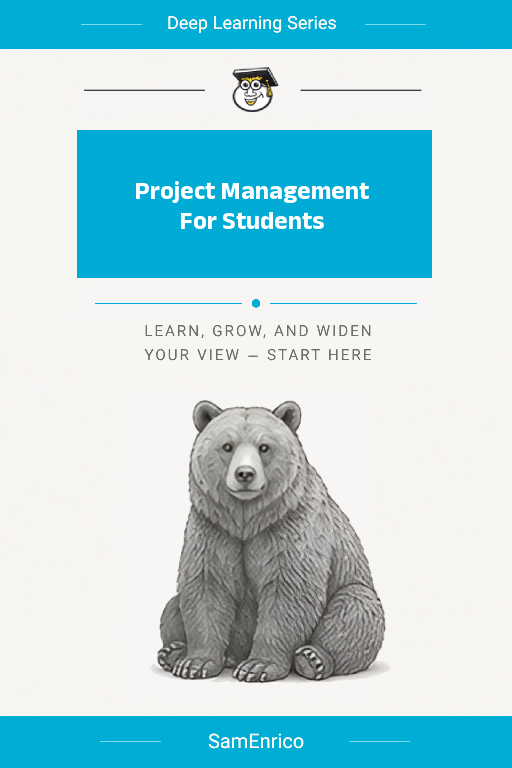
Project Management For Students eBook
Use Asana Trello or Notion for academic project ma
by Oldham Alla
Use Asana Trello or Notion for academic project management including group assignments and thesis tracking.
Formats
Free sample
Chapter 1: The Invisible Chaos--–- You have fifteen minutes until the deadline. Your group’s Google Doc shows three different versions of the same paragraph. One teammate uploaded her sources to a folder nobody can access. Another sent his section via Instagram DM thirty minutes ago, and it’s just a photo of a handwritten page. The fourth member has not replied in four days.
Your heart is pounding. Your cursor is blinking. And somewhere in the back of your mind, you know this is not the first time this has happened.This is not a failure of intelligence. It is not a lack of effort. It is not even a problem of time management, despite what every well-meaning productivity guru has told you.
This is the result of something far more insidious and far less discussed: invisible chaos. It is the silent tax that students pay every single day, in every group project, every thesis draft, and every last-minute cram session. You cannot see it, you cannot touch it, but you can feel it in the pit of your stomach when you realize nobody knows who is doing what.The tragedy is that most students blame themselves. They think, “I am just disorganized.” Or “My group members are lazy.” Or “This professor is unreasonable.” And in rare cases, those things might be true. But the overwhelming majority of academic project failures—the late submissions, the duplicated work, the frantic citation hunts at 2 AM—are not character flaws.
They are systems failures. Specifically, they are failures of visibility, accountability, and shared reality.This book exists to prove that you are not the problem. Your system is. And systems can be fixed.The Anatomy of a Meltdown: A Case Study Let us look at a real example. Not a hypothetical, not an exaggeration, but a composite of thousands of student experiences that I have documented across universities, disciplines, and continents.The Assignment: A 20-page group research paper on urban sustainability, due in six weeks.
Four students: Maria (the organizer), James (the researcher), Sofia (the writer), and David (the quiet one).The Tools: Google Docs for writing, a Whats App group for chat, email for file attachments, and everyone’s personal calendar for deadlines.The Result: A passing grade, barely, after two all-nighters, one crying phone call, and a professor’s comment: “Your content is solid, but your structure is chaotic. See me after class.”Here is what actually happened, week by week, beneath the surface.Week One: Maria creates the Google Doc and shares the link. She also sends an email with the rubric. James saves the email to a folder he forgets exists. Sofia reads it and makes mental notes.
David sees it and thinks, “I will come back to this.” Everyone feels productive.Week Two: James finds five great sources. He downloads the PDFs to his desktop. He mentions them in the Whats App group: “Got some good stuff.” Nobody asks for the files because nobody wants to seem lazy. Sofia starts writing the introduction based on assumptions. Maria asks, “Who is doing the literature review section?” Silence for six hours, then David says, “I can.” Nobody adds that to a shared task list.Week Three: Sofia’s introduction now conflicts with James’s findings, because James never shared the actual PDFs until Maria asked three times.
David has not started the literature review because he forgot the due date. The Whats App group has 147 messages, sixteen of which are variations of “Wait, who is doing what?”Week Four: Maria creates a second Google Doc because the first one became too slow to load. Now there are two versions. Sofia writes her section in Doc A. James pastes his notes into Doc B.
David is still working in a Word document on his laptop. The group spends two hours on a video call just finding where everything is.Week Five: The professor adds a new requirement: five peer-reviewed sources published within the last three years. This is announced in class, not in writing. Only Maria hears it. She posts it in the Whats App group, but the message is buried under memes.
Nobody updates the citations until the night before the deadline.Week Six: The final push. Sofia realizes her introduction does not match James’s data. David’s literature review is three paragraphs of Wikipedia summaries. The citations are a mix of APA, MLA, and “I will fix it later.” Maria stays up until 4 AM reformatting everything. The group submits the paper at 11:59 PM, seventeen seconds before the deadline.
They never speak to each other again.This story is not exceptional. It is ordinary. And it happens because of five specific, diagnosable friction points.The Five Friction Points of Academic Work After analyzing hundreds of student projects and interviewing dozens of professors, I have identified five patterns of breakdown that recur across every discipline, every institution, and every level of study. These are the Five Friction Points.Friction Point 1: The “Where Did You Save the File?” Loop You have experienced this. Someone asks for the final draft, and the reply is: “It is in the Google Drive folder I shared last week.” Another person says, “I do not see it.” A third says, “I have a different folder.” Fifteen minutes later, you discover that there are three versions of the same document, none of which is clearly labeled as “FINAL.”This friction point is caused by distributed storage.
Files live in email attachments, chat histories, personal desktops, cloud drives, USB sticks, and sometimes not even digitally—printed pages with handwritten notes. When storage is distributed, the group no longer shares a single reality. They share a guessing game.Friction Point 2: Invisible Progress In a well-functioning project, you can answer two questions at any moment: What is done? and What is being worked on right now? In most student projects, you cannot.
Progress is invisible because it lives in people’s heads, their private to-do lists, or vague status updates like “Almost there.”Invisible progress creates three specific harms. First, duplicated effort – two people unknowingly doing the same task. Second, missed handoffs – Person A finishes their part but Person B does not know, so Person B’s work gets delayed. Third, false confidence – the group believes they are further along than they actually are, because nobody has checked the actual artifacts.Friction Point 3: Social Loafing (The Visibility Problem)Social loafing is the phenomenon where individuals exert less effort when working in a group than when working alone. But here is the crucial insight: social loafing is not primarily a moral failing.
It is a visibility failing. When contributions are invisible, it is psychologically easier to coast. When every task is publicly assigned and every completion is publicly visible, coasting becomes uncomfortable.The student who does nothing in a group project is not always lazy. Sometimes they are confused. Sometimes they assume someone else will handle it.
Sometimes they genuinely do not know what is expected of them. And sometimes, yes, they are avoiding work. But in all cases, the solution is the same: make every action visible.Friction Point 4: Last-Minute Citation Hell Citations are the cockroaches of academic projects.…
This is the end of the free sample. Get the eBook to keep going. Buy now
About this book
Details
- Author
- Oldham Alla
- Publisher
- SamEnrico
- Language
- English
- Genre
- Non-Fiction, Professional's Cheat Sheet, Academic
- Released
- 2026-05-30
- Pages (approx.)
- 139
- Available as
- eBook, Audiobook

Read better in the ZLOADR app
Your eBooks on your phone or tablet. Sign in with your SamEnrico account and start reading.
More by Oldham Alla
 Uber Driver Airport Queue StrategyOldham Alla$11.99
 The Connector PersonalityOldham Alla$11.99
 Event Planning Priority GuideOldham Alla$11.99
 Clash of Clans Notification FixOldham Alla$11.99
 Nutritional Hair Loss GuideOldham Alla$11.99
 Resilience Adaptability Skills GuideOldham Alla$12.99
 Understanding MeningococcemiaOldham Alla$17.99
 Rf TestingOldham Alla$11.99Rf TestingOldham Alla$11.99Rf TestingOldham Alla$11.99
 How to Become a Splitter OperatorOldham Alla$11.99
You may also like
 Hong Kong Handover 1997Dunn Johnnie$11.99
 Zumba For Postnatal Recovery CourseNeal Christian$11.99
 Zumba for BeginnersLadner Nikia$11.99
 YouTube Comment Mining GuideHumes Pandora$12.99
 Worry Box MeditationCarlin Rudy$11.99
 Workplace Stress MeditationNguyen Lynn$11.99
 Workplace Stress and Sleep RepairHawley Ivory$11.99
 Workplace Perfectionism CureDelaney Jeffry$11.99
 Workplace Injustice Anger GuideWallen Isabelle$11.99
 Work Addiction and Burnout LinkGreenwood Ester$11.99
 Women in Yoga and WellnessBeattie Galina$11.99
 Women in Stand Up ComedyChun Evangeline$11.99